A calm, fully-sourced 30-day plan for belly fat — the levers that genuinely move it, week by week, and an honest read on where supplements do and don’t help. No miracle switches, no spot reduction.
The 30-Day Belly Fat Reset is a habit-building launch phase, not a magic switch. Belly fat responds to a modest calorie deficit — around 500 kcal/day — built mostly from protein and fiber, plus resistance training and daily walking[1]. That yields roughly 2–4 kg of fat loss in a month, with visceral fat often shrinking first[5]. You cannot spot-reduce, and supplements are, at best, a small add-on[3]. Our verdict: this works — because the fundamentals work.
“30-day belly fat reset” is one of the most searched phrases in weight loss, and most of what fills that search is nonsense: detox teas, waist trainers, secret morning tonics and 10-minute ab routines that promise to melt the fat you can pinch. At SourceLean we take those claims apart for a living, so this pillar is the honest version — a genuine month-long plan built only from things with evidence behind them. The 30-Day Belly Fat Reset is not a product; it is a structure. It uses a modest calorie deficit, a protein and fiber floor, resistance training, daily movement, better sleep and fewer liquid calories to shrink belly and visceral fat over four weeks — and it tells you plainly what 30 days can and cannot do.
Every effectiveness claim below is checked against primary sources — peer-reviewed nutrition and exercise research, the NIH Office of Dietary Supplements, the NIH National Center for Complementary and Integrative Health, the Physical Activity Guidelines for Americans, and FDA and FTC guidance — not marketing. SourceLean makes money only through transparent affiliate links, disclosed above; we run no star ratings, sponsored placements or fabricated results, and our verdict scale (real / modest / weak / hype) is applied the same way to every product. This is educational information, not medical advice.
- What is the 30-Day Belly Fat Reset?
- Can you really lose belly fat in 30 days?
- Why does belly fat form, and why is visceral fat different?
- What actually reduces belly fat?
- How much protein do you need to lose belly fat?
- Week 1: What should you do in the first 7 days?
- Week 2: How do you build the deficit?
- Week 3: How do you keep fat loss going?
- Week 4: How do you lock in the reset?
- Which weight-loss ingredients actually have evidence?
- Do belly-fat supplements work?
- Which drinks help, and which sabotage the reset?
- Who should avoid an aggressive reset?
- What this plan can’t do — honest limitations
- How do the popular products compare?
- The verdict
- FAQ
What is the 30-Day Belly Fat Reset?
The 30-Day Belly Fat Reset is a structured month of evidence-based habits designed to reduce abdominal fat: a modest calorie deficit built from protein and fiber, resistance training, daily walking, better sleep and fewer liquid calories. It is a launch phase that builds repeatable habits — not a diet you finish and abandon.
Let’s define the term plainly, because the internet has stretched it beyond recognition. A “reset” here does not mean detoxing, flushing, or resetting your metabolism — your metabolism is not broken and does not need rebooting. It means deliberately restructuring the handful of daily habits that determine whether you store or release fat, and running that structure consistently for 30 days so the changes become automatic. The number 30 is not magic; it is simply long enough to see real movement on the scale and the tape measure, and short enough to commit to without burning out.
The plan rests on one non-negotiable fact of physiology: fat loss requires an energy deficit — burning more energy than you take in over time[1]. Everything else in this guide, from protein targets to walking to the honest supplement section, exists to make that deficit easier to create and easier to sustain without misery. No food, drink, pill or exercise overrides energy balance. What the good habits do is let you hold a deficit while protecting muscle, controlling hunger and improving the metabolic markers that make belly fat dangerous.
Because this is a broad hub, it links out to our deeper single-topic guides throughout — on protein targets, specific ingredients, drinks and why fat loss stalls. Think of this page as the map, and those as the detailed routes.
Can you really lose belly fat in 30 days?
Yes, you can visibly reduce belly fat in 30 days, but within limits. A sustained deficit of about 500 kcal/day produces roughly 2–4 kg of total fat loss in a month, and belly and visceral fat often respond first[1]. What 30 days cannot do is finish the job or override genetics on where fat sits.
Here is the realistic math, because honesty about numbers is the whole point of SourceLean. Roughly 7,700 kcal equals about one kilogram of body fat. A daily deficit of 500 kcal therefore adds up to around 3,500 kcal a week — close to half a kilogram of fat, or about 2 kg over a month, before accounting for the extra water and glycogen shifts that make the first two weeks look faster on the scale[1]. Most well-run plans land people at about 0.5–1% of body weight lost per week, which is the sweet spot: fast enough to feel it, slow enough to protect muscle.
There is a genuinely encouraging wrinkle for belly fat specifically. Visceral fat — the deep fat packed around the organs — is metabolically active and tends to be mobilized relatively early in a deficit, especially when aerobic exercise is added[5]. That means your waistband and waist measurement can improve more than the scale number alone suggests in the first month. The flip side, and the honest caveat: you cannot spot-reduce. No exercise or food burns fat preferentially from your stomach; fat leaves the whole body in a pattern set largely by genetics, hormones and sex[8]. Thirty days is a strong start, not a finish line — treat it as the first chapter of a longer, sustainable change, which is exactly how we frame it in our guide to setting realistic expectations.
Why does belly fat form, and why is visceral fat different?
Belly fat forms when you store more energy than you burn, with the pattern shaped by genetics, sex, age and hormones like insulin and cortisol. There are two types: subcutaneous fat you can pinch, and visceral fat wrapped around the organs. Visceral fat is more metabolically harmful — but also often the first to shrink in a deficit[5].
Understanding the mechanism matters because it tells you which levers are real. Subcutaneous fat is the soft layer directly under the skin — the part you can grab. Visceral fat sits deeper, cushioning the liver, intestines and other organs, and it behaves almost like an organ itself, releasing inflammatory signals and free fatty acids that worsen insulin resistance[9]. This is why a larger waist is associated with higher cardiometabolic risk even at the same overall weight, and why the tape measure around your navel is a more useful reset metric than the scale alone.
Several factors push fat toward the abdomen. Age and falling estrogen after menopause shift storage toward the middle in women; men store visceral fat more readily throughout life. Chronic sleep loss and stress raise the appetite and cortisol signals that favor abdominal storage and drive higher calorie intake[11]. And a diet heavy in refined carbohydrates, alcohol and sugar-sweetened drinks provides an easy surplus that the body preferentially parks as visceral and liver fat[12]. We go deeper on the hormonal side — insulin, cortisol and the honest limits of “hormonal belly fat” framing — but the practical takeaway is simple: the same deficit that shrinks total fat shrinks visceral fat too, usually faster.
What actually reduces belly fat?
Belly fat is reduced by a small number of high-leverage habits: a modest calorie deficit, high protein, plenty of fiber, resistance training, daily aerobic movement, adequate sleep and cutting liquid calories. Everything else — spot exercises, detoxes, most supplements — is either marginal or marketing[3].
Rather than bury the levers, here are the six that carry almost all the weight, in rough order of impact. Master these and the reset works; skip them and no pill rescues it.
- A modest calorie deficit (the engine). Around 300–500 kcal/day below maintenance is enough to lose fat steadily while staying livable[1]. Aggressive crash deficits backfire by stripping muscle and triggering rebound hunger.
- Protein at 1.2–1.6 g/kg (the muscle protector). Higher protein preserves lean mass in a deficit and is the single most filling macronutrient, making the deficit easier to hold[4].
- Fiber, especially soluble fiber (the appetite brake). Vegetables, legumes, oats, fruit and whole grains slow digestion and improve fullness; higher fiber intake is consistently linked to lower body weight and less abdominal fat[10].
- Resistance training (the shape keeper). Lifting or bodyweight training two to three times a week protects and builds muscle, which keeps your metabolic rate up during weight loss[7].
- Daily aerobic movement (the visceral-fat lever). Walking and cardio are specifically linked to reductions in visceral fat, even when scale weight moves modestly[5]. Aim toward the guideline 150+ minutes a week of moderate activity[7].
- Sleep and fewer liquid calories (the quiet multipliers). Short sleep raises appetite and abdominal storage signals[11], and sugar-sweetened drinks and alcohol add easy surplus calories tied to visceral fat[12]. Fixing both removes hundreds of silent calories and blunts hunger.
Notice what is not on the list: crunches, waist trainers, “fat-burning” teas and morning tonics. Ab exercises build the muscle beneath the fat but do not burn the fat on top of it — spot reduction is not physiologically possible[8]. If you want the deeper walkthrough of the fundamentals, our companion guide on how to lose belly fat covers them at length.
How much protein do you need to lose belly fat?
Aim for about 1.2–1.6 g of protein per kilogram of body weight per day during the reset — for many adults that is roughly 100–140 g. Protein preserves muscle in a deficit and is the most satiating macronutrient, so a higher intake makes the calorie deficit easier to sustain without constant hunger[4].
Protein earns its own section because it is the highest-leverage dietary change most people can make, and it is the one the reset leans on hardest. In a calorie deficit, the body can burn muscle alongside fat; a higher protein intake, combined with resistance training, shifts that loss strongly toward fat and protects the lean tissue that keeps your metabolism higher[4]. Protein also has the highest thermic effect of the macronutrients — you burn a modestly larger fraction of its calories just digesting it — and it blunts appetite more than carbohydrate or fat, which is why higher-protein diets reliably produce greater fullness and slightly lower overall intake.
In practice, that means anchoring each meal with a clear protein source: eggs or Greek yogurt at breakfast, a palm-sized portion of chicken, fish, tofu, lentils or lean meat at lunch and dinner, and protein-forward snacks if you need them. Spreading protein across three or four eating occasions, rather than loading it all at dinner, appears to support muscle retention better. You do not need powders or bars — they are convenient, not magic — and you do not need extreme “bodybuilder” amounts; going far above ~2 g/kg adds little for fat loss and simply crowds out other foods. Our full breakdown, with numbers by body weight and worked examples, lives in how much protein to lose belly fat.
Week 1: What should you do in the first 7 days?
In week 1 you set the foundation, not the deficit. Measure your starting point, hit your protein target, cut sugar-sweetened drinks and alcohol, and add a daily walk. Avoid slashing calories hard on day one — building the habits first makes the deficit in week 2 far easier to sustain.
The most common way a 30-day reset fails is starting too aggressively and quitting by day five. Week 1 deliberately front-loads the easy, high-yield changes so momentum builds before the harder part. Your job this week:
- Measure and photograph the baseline. Record body weight (same time of day), waist circumference at the navel, and take a couple of reference photos. The tape measure matters as much as the scale for belly fat.
- Hit protein every day. Before you count another calorie, just make sure protein is present at every meal. This one change quietly reduces hunger and starts protecting muscle from day one.
- Cut liquid calories. Replace sodas, juices, sweetened coffees and most alcohol with water, unsweetened coffee or tea. For many people this alone removes 200–500 calories a day and starts a visceral-fat-friendly trend[12].
- Walk daily. Aim for a 20–30 minute walk, or a step target you can actually hit. Movement here is about consistency, not intensity.
Notice there is no crash diet in week 1. By fixing drinks, prioritizing protein and adding a walk, most people already nudge into a small deficit without formally cutting portions — a gentler on-ramp that makes week 2 feel like a step, not a cliff. If you want a smarter drink swap list, our guide to the best and worst drinks for weight loss pairs perfectly with this week.
Week 2: How do you build the deficit?
In week 2 you formalize the calorie deficit. Estimate your maintenance calories, subtract about 400–500, and build meals around protein and fiber to hit that target without hunger. Add one or two short resistance sessions. This is where visible fat loss usually begins in earnest.
With the habits from week 1 in place, week 2 turns the deficit from accidental to intentional. You do not need a perfect calorie count — rough tracking for a few days is enough to reveal where the easy surplus hides (often oils, snacks, portion sizes and, yes, drinks). A practical approach: keep the protein floor, fill half the plate with vegetables and fiber, keep starchy carbs and fats to sensible portions, and let that structure create most of the deficit for you. Many people find they can hit a 400–500 kcal deficit simply by front-loading protein and fiber, because both are so filling that total intake falls on its own[4][10].
Week 2 is also where resistance training enters properly. Two full-body sessions — squats, hinges, presses, rows, and some direct core work for strength and posture — signal the body to keep muscle while you lose fat[7]. If a gym isn’t available, bodyweight circuits work. Keep the daily walk. Expect the scale to drop noticeably this week partly because of water and glycogen shifts as carbohydrate intake settles — real, but not all fat, so don’t over-read the first big number. If the scale isn’t moving at all after a fortnight, our guide to why you might not be losing belly fat walks through the usual culprits.
Week 3: How do you keep fat loss going?
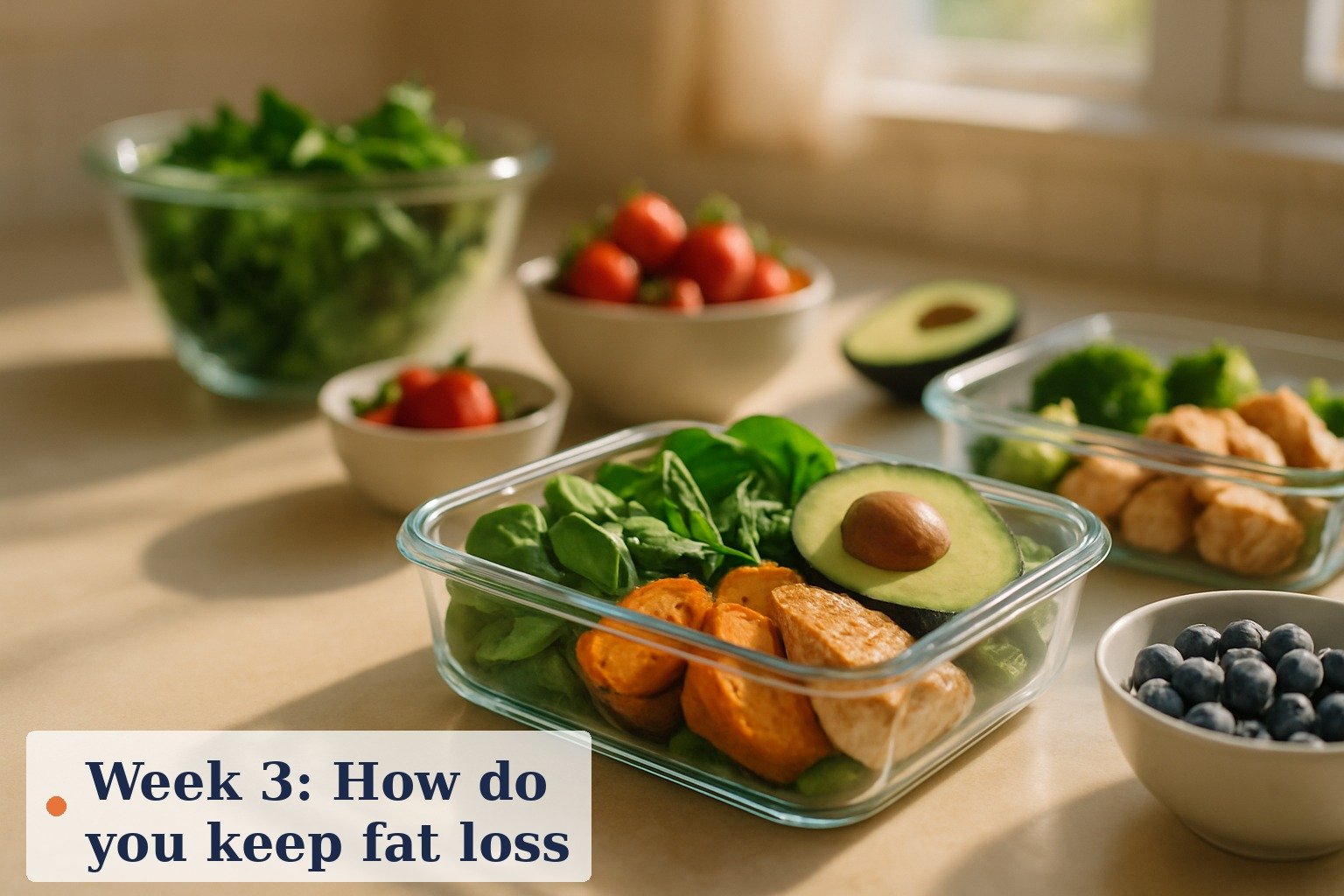
In week 3, consistency beats novelty. Hold the deficit, protein and training, prioritize sleep, and manage the hunger and plateaus that often appear now. Adjust portions slightly if progress stalls, but resist the urge to slash calories harder — that usually costs muscle and backfires.
The third week is where most resets are won or lost, because the initial motivation fades and the body starts adapting. Two things matter most here. First, sleep. If it slipped, fix it now: consistently short sleep raises hunger hormones, worsens cravings and is independently linked to greater abdominal fat, so seven-plus hours does real metabolic work[11]. Second, expectations. A brief plateau or a whoosh-then-stall pattern is normal, not failure; body weight fluctuates daily with water, sodium, hormones and digestion.
If genuine progress has stalled for a week — waist and weight both flat — make one small adjustment rather than a drastic one: tighten portion sizes slightly, add 10–15 minutes to your daily walk, or double-check that “small” extras (oils, nuts, tastes while cooking) haven’t crept the deficit closed. Resist the temptation to crash: cutting calories too hard now tends to strip muscle, spike hunger and trigger rebound eating, undoing the careful work of the first fortnight. Steady wins. This is also a good week to add a second or third short resistance session if you’re recovering well, since more muscle-preserving stimulus pays off over the following weeks.
Week 4: How do you lock in the reset?
Week 4 is about converting a 30-day push into a lasting routine. Measure your progress, keep the deficit slightly gentler to build sustainability, cement the protein-fiber-movement-sleep pattern, and plan the transition to maintenance. The goal is habits you keep, not a finish line you cross and abandon.
The final week has a different job from the first three: it prepares you to not regain what you lost. Remeasure everything you baselined in week 1 — weight, waist, photos — and compare honestly. Most people who did the work will see a meaningful waist change and a few kilograms down, with the largest visual difference often around the midsection because of early visceral fat loss[5]. That result is the proof of concept: the fundamentals worked, and you now have data showing what your body responds to.
Then plan the handoff. A 30-day reset regains fat the moment the habits stop, because the fat responded to the deficit, not to any permanent switch. So decide which pieces you keep: the protein floor and fewer liquid calories are the easiest to maintain forever; the training and walking should continue; the deficit itself can ease toward maintenance or continue gently if you have more to lose. If you want to keep going, simply repeat the structure — the reset is designed to be run again or extended, not treated as a one-off crash. Frame month one as chapter one, and the odds of keeping the result climb dramatically.
Which weight-loss ingredients actually have evidence?
A handful of supplement ingredients have real but modest metabolic evidence — caffeine, green tea catechins, soluble fiber like glucomannan, and berberine — while most “fat burner” ingredients have thin or no human data. Even the best of them produce small effects, and dose is what separates a real ingredient from a label sprinkle[3].
Because this is a hub, here is an honest ingredient-by-ingredient read, graded for direct weight or fat evidence, with the studied dose set against what products typically deliver. “Evidence for weight” means human research on body weight or fat — not general antioxidant or wellness claims. The pattern to notice: even the ingredients that “work” work at the margins, and only on top of the deficit.
| Ingredient | Proposed mechanism | Studied dose vs. typical label dose | Realistic effect | Evidence |
|---|---|---|---|---|
| Caffeine | Small rise in metabolic rate; mild appetite & performance effect | Studied ~100–400 mg/day; most products are in range, but “energy” blends vary widely | Minor calorie burn & better workouts; tolerance builds | Moderate |
| Green tea catechins (EGCG) | Catechins + caffeine may slightly raise fat oxidation | Studied ~270–1,200 mg catechins/day; blends often under-dose or hide the amount[6] | ~1 kg over months in pooled trials | Modest |
| Berberine | Activates AMPK; improves blood sugar & insulin sensitivity | Studied ~900–1,500 mg/day split; blends frequently under-dose[13] | ~2 kg over ~12 weeks in meta-analysis | Moderate |
| Glucomannan (soluble fiber) | Absorbs water, expands in stomach, increases fullness | Studied ~3 g/day before meals with water[10] | Small appetite & weight effect; works via satiety | Weak–modest |
| Capsaicin (chili extract) | Mild thermogenesis and appetite effect | Studied ~2–6 mg capsaicinoids/day; product amounts rarely disclosed | Very small; easy to overstate | Weak |
| Chromium | Marketed for blood-sugar & craving control | Studied ~200–1,000 mcg/day | Negligible for weight in non-deficient people | Weak |
The honest summary of the table: the ceiling for even the best-supported ingredient is roughly a kilogram or two over months, and only when it’s dosed like the studies and stacked on a real deficit. That is why the reset puts diet, protein, fiber and movement first and treats ingredients as optional. For the deeper dive, see our roundups of the weight-loss ingredients with the strongest evidence, plus the individual guides to berberine and green tea extract.
Do belly-fat supplements work?
Belly-fat supplements work only modestly, and only as an add-on to a calorie deficit. The NIH concludes weight-loss supplements produce, at best, small effects and are no substitute for diet and activity[3]. Popular products like Java Burn, Ikaria and Nagano Tonic bundle a few real ingredients with a lot of marketing.
Since this hub is where readers arrive wondering whether a specific product will fast-track their reset, here is the plain answer. There is no capsule, coffee additive or tonic that melts belly fat; the FTC explicitly flags “effortless” and “melt fat” weight-loss claims as hallmarks of deceptive marketing[2], and the FDA does not approve any dietary supplement before sale[14]. What the better products can do is deliver a modest ingredient or two — usually caffeine or green tea catechins — that provide a marginal metabolic nudge or make workouts a little easier. That is a supporting role, not a plan.
Two structural problems recur across the category. First, proprietary blends hide the per-ingredient dose, so you often can’t tell whether the one active with evidence reaches the studied amount — a practice that enables “fairy dusting” a hero ingredient at a token dose. Second, the marketing outruns the science, wrapping small effects in transformation stories. We’ve reviewed the popular formulas individually and honestly — Java Burn, Ikaria Lean Belly Juice, Liv Pure, Mitolyn and Nagano Tonic — and the throughline is the same: real ingredients, overstated claims, effects that live at the margins. If a supplement helps you adhere to the reset, fine; just don’t expect it to do the reset’s job. Our 2026 buyer’s guide and the roundup of natural alternatives to Ozempic apply the same skeptical lens across the field.
Which drinks help, and which sabotage the reset?
Water is the best drink for a belly fat reset — zero calories, and drinking it before meals can slightly reduce intake. Unsweetened coffee and green tea are reasonable extras. The bigger win is removal: sugar-sweetened drinks and alcohol add liquid calories strongly linked to weight and visceral fat gain[12].
Drinks deserve their own section because they are the single easiest place most people find a painless deficit. Liquid calories are poorly compensated for — the body doesn’t reduce later food intake to account for a sugary drink the way it does for solid food — so sodas, sweetened coffees, juices and alcohol quietly stack surplus calories that preferentially feed liver and visceral fat[12]. Cutting them is often the highest-yield change in week 1, worth several hundred calories a day for regular drinkers.
On the helpful side: water is the workhorse — calorie-free, and a glass before meals can modestly lower how much you eat. Unsweetened coffee and green tea add a little caffeine and, in green tea, catechins, both of which carry small metabolic and appetite effects and are perfectly reasonable within the reset[6]. What to be skeptical of are “detox teas,” slimming tonics and apple-cider-vinegar miracle claims — the evidence is thin, and any real effect is small and easily swamped by what you eat. Our full ranked breakdown lives in the best and worst drinks for weight loss guide.

Who should avoid an aggressive reset?
An aggressive 30-day deficit is not for everyone. People who are pregnant or breastfeeding, anyone with a history of disordered eating, those who are underweight, teenagers, and people with diabetes, kidney or heart conditions should not attempt a sharp calorie cut or add supplements without medical guidance[14].
Because a “reset” can tip into extremes if taken too literally, the safety boundaries matter. This plan is built around a modest deficit and habit change, which is safe for most healthy adults — but the following groups should either skip it or run it only under professional supervision:
Skip or seek guidance first
- Pregnant or breastfeeding — this is not the time for a deliberate deficit
- Anyone with a current or past eating disorder — structured restriction can be a trigger
- Underweight individuals or those with a very low BMI
- Children and teenagers, whose needs differ and who should be guided by a clinician
Get medical clearance before starting
- Diabetes or on blood-sugar medication — deficits and ingredients like berberine can lower glucose too far[13]
- On blood-pressure medication, statins or immunosuppressants (relevant if adding supplements)
- Kidney disease — high-protein targets may need adjustment
- Any chronic condition, or if you feel unwell during the reset
The general rule: if you take any prescription medication, are managing a health condition, or are unsure, a two-minute conversation with your doctor or pharmacist beats a guess — especially before adding any supplement on top of the plan. The reset’s power comes from consistency, not severity, so no one needs to push into unsafe territory to benefit.
What this plan can’t do — honest limitations
The 30-Day Belly Fat Reset cannot spot-reduce fat, override genetics on where fat sits, fix a stubborn last-inch overnight, or deliver a permanent result from a temporary effort. It also can’t promise a specific number of pounds — individual response varies widely with age, sex, starting point and hormones[8].
Honesty about limits is what separates a useful guide from a sales page, so here are the things this plan will not do, stated plainly. It won’t spot-reduce. No amount of core work or targeted “belly” food burns fat specifically from your midsection; fat leaves the whole body in a genetically influenced order, and for many people the abdomen is among the last areas to fully lean out even as the waist shrinks[8]. It won’t override biology. Menopause, age, sex and genetics shape where fat sits and how fast it goes; two people running the same reset can see quite different results, and that’s normal.
It won’t make results permanent by itself. Thirty days is a launch phase; stop the habits and the fat returns, because it responded to the deficit rather than to a lasting change. And it won’t match the fantasy numbers on supplement sales pages — a realistic month is a few kilograms and a visibly smaller waist, not a transformation. Finally, this is general educational information, not a personalized medical or nutrition plan; a registered dietitian or your doctor can tailor targets to your situation, particularly if progress stalls or health conditions are involved. Set expectations here correctly and the reset delivers; expect magic and it will disappoint, exactly as we argue in setting realistic expectations.
How do the popular products compare?
Compared honestly, the popular belly-fat products differ mostly in format and marketing rather than in effectiveness — all sit somewhere between “modest add-on” and “overstated.” None substitutes for the deficit. Below is a plain side-by-side of how each fits, if at all, into a reset[3].
Readers landing on a “reset” page often want to know which product, if any, to bolt on. The honest answer is that the plan is the product; these are optional extras whose value is marginal. Here’s how the ones we’ve reviewed stack up on the things that actually matter — dose transparency and evidence — with links to the full reviews.
| Approach | Format | Dose transparency | Honest role in a reset |
|---|---|---|---|
| The reset itself (diet + activity) | Habits | Fully in your control | The engine — does the actual work |
| Java Burn | Coffee additive | Partial; blend-based | Optional caffeine/green-tea nudge |
| Ikaria Lean Belly Juice | Powder drink | Proprietary blend | Overstated; minor at best |
| Nagano Tonic | Powder tonic | Proprietary blend | Overstated; minor at best |
| Liv Pure / Mitolyn | Capsules | Blend-based | Optional; verify doses first |
The comparison makes the reset’s priority obvious: the only row that reliably reduces belly fat is the first one. If you still want to try a product, choose one whose single evidence-backed ingredient is dosed transparently, buy only from the official site, and treat it as an adjunct. For head-to-heads, see Java Burn vs Nagano Tonic and Ikaria vs Liv Pure, and our overview of which supplement format actually suits you.
To be clear: the reset works without any of these. But if you’ve read the trade-offs and still want to try a product alongside the plan, start with our full honest review, then buy only from the official site — and keep it as an adjunct to diet and activity, never a substitute.
Java Burn
A flavorless coffee add-in built around caffeine and green-tea catechins. Modest at best. Read our full review before deciding, then check the current price and guarantee on the official site.
Ikaria Lean Belly Juice
A superfood-style powder marketed for belly fat, with a proprietary blend that hides doses. Effects are minor at best. See our honest review first, then verify terms on the official site.
Compare before you buy
See how the popular formulas stack up on transparency and evidence, and read the individual reviews, before spending on any add-on to your reset.
The free, effective option
Protein, fiber, resistance training, daily walking, sleep and fewer liquid calories. This is the part that actually reduces belly fat — and it costs nothing.
The verdict: the reset works because the fundamentals work
Our verdict on the 30-Day Belly Fat Reset is REAL — because it is nothing more than the fundamentals, structured. A modest deficit, high protein, fiber, resistance training, movement, sleep and fewer liquid calories reliably reduce belly and visceral fat[1]. What it isn’t is a miracle, a spot-reduction trick, or a reason to buy a tonic.
Strip away the internet’s “reset” mythology and what remains is a defensible, effective month: a plan that produces a few kilograms of fat loss and a visibly smaller waist for most people who run it honestly, with visceral fat often leading the way[5]. That is genuinely worth doing — and it is the opposite of the effortless-transformation story the supplement industry sells.
The 30-Day Belly Fat Reset delivers because it’s built only from levers with evidence. Expect a modest, real result — a few kilograms and a smaller waist — not a transformation, and treat month one as chapter one. Supplements are optional add-ons at best; the deficit, protein, fiber, training, sleep and drink swaps do the work. Buy any product only from its official site, and check with your doctor if you take medication or have a health condition.
Frequently asked questions
Can you actually lose belly fat in 30 days?
Yes, you can reduce belly fat in 30 days, but within limits. A sustained calorie deficit of about 500 kcal a day yields roughly 1.5 to 3.5 kg of total fat loss in a month, and belly and visceral fat often shrink first.
You cannot spot-reduce, and 30 days is a strong start rather than a finish line — treat it as the first chapter of a longer, sustainable change.
How much belly fat can you realistically lose in a month?
Most people lose about 0.5 to 1 percent of body weight per week when a deficit is done well, so roughly 2 to 4 kg of fat over 30 days.
Visceral fat around the organs is metabolically active and often responds faster than the subcutaneous fat you can pinch, so waist measurements can improve more than the scale suggests.
What is the fastest way to lose belly fat?
The fastest evidence-based approach is a modest calorie deficit built mostly from protein and fiber, plus resistance training and daily walking, with alcohol and sugary drinks cut back.
There is no faster shortcut: crunches, waist trainers, detox teas and fat-burner pills do not meaningfully accelerate belly fat loss beyond the deficit itself.
Do you need to do crunches to lose belly fat?
No. Crunches strengthen the abdominal muscles but do not burn the fat sitting on top of them, because spot reduction is not physiologically possible.
Fat is lost from the whole body in a pattern set largely by genetics. Resistance training that works large muscle groups and a calorie deficit do far more for belly fat than targeted ab work.
How much protein should I eat to lose belly fat?
Aim for roughly 1.2 to 1.6 grams of protein per kilogram of body weight per day while in a deficit, which for many adults lands around 100 to 140 grams daily.
Higher protein preserves muscle during weight loss and increases fullness, which makes the calorie deficit easier to hold without extreme hunger.
Do belly-fat supplements like Java Burn or Ikaria really work?
At best they play a small supporting role, and only alongside diet and activity. The NIH concludes weight-loss supplements produce modest effects at most and never replace a calorie deficit.
A few ingredients such as caffeine, green tea catechins and berberine have real but small metabolic data; the products built around them are optional add-ons, not the reset itself.
What is the best drink for losing belly fat?
Water is the best drink for a belly fat reset because it has zero calories and can blunt appetite before meals. Unsweetened coffee and green tea are reasonable extras.
The bigger win is what you remove: sugar-sweetened drinks and alcohol add liquid calories that are strongly linked to weight and visceral fat gain.
Does the 30-day reset get rid of visceral fat?
A 30-day reset can start reducing visceral fat, the deep fat around the organs, which is the more dangerous type and often the first to respond to a calorie deficit and exercise. Aerobic activity in particular is linked to visceral fat reduction.
Thirty days moves the needle, but fully normalizing visceral fat usually takes longer sustained effort.
Will the belly fat come back after 30 days?
Belly fat returns if the habits stop, because the fat responded to the deficit, not to any permanent change. The 30-day reset is best treated as a launch phase that builds repeatable habits — protein, fiber, movement, sleep and fewer liquid calories — that you carry forward.
Weight regain is common precisely when a plan is temporary rather than sustainable.
Is fasting necessary to reset belly fat?
No. Intermittent fasting is one way to create a calorie deficit, and it suits some people, but studies show it produces similar fat loss to simple calorie restriction when calories match.
Fasting is a tool, not a requirement. Choose whichever eating pattern makes holding a modest deficit easiest for you to sustain.
Who should not try an aggressive 30-day reset?
People who are pregnant or breastfeeding, those with a history of eating disorders, anyone underweight, teenagers, and people with diabetes, kidney disease or other conditions should not attempt an aggressive deficit without medical guidance.
If you take medication, especially for blood sugar or blood pressure, talk to your doctor before adding supplements or a sharp calorie cut.
How to lose belly fat: what actually works
How much protein to lose belly fat
Why am I not losing belly fat?
Best and worst drinks for weight loss
Ingredients with the strongest evidence
Best weight-loss supplements of 2026
Setting realistic expectations
All health articles
We research weight-loss supplements and the ingredients inside them, scoring products on label transparency rather than hype. No star spam, no fabricated reviews — just the evidence, stated plainly. Our editorial standards →
- Hall KD, Kahan S. Maintenance of Lost Weight and Long-Term Management of Obesity (energy balance and deficit). Medical Clinics of North America, 2018. pubmed.ncbi.nlm.nih.gov
- U.S. FTC — “Gut Check”: red-flag weight-loss claims; Health Products Compliance Guidance. ftc.gov
- NIH Office of Dietary Supplements — Dietary Supplements for Weight Loss (Health Professional Fact Sheet). ods.od.nih.gov
- Leidy HJ, et al. The role of protein in weight loss and maintenance. American Journal of Clinical Nutrition, 2015. pubmed.ncbi.nlm.nih.gov
- Verheggen RJHM, et al. A systematic review and meta-analysis on the effects of exercise training versus hypocaloric diet on visceral adipose tissue. Obesity Reviews, 2016. pubmed.ncbi.nlm.nih.gov
- Hursel R, et al. The effects of green tea on weight loss and weight maintenance: a meta-analysis. International Journal of Obesity, 2009. pubmed.ncbi.nlm.nih.gov
- U.S. Department of Health and Human Services — Physical Activity Guidelines for Americans, 2nd edition (150+ min/week; resistance training). health.gov
- Ramírez-Campillo R, et al. Regional fat changes induced by localized muscle endurance resistance training (spot reduction does not occur). Journal of Strength and Conditioning Research, 2013. pubmed.ncbi.nlm.nih.gov
- Neeland IJ, et al. Visceral and ectopic fat, atherosclerosis, and cardiometabolic disease: a position statement. The Lancet Diabetes & Endocrinology, 2019. pubmed.ncbi.nlm.nih.gov
- Sood N, et al. Effect of glucomannan on plasma lipid and appetite/weight measures: a meta-analysis. American Journal of Clinical Nutrition, 2008. pubmed.ncbi.nlm.nih.gov
- St-Onge MP, et al. Sleep duration and quality: impact on lifestyle behaviors and cardiometabolic health (AHA scientific statement). Circulation, 2016. pubmed.ncbi.nlm.nih.gov
- Malik VS, et al. Sugar-sweetened beverages and weight gain in children and adults: a systematic review and meta-analysis. American Journal of Clinical Nutrition, 2013. pubmed.ncbi.nlm.nih.gov
- Ilyas Z, et al. The effect of Berberine on weight loss in order to prevent obesity: A systematic review. Biomedicine & Pharmacotherapy, 2020. pubmed.ncbi.nlm.nih.gov
- U.S. FDA — Questions and Answers on Dietary Supplements (supplements are not FDA approved; post-market oversight). fda.gov
- Jul 8, 2026 — Pillar guide published; week-by-week plan and ingredient evidence checked against current NIH, FDA, FTC, HHS and peer-reviewed sources.
Affiliate disclosure: SourceLean is reader-supported. When you buy through links on this site, we may earn a commission at no extra cost to you. Checkout is always handled on the official product website.