The bottle’s shape sells the dream, but the science cares about one thing: does the active ingredient reach your blood at a dose that matters? Here’s the honest, fully-sourced read on supplement delivery formats.
No format is magic, and the boldest delivery claims have the weakest evidence. Powders and capsules deliver verified oral doses reliably; teas can carry real but modest catechin-and-caffeine effects; drops rarely beat a swallowed pill despite “sublingual” marketing; and patches face a hard physics barrier — most weight-loss ingredients simply cannot cross intact skin in meaningful amounts[4]. Judge a supplement by its ingredient, dose and disclosure, not its packaging.
Walk through the weight-loss aisle — physical or digital — and you’ll meet the same ingredients dressed in four very different costumes. Berberine and green tea appear as capsules, as flavored powders, as “fast-absorbing” tongue drops, and as skin patches you wear overnight. Each format comes with a story about why this delivery is the breakthrough the others missed: drops “bypass digestion,” patches give “steady all-day release,” powders are “more bioavailable,” teas are “gentle and natural.” This guide is the evidence-first version of that conversation. We’ll define the terms, walk format by format through what physiology and clinical research actually support, and finish with a plain rule for choosing. Spoiler: the format matters far less than the marketing wants you to believe — and far less than the dose on the label.
Every claim below about how a format behaves in the body is checked against primary sources — peer-reviewed pharmacology and dermatology research, the NIH Office of Dietary Supplements, the NIH National Center for Complementary and Integrative Health, and FDA and FTC guidance — not the product marketing. SourceLean makes money only through transparent affiliate links, disclosed above; we run no star ratings, sponsored placements or fabricated reviews. This is educational information, not medical advice.
- What are the main weight-loss supplement formats?
- Does the format actually change how well a supplement works?
- Do drops and liquid tinctures absorb better than pills?
- Do weight-loss patches actually work through the skin?
- Are weight-loss teas worth drinking?
- What can powders do that other formats can’t?
- Where do capsules fit in?
- How do the formats compare on dose transparency?
- Which format is most accurate for dosing?
- Which format is best for convenience and sticking with it?
- Does format affect cost and value?
- Which weight-loss supplement format should you choose?
- FAQ
What are the main weight-loss supplement formats?
The main weight-loss supplement formats are capsules and tablets, powders (mixed into water, coffee or a shake), liquid drops or tinctures (taken by mouth or under the tongue), brewed or instant teas, and transdermal patches worn on the skin. Each delivers ingredients by a different route, which changes convenience and dosing far more than effectiveness.
Before comparing them, it helps to name what a format (or delivery system) actually is: the physical form a supplement takes and the route by which it enters the body. Four of the five formats here are oral — capsules, powders, most drops and teas all end up swallowed and digested through the gut. Only one, the patch, attempts a genuinely different route: transdermal delivery, meaning absorption through the skin. That single distinction is the heart of the whole debate, because the route determines what the body can realistically absorb.
It is worth stating up front what no format can change. A dietary supplement is a product taken to supplement the diet, not a drug, and the U.S. Food and Drug Administration does not approve any supplement for safety or effectiveness before it is sold[7]. The NIH Office of Dietary Supplements is blunt about the category as a whole: weight-loss supplements produce, at best, modest effects and are no substitute for diet and physical activity[5]. No drop, tea, patch or powder repeals that conclusion. What the format can change is whether a given ingredient reaches your bloodstream at a dose that has ever been studied — and that is the question worth taking seriously.
Does the format actually change how well a supplement works?
Format changes effectiveness only when it changes two things: how much of the active ingredient reaches your bloodstream (bioavailability) and at what dose. For most weight-loss ingredients taken orally, the format makes little difference — a capsule and a powder of the same compound absorb similarly. Format matters most when a route genuinely bypasses a barrier, which is rarer than marketing implies.
Bioavailability is the fraction of a dose that actually reaches your circulation in active form. An ingredient can be swallowed in a huge amount and still do nothing if almost none of it is absorbed — and conversely, a small, well-absorbed dose can matter. Two things mainly limit oral bioavailability: poor absorption across the gut wall, and first-pass metabolism, where the liver chemically alters a compound before it ever reaches the rest of the body. The genuine, defensible argument for an alternative format is that it sidesteps one of these obstacles.
The trouble is that this argument is usually borrowed, not earned. Sublingual and transdermal routes do bypass first-pass metabolism for a handful of specific drugs — nitroglycerin under the tongue, nicotine and certain hormones through the skin. But those molecules were chosen because they are small and fat-soluble enough to cross the relevant membrane. Most weight-loss supplement ingredients — berberine, green tea catechins, glucomannan fiber, many botanical extracts — are either large, water-soluble, or both, which is precisely why they don’t cross skin or oral mucosa well. Borrowing a delivery story from nicotine and applying it to a fiber blend is where the marketing breaks from the biology.
A format only beats a plain pill if (1) the ingredient is destroyed or heavily metabolized when swallowed, and (2) the new route genuinely delivers it intact, and (3) it does so at a dose that has been studied. If a product can’t clear all three bars, “revolutionary delivery” is packaging, not pharmacology. Most weight-loss drops and patches clear none of them.
So the honest framing for the rest of this guide is narrow and useful: for the ingredients that actually have weight-management evidence, the format you choose changes convenience, dosing precision and price — and only occasionally changes how much active reaches your blood. We’ll take each format on those terms.
Do drops and liquid tinctures absorb better than pills?
Usually no. Most weight-loss drops are simply swallowed and digested like any pill, so they offer no real absorption advantage. The “sublingual” claim — that holding drops under the tongue lets ingredients slip straight into the blood — works only for a few small, fat-soluble molecules, not for the large botanical extracts that fill most weight-loss tinctures[1].
Liquid drops, often sold as tinctures, are among the fastest-growing weight-loss formats, and they lean hard on one idea: sublingual absorption. The tissue under the tongue is thin and richly supplied with blood vessels, and for certain drugs it genuinely allows a compound to enter the circulation directly, bypassing the gut and first-pass liver metabolism[1]. That is real pharmacology — but it is also tightly constrained. Sublingual delivery favors molecules that are small (roughly under a few hundred daltons), fat-soluble enough to cross the membrane, potent at low doses, and able to stay under the tongue long enough to absorb[1].
Almost none of that describes a typical weight-loss drop. These products are usually packed with herbal extracts and blends that are large, water-soluble, and dosed in amounts too big to absorb through a small patch of mucosa in seconds. In practice, people squeeze the dropper, swallow within moments, and the ingredients travel the ordinary digestive route — exactly like a capsule, just with added flavoring, glycerin or alcohol as a carrier. A useful real-world check on the sublingual premise is vitamin B12: trials comparing sublingual and ordinary oral B12 have generally found no meaningful difference in blood levels, because for many nutrients the swallowed route works just as well and the under-the-tongue step adds little[8].
There are two further honest knocks against drops. First, dosing precision is poor: a squeezed dropper is one of the least accurate ways to measure a dose, varying with squeeze pressure, bubble formation and how you hold the bottle, so two “full droppers” can differ noticeably. Second, drops are a favorite home for proprietary blends that hide individual ingredient amounts (more on that below), and the liquid format makes it even harder to reason about how much active you’re getting. None of this makes drops useless — a pleasant-tasting liquid can aid consistency for people who dislike pills — but the “absorbs better, bypasses digestion” promise is the part to disregard. For an ingredient like berberine, whose evidence rests on specific oral doses, a liquid that hides the amount is a step backward; see our berberine for weight loss explainer for what the dose actually needs to be.
Do weight-loss patches actually work through the skin?
There is little credible evidence that weight-loss patches work. Skin is a deliberate barrier built to keep things out, and the “500 Dalton rule” means only small, fat-soluble molecules cross it in useful amounts[4]. Most weight-loss ingredients are too large or too water-soluble to penetrate, and patches almost never disclose how much active actually reaches your blood.
Transdermal patches are the format making the boldest physiological claim — that an ingredient worn on the skin will absorb steadily into the bloodstream all day. For a small set of real drugs, that works: nicotine, the motion-sickness drug scopolamine, and several hormones are delivered this way. But dermatology research explains why those particular molecules succeed, and it is bad news for weight-loss patches. The 500 Dalton rule, described by Bos and Meinardi, holds that compounds need a molecular weight under roughly 500 daltons to penetrate intact skin effectively; above that, the outer skin layer (the stratum corneum) blocks them[4]. Successful transdermal drugs are also fat-soluble and active at very low doses, because only a trickle gets through.
Now hold a typical weight-loss patch ingredient list against that bar. Many botanical extracts and fibers far exceed 500 daltons. Even berberine, which is smaller (around 336 daltons), is notoriously poorly absorbed even when swallowed and has no good clinical evidence of meaningful transdermal delivery — and its studied benefits come from oral doses near 900–1,500 mg per day[2], an amount no skin patch is going to push through. Caffeine is one of the few weight-loss-adjacent compounds small and lipophilic enough to cross skin to some degree, but the quantities and the resulting effect on body weight are not established at the level patch marketing implies.
For a patch to help, the ingredient must clear the 500-dalton skin barrier and arrive at a studied dose. Weight-loss patches almost never publish blood-level data showing either. The pleasant idea of absorbing a fat-burner through your arm runs straight into the skin’s entire evolutionary job: keeping outside molecules out[4].
The U.S. Federal Trade Commission has specifically warned about weight-loss patches and similar “wearable” products, and lists effortless, dramatic weight loss with no diet or exercise among its top red flags for deceptive marketing[11]. That doesn’t mean every patch is fraudulent, but it does mean the burden of proof sits with the seller — and for weight loss, that proof is essentially absent. If a patch can’t show that its active crosses skin at a meaningful dose, the most likely explanation for any result is the diet and activity changes people adopt alongside it.
Are weight-loss teas worth drinking?
Weight-loss teas have modest, ingredient-dependent effects at best. Green tea catechins combined with caffeine can raise energy expenditure slightly, and meta-analyses link green tea to roughly 1–2 kg of average weight loss[3]. But many commercial “slimming” teas underdose the catechins or lean on senna, a laxative that causes water loss, not fat loss.
Tea is the one alternative format with a genuine, if small, evidence base — because the active ingredients themselves have data, not because brewing is a clever delivery trick. Green tea supplies catechins, chiefly EGCG (epigallocatechin gallate), plus caffeine. The leading hypothesis is that EGCG and caffeine together modestly increase thermogenesis (heat and energy production) and fat oxidation. A 2009 meta-analysis by Hursel and colleagues found green tea catechins with caffeine produced a small but significant reduction in body weight and helped with weight maintenance[3], and the NIH National Center for Complementary and Integrative Health agrees the effect on weight is small and not a reason to expect dramatic results[9].
Two caveats keep teas in proportion. First, EGCG bioavailability is low and variable — only a modest fraction of catechins is absorbed, absorption improves on an empty stomach, and the brewed concentration in a casual cup of tea is often well below the doses used in trials[10]. A standardized green tea extract capsule generally delivers a more reliable catechin dose than a teabag, though high-dose extracts carry a rare risk of liver injury, so more is not automatically better. Our green tea extract for fat loss piece walks through the dose-response in detail.
Second, and more important for consumer protection: many products marketed as “detox” or “slimming” teas owe their visible effect not to fat loss but to senna or other stimulant laxatives. These cause bowel movements and fluid loss that can register as a quick drop on the scale, then reverse within days, while regular use risks cramping, dependence and electrolyte problems. That is a cosmetic, temporary change dressed up as fat loss — exactly the kind of claim to treat with suspicion. A real green-tea or caffeine effect is small and gradual; a tea that “works” in 48 hours is almost always moving water, not fat. For the broader question of which drinks help or hurt, see the best drinks for weight loss and the worst.
What can powders do that other formats can’t?
Powders have one genuine advantage no pill can match: they can carry gram-sized doses. Ingredients like soluble fiber, protein, creatine or amino acids are needed in amounts that would require many capsules, so a scoop mixed into water, coffee or a shake is the practical way to deliver them. For small actives, though, powders hold no absorption edge over capsules.
Powders — the format behind many popular “coffee” and “tonic” products — earn their place through dose volume, not bioavailability. Some of the better-evidenced appetite and metabolic ingredients work only at quantities measured in grams. Glucomannan, a soluble fiber that swells with water to promote fullness, is studied at around 2–4 grams per day taken before meals with plenty of water — far too bulky for a sensible number of capsules[6]. Protein, which supports satiety and helps preserve muscle during weight loss, is needed in tens of grams; you cannot pill your way to a protein target, which is why a powder (or simply food) is the realistic delivery. Our guide to how much protein to lose belly fat covers the targets.
Powders carry trade-offs of their own. They require preparation and water, the taste must be palatable enough to repeat daily, and the convenience of a flavored coffee or shake can quietly smuggle in added sugars or stimulant doses worth checking on the label. Dosing accuracy depends on a scoop, which is more reliable than a dropper but less precise than a pre-measured capsule, and it’s easy to heap or level a scoop differently day to day. Crucially, the format itself doesn’t make ingredients work better: a gram of berberine in a powder and a gram in capsules absorb essentially the same way once swallowed. The powder’s edge is purely that it can hold the gram in the first place.
Many of the best-known weight-loss powders are blends sold on a metabolic story — coffee add-ins, “tonics” and greens-style mixes. The same scrutiny applies as to any format: what are the actives, are they dosed where the research is, and does the label disclose the amounts or hide them in a blend? A powder with a transparent, well-dosed fiber or protein content is doing something a capsule can’t; a powder that’s mostly flavoring around a fairy-dusted herb is just a more expensive cup of coffee.
Where do capsules and tablets fit in?
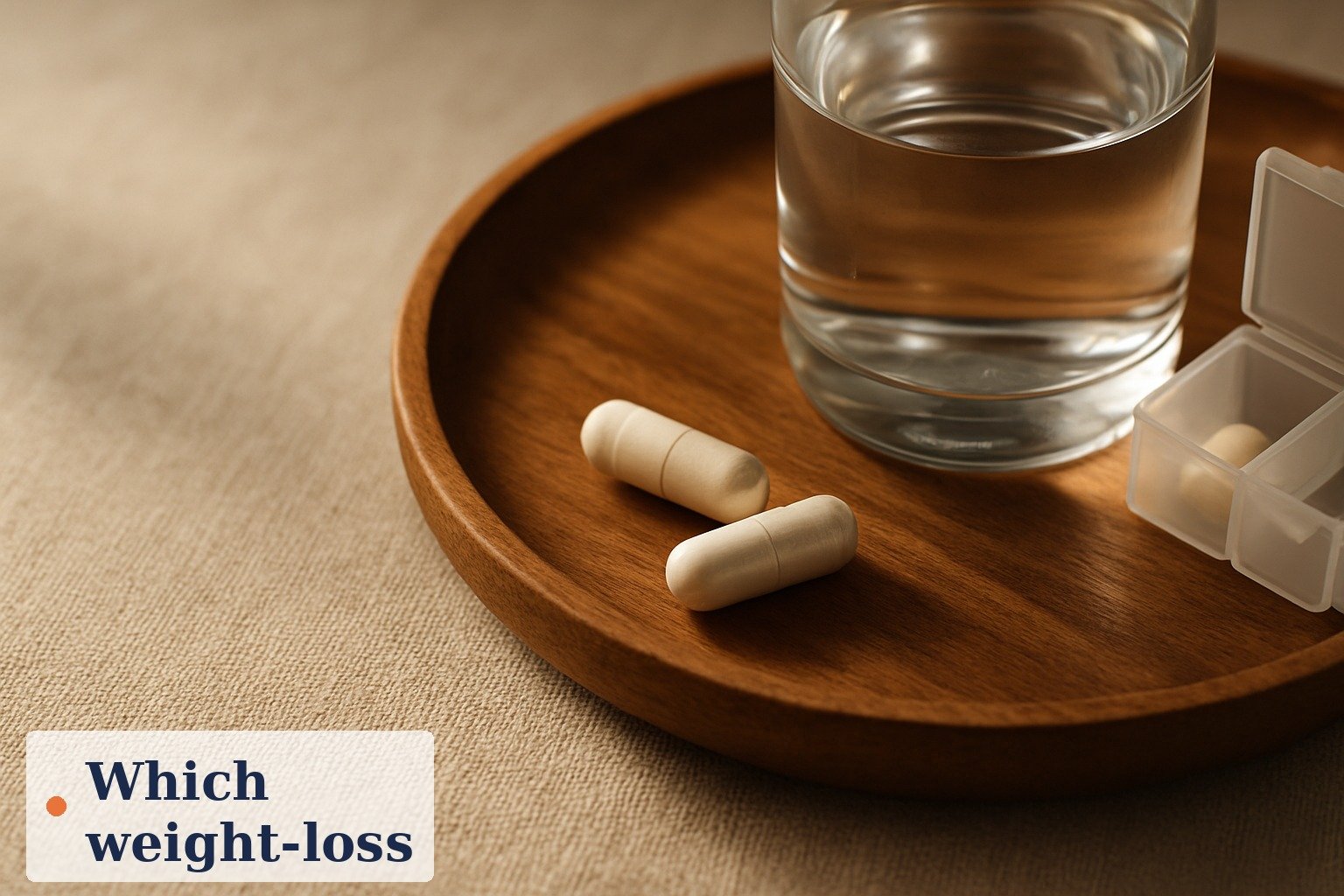
Capsules and tablets remain the default for good reasons: each one delivers a pre-measured, verifiable dose, they’re portable and tasteless, and most clinical trials of supplement ingredients use exactly this form. Their limit is volume — they can’t practically carry the gram-sized doses of fiber or protein that some ingredients require.
It’s easy to overlook the plain capsule when newer formats are shouting, but the capsule is the quiet benchmark the others are measured against. A capsule’s dose is fixed and printed: “500 mg per capsule, two capsules per serving” tells you exactly what you’re taking, assuming the label is honest and the ingredients aren’t buried in a blend. That precision is why the overwhelming majority of human trials on weight-loss ingredients — berberine, green tea extract, caffeine, glucomannan in capsule form — administer them as capsules or tablets[5]. When you take the same ingredient at the same dose in capsule form, you’re taking the version closest to what was actually studied.
The capsule’s honest limitations are convenience-related, not effectiveness-related: pill fatigue for people who dislike swallowing capsules, the gram-dose ceiling already noted, and the fact that a tidy capsule can hide a fairy-dusted blend just as easily as any other format. But on the two things that matter most — a verifiable dose and alignment with the research — capsules quietly outperform the flashier formats. If you want a sense of how specific products in capsule and other forms stack up, our best weight-loss supplements of 2026 buyer’s guide applies the same transparency-first lens across the category.
How do the formats compare on dose transparency?
Transparency is about whether the label tells you how much of each active ingredient you’re getting — and it varies more by brand than by format, though drops, patches and blended powders are the worst offenders. A proprietary blend legally must disclose only the blend’s total weight, not each ingredient’s dose, hiding the one number that decides whether a product works[12].
This is the single most important comparison in the whole guide, and it cuts across every format. Under U.S. labeling rules (21 CFR 101.36), a proprietary blend must list its ingredients in descending order by weight and state the blend’s total weight — but it does not have to reveal the milligrams of each individual ingredient[12]. So a “750 mg Metabolic Support Complex” with eight ingredients could be mostly cheap filler with a token sprinkle of the hero compound, and the label would be entirely legal. The industry term for that token sprinkle is fairy dusting — adding just enough of a research-backed ingredient to name it on the label, far below the dose that did anything in a study.
| Format | Typical absorption route | Dose accuracy | How often doses are disclosed |
|---|---|---|---|
| Capsule / tablet | Oral / digestive | High — pre-measured | Often, but blends still common |
| Powder | Oral / digestive | Moderate — scoop-dependent | Mixed; large fiber/protein doses easier to verify |
| Tea | Oral / digestive | Low — brewing varies widely | Often vague; catechin content rarely standardized |
| Drops / tincture | Mostly swallowed (sublingual claim overstated) | Low — dropper imprecise | Frequently a proprietary blend |
| Patch | Transdermal (limited by 500-dalton barrier) | Unknown — absorbed amount unclear | Rarely discloses delivered dose |
The pattern is hard to miss: the formats that make the loudest absorption claims — drops and patches — are also the ones least likely to tell you how much active you actually receive, and in the patch’s case the delivered dose is genuinely unknowable from the label. Powders and capsules can be transparent or opaque depending on the brand, but at least the swallowed dose is the dose. The practical move is to ignore the format’s story and look for one thing: a Supplement Facts panel that lists each active ingredient with its own amount in milligrams or grams. If you can’t find that number, you can’t judge the product — whatever shape it comes in.
Which format is most accurate for dosing?
Capsules and tablets are the most accurate, because each unit is pre-measured. Powders are next, limited by scoop variability. Teas and drops are the least accurate — brewing strength and dropper squeeze vary every time — and patches are the hardest of all, because the amount that crosses the skin is uncertain even when the patch’s contents are known.
Dosing accuracy matters because almost every ingredient with real evidence has a dose-response relationship: too little does nothing, and the studied benefit appears only within a specific range. Berberine’s metabolic effects show up at roughly 900–1,500 mg per day split across meals[2]; glucomannan’s satiety effect needs about 2–4 grams with water before meals[6]; green tea’s small effect depends on getting enough catechins[3]. A format that can’t reliably hit the target dose undermines the ingredient before pharmacology even enters the picture.
Rank the formats on this and the order is clear. A capsule delivers the same amount every time. A scoop of powder is reasonably consistent if you level it, though heaping adds error. A brewed tea swings with leaf amount, water temperature and steep time, so two cups can differ severalfold in catechin content. A dropper is squeeze- and bubble-dependent. And a patch is in a category of its own: even if you knew exactly how much ingredient the patch contained, you wouldn’t know how much crossed your skin, which is the only number that counts. For any ingredient whose evidence rests on a specific dose, that uncertainty is disqualifying — you simply cannot reproduce the studied conditions.
Which format is best for convenience and sticking with it?
The best format for adherence is the one you’ll actually use every day, and that’s personal. Capsules win on portability and being tasteless; powders and teas can become an enjoyable daily ritual but need preparation; drops are fast but easy to forget; patches appeal to people who dislike swallowing pills. Consistency beats delivery, because no format helps once you stop.
It’s worth taking adherence seriously rather than treating it as a footnote, because a modest ingredient taken daily for months will out-perform a “better” ingredient abandoned in week two. The honest truth about supplement effects is that they’re small and cumulative, so the format’s real job — once dose and transparency are settled — is to fit your life well enough that you keep going. That’s a behavioral question, not a pharmacological one.
Formats that suit consistency
- Capsules — pocketable, tasteless, easy to tie to an existing habit like breakfast
- Powders & teas — can become a pleasant daily ritual (morning coffee or tea) that anchors the habit
- Anything you genuinely enjoy taking, because enjoyment drives repetition
Where formats trip people up
- Drops — quick, but easy to skip or forget without a fixed cue
- Teas & powders — preparation friction on busy days; travel is harder
- Patches — skin irritation for some, and a daily change to remember
Notice that none of these adherence points argue that a format works better in the body — they argue it fits a routine better. That distinction matters: choose the format you’ll stay consistent with among the products that already pass the dose-and-transparency test, not instead of it. A patch you’ll wear daily still won’t deliver an unabsorbable ingredient, and a capsule you forget won’t help either. Adherence is the tie-breaker, not the first filter.
Does format affect cost and value?
Yes — and often in the wrong direction. Drops and patches tend to cost the most per dose precisely because the novel-delivery story justifies a premium, despite having the weakest absorption evidence. Plain capsules and bulk powders usually deliver the most verified active ingredient per dollar. Value tracks the dose you can confirm, not the cleverness of the packaging.
Cost in this category is driven far more by marketing and packaging than by what’s inside. A novel format is itself a selling point, and “fast-absorbing sublingual drops” or “all-day transdermal patches” command a price premium built on the implied breakthrough. When you do the arithmetic on cost per studied dose of the actual active ingredient, the flashier formats frequently come out worst: you may be paying a premium for a delivery mechanism that doesn’t deliver, around an ingredient that’s fairy-dusted anyway.
There’s also the bundle math common to digital-first supplements of every format — single units priced high, multi-month bundles discounted to push a larger upfront commitment, sometimes with “bonus” digital guides. None of that bundle structure tells you anything about whether the product works; it’s a sales mechanism. The value-maximizing move is the same across formats: find the transparently dosed product that hits the studied amount of the ingredient you actually want, then compare price per day at that dose. Often that’s an unglamorous capsule or a simple, well-disclosed powder. If you’re weighing specific products against each other, our side-by-side comparisons hub lines them up on exactly these terms.
Which weight-loss supplement format should you choose?
Choose by ingredient and dose first, format second. For small actives like berberine or green tea extract, a transparently dosed capsule is the safest bet; for gram-sized fiber or protein, a powder is the practical choice; teas suit people who enjoy the ritual and accept a small effect. Treat drops and patches with skepticism until they prove the dose reaches your blood.
Here’s the decision framework, stripped to its essentials. Start by deciding which ingredient you actually want and what dose the research supports — that question comes before format entirely. Then pick the format that can deliver that dose, verifiably, in a way you’ll stick with. For most evidence-backed weight-loss ingredients, that lands you on a capsule or a transparent powder.
| If your goal is… | Best-fit format | Why | Evidence for the format claim |
|---|---|---|---|
| A specific small active (berberine, green tea extract) | Capsule / tablet | Verifiable dose, matches how it was studied | Strong (as delivery) |
| Fiber for fullness or protein for satiety | Powder | Only practical way to deliver gram-sized doses | Strong (as delivery) |
| A gentle catechin-and-caffeine nudge you enjoy | Tea / extract | Real but small effect; standardize the dose | Modest |
| “Fast absorption” or “bypass digestion” | Drops | Sublingual claim rarely applies to these ingredients | Weak / unproven |
| “All-day” absorption through the skin | Patch | Most actives can’t cross the skin barrier | Weak / unproven |
The unifying verdict is the same one we reached at the top: format is a convenience-and-dosing decision wrapped in a marketing story, and the story is loudest exactly where the evidence is thinnest. A swallowed capsule or a transparent powder will, for most ingredients, deliver more verifiable active than a premium drop or patch — and whatever you choose, it’s still riding on top of the real drivers of weight loss: a calorie-aware diet, adequate protein, sleep, movement and time, as laid out in how to lose belly fat: what actually works. If a format promises to replace those, that promise — not the packaging — is the red flag.
If you want to see how this format thinking plays out on real products, here are our honest, evidence-first SourceLean reviews — each judges the formula on dose and disclosure, not delivery hype.
Java Burn
A flavorless powder you stir into coffee. We break down what’s actually in the blend, whether the actives are dosed where the research is, and how transparent the label really is.
Nagano Tonic
A mix-with-water “tonic” powder built on a long ingredient list. Our review weighs the doses against the evidence and flags where the proprietary blend hides the numbers.
Ikaria Lean Belly Juice
A powdered “juice” you blend into water. We look at the fiber and botanical content, the realistic effect size, and whether the format earns its premium.
Liv Pure
A capsule formula — the pre-measured, verifiable format. Our review checks how its actives compare to studied doses and where the marketing outruns the science.
Frequently asked questions
Do liquid drops absorb better than capsules?
Usually no. Most weight-loss drops are swallowed and digested like any pill, so they offer no real absorption advantage.
The sublingual claim — that holding drops under the tongue lets ingredients bypass digestion — only works for a few small, fat-soluble molecules, not for the large botanical extracts in most weight-loss tinctures.
Do weight-loss patches actually work?
There is little credible evidence that weight-loss patches work. Skin is a deliberate barrier, and the 500 Dalton rule means only small, fat-soluble molecules cross it well.
Most weight-loss ingredients are too large or too water-soluble to penetrate in meaningful amounts, and patches almost never disclose how much active you absorb.
Are weight-loss teas effective?
Weight-loss teas have modest, ingredient-dependent effects at best. Green tea catechins plus caffeine can raise energy expenditure slightly and meta-analyses show roughly 1 to 2 kg of average weight loss.
But many commercial teas underdose the catechins or rely on senna, a laxative that causes water loss, not fat loss.
What is the best format for a weight-loss supplement?
There is no single best format. What matters is the ingredient, its dose and whether the label discloses it.
Powders and capsules deliver verified oral doses reliably; teas suit caffeine and catechins; drops and patches make the boldest absorption claims with the weakest evidence. Choose by transparency and dose, not delivery hype.
Are powders better than pills?
Powders are not inherently better, but they have one real advantage: they can carry gram-sized doses of fiber, protein or amino acids that would need many capsules.
For small actives, capsules are more convenient and precise. Both are swallowed and digested the same way, so neither has an absorption edge over the other.
Is sublingual absorption real?
Sublingual absorption is real but narrow. The tissue under the tongue can absorb certain small, fat-soluble drugs and a few nutrients directly into the blood.
However, most supplement ingredients are too large or water-soluble, and the liquid is usually swallowed within seconds, so the realistic route is ordinary digestion, not sublingual delivery.
Why do drops and patches often hide their doses?
Drops and patches frequently list ingredients in a proprietary blend, which legally must disclose only the blend’s total weight, not each ingredient’s amount. This hides whether any active reaches a studied dose.
It also conveniently obscures the fact that little of a patch’s contents may actually cross the skin in the first place.
Does the claim that a format bypasses digestion mean anything?
Usually it is marketing, not mechanism. Bypassing digestion only matters for ingredients destroyed by stomach acid or heavily cleared by the liver on first pass, and only if the alternative route genuinely delivers them.
For most weight-loss ingredients, oral digestion works fine and the bypass claim adds cost and confidence without adding evidence.
Is green tea extract better as a tea, capsule, or drop?
For green tea, a standardized capsule usually delivers the most reliable catechin and EGCG dose, since brewed tea varies widely and drops are often underdosed.
Taking it without food may improve catechin absorption, but high-dose extracts carry a rare liver-injury risk, so the dose and standardization matter more than whether it is tea or capsule.
Are berberine patches a good way to take berberine?
Berberine patches are a poor match for the evidence. Berberine’s metabolic benefits come from oral doses of roughly 900 to 1,500 mg per day, and berberine is poorly absorbed even by mouth.
There is no good clinical evidence that a skin patch delivers a comparable amount, so an oral form with a disclosed dose is the safer bet.
Does a more expensive format work better?
No. Price tracks marketing and packaging more than effectiveness. Drops and patches are often the most expensive per dose precisely because the novel-delivery story justifies a premium, yet they carry the weakest absorption evidence.
A plain, transparently dosed capsule or powder usually delivers more verified active per dollar.
Which format is easiest to stick with?
The best format is the one you will take consistently. Capsules are the most portable and tasteless; powders and teas build into a daily ritual but need preparation; drops are quick but easy to forget; patches suit people who dislike swallowing pills.
Adherence matters more than delivery, because no format helps if you stop using it.
The ingredients with the strongest evidence
Berberine for weight loss
Green tea extract for fat loss
Best and worst drinks for weight loss
Natural alternatives to Ozempic
Side-by-side comparisons
We research weight-loss supplements and the ingredients inside them, scoring products on label transparency rather than hype. No star spam, no fabricated reviews — just the evidence, stated plainly. Our editorial standards →
- Narang N, Sharma J. Sublingual mucosa as a route for systemic drug delivery. International Journal of Pharmacy and Pharmaceutical Sciences, 2011. pubmed.ncbi.nlm.nih.gov
- NIH National Center for Complementary and Integrative Health — Berberine and Weight Loss (evidence status, dosing and safety). nccih.nih.gov
- Hursel R, et al. The effects of green tea on weight loss and weight maintenance: a meta-analysis. International Journal of Obesity, 2009. pubmed.ncbi.nlm.nih.gov
- Bos JD, Meinardi MMHM. The 500 Dalton rule for the skin penetration of chemical compounds and drugs. Experimental Dermatology, 2000. pubmed.ncbi.nlm.nih.gov
- NIH Office of Dietary Supplements — Dietary Supplements for Weight Loss (Health Professional Fact Sheet). ods.od.nih.gov
- Onakpoya I, et al. The efficacy of glucomannan supplementation in overweight and obesity: a systematic review and meta-analysis. Journal of the American College of Nutrition, 2014. pubmed.ncbi.nlm.nih.gov
- U.S. FDA — Questions and Answers on Dietary Supplements (supplements are not FDA approved; post-market oversight). fda.gov
- Sharabi A, et al. Replacement therapy for vitamin B12 deficiency: comparison between the sublingual and oral routes. British Journal of Clinical Pharmacology, 2003. pubmed.ncbi.nlm.nih.gov
- NIH National Center for Complementary and Integrative Health — Green Tea: Usefulness and Safety. nccih.nih.gov
- Chow HHS, et al. Pharmacokinetics and safety of green tea polyphenols after multiple-dose administration of epigallocatechin gallate and Polyphenon E. Clinical Cancer Research, 2003. pubmed.ncbi.nlm.nih.gov
- U.S. FTC — “Gut Check”: red-flag weight-loss claims (including patches and wearables); Health Products Compliance Guidance. ftc.gov
- U.S. FDA — Supplement Facts panel and proprietary blend rules, 21 CFR 101.36 (eCFR). ecfr.gov
- Jun 27, 2026 — Guide published; format claims checked against current NIH, FDA, FTC and peer-reviewed pharmacology and dermatology sources.
Affiliate disclosure: SourceLean is reader-supported. When you buy through links on this site, we may earn a commission at no extra cost to you. Checkout is always handled on the official product website.