What you drink can quietly add or subtract hundreds of calories a day. Here is the honest, fully-sourced read on which drinks help, which sabotage you, and why liquid calories are uniquely dangerous.
The best drinks for weight loss are the ones with no calories and some appetite benefit: water, unsweetened green tea, black coffee and plain sparkling water. The worst are sugar-sweetened beverages — soda, fruit juice, sweetened coffee drinks, energy and sports drinks — plus alcohol, because liquid sugar adds calories without triggering fullness. No drink “burns” fat; the real win is swapping liquid calories for free ones. Pre-meal water added about 2 kg of extra loss over 12 weeks in one trial[1].
Most weight-loss advice fixates on what you eat and ignores what you pour. That is a mistake, because beverages are the easiest place to hide — or shed — hundreds of calories a day, and the body handles liquid calories worse than almost any solid food. This guide ranks the best drinks for weight loss and the worst, strictly by what the research shows. Every claim below is tied to a numbered source, and the framing throughout is the same one we apply to supplements: no drink is magic, the effects are modest, and the biggest gains come from subtraction — replacing sugary, alcoholic and “detox” drinks with water and unsweetened tea or coffee. If you want the full habit picture, pair this with our guide to what actually works for belly fat.
Every effectiveness claim below is checked against primary sources — peer-reviewed nutrition trials and meta-analyses, the NIH Office of Dietary Supplements, the World Health Organization, and FDA and FTC guidance — not marketing. SourceLean makes money only through transparent affiliate links, disclosed above; we run no star ratings, sponsored placements or fabricated reviews, and our evidence scale (strong / moderate / weak) is applied the same way to every claim. This is educational information, not medical advice.
- What makes a drink good or bad for weight loss?
- What is the best drink for weight loss?
- Does drinking water before meals help?
- Is green tea good for weight loss?
- Does black coffee help you lose weight?
- Are protein shakes a good weight-loss drink?
- What are the worst drinks for weight loss?
- Why is soda so bad for weight loss?
- Are fruit juice and smoothies any better?
- Does alcohol cause weight gain?
- Are diet sodas and sweeteners okay?
- Do detox teas and ACV drinks work?
- How should you build a daily drink routine?
- The verdict
- FAQ
What makes a drink good or bad for weight loss?
A drink is good for weight loss if it adds few or no calories and either curbs appetite or replaces something worse; it is bad if it delivers calories your body fails to register as food. The single most important fact is that liquid calories — especially sugar — produce far weaker fullness than the same calories eaten solid.
The science here is unusually clean. When you eat solid food, chewing, stomach stretch and slower digestion all send satiety signals that make you eat less later. Liquids bypass much of that. In a classic study, people given a fixed number of calories as a liquid (a sugary drink) failed to compensate by eating less at later meals, while the same calories given as a solid (jelly beans) were largely offset — the liquid group simply added the calories on top[2]. That single mechanism explains most of the difference between helpful and harmful drinks.
So the framework is simple. A drink earns a place in a weight-loss routine if it meets one or more of three tests: it has essentially no calories (water, plain tea, black coffee); it reduces appetite at the next meal (pre-meal water, a filling protein shake); or it replaces a worse drink (sparkling water instead of cola). A drink works against you when it does the opposite — delivering rapidly absorbed sugar or alcohol that the body neither registers as a meal nor stops you from eating more on top of.
Two honest caveats frame everything below. First, no drink burns fat in any meaningful sense. The thermogenic effects of caffeine and tea catechins are real but small, and they do not override energy balance. Second, the headline benefit of “good” drinks is usually subtraction — the calories you are not drinking — rather than any special property of the drink itself. Keep that in mind whenever a beverage is marketed as a fat-burner.
What is the best drink for weight loss?
Plain water is the best drink for weight loss. It has zero calories, supports normal metabolism and exercise, can blunt appetite when you drink about 500 ml before a meal, and — most importantly — it is the natural replacement for the sugary and alcoholic drinks that drive weight gain. Nothing else combines those benefits at zero cost.
It is tempting to look for something cleverer than water, and the supplement industry is happy to sell it. But on the evidence, water wins on every axis that matters. It costs nothing, has no calories, carries no sugar, no alcohol and no additives, and it is the drink you can return to indefinitely without consequence. The other “good” drinks below — green tea, black coffee, sparkling water, a sensible protein shake — are essentially water with a small, specific bonus attached.
The best-drinks shortlist looks like this, graded by the strength of human evidence that the drink genuinely aids weight management (as opposed to merely being calorie-free):
| Drink | Why it helps | Calories (per serving) | Evidence for weight |
|---|---|---|---|
| Plain water | Zero calories; pre-meal satiety; replaces sugary drinks | 0 | Moderate |
| Green tea / matcha (unsweetened) | Catechins + caffeine; small, real thermogenesis | 0–3 | Moderate |
| Black coffee | Caffeine raises energy expenditure; blunts appetite | 0–5 | Moderate |
| Sparkling / mineral water | Zero-calorie swap for soda; fizz aids the switch | 0 | Moderate (as a swap) |
| Protein shake (water + whey) | High satiety per calorie; preserves muscle; high thermic effect | 100–160 | Moderate |
| Black / oolong tea (unsweetened) | Caffeine + polyphenols; modest, like green tea | 0–3 | Weak–Moderate |
Notice what is not on the list: anything marketed specifically as a “fat-burning” or “detox” drink. The drinks that help are ordinary, cheap and unsweetened. The next sections work through each one, with the realistic effect size attached, before turning to the drinks that quietly undo a diet.
Does drinking water before meals help you lose weight?
Drinking about 500 ml of water roughly 30 minutes before a meal modestly aids weight loss by reducing how much you eat at that meal. In a 2010 randomized trial, older adults who did this while dieting lost about 2 kg more over 12 weeks than dieters who skipped the pre-meal water[1].
This is one of the few drink “hacks” with a controlled trial behind it. Researchers at Virginia Tech had overweight and obese middle-aged and older adults follow a low-calorie diet; half drank 500 ml of water before each main meal and half did not. After 12 weeks, the pre-meal-water group lost roughly 2 kg more — about 44% more weight loss — than the control group[1]. The likely mechanism is simple stomach filling that takes the edge off appetite, leading to slightly smaller portions.
Two honest qualifiers. First, the effect was clearest in middle-aged and older adults; in younger people, pre-meal water tends to dampen intake less, because they regulate appetite more efficiently. Second, the broader, longer-term evidence is mixed: large observational studies link replacing caloric drinks with water to less weight gain over time[3], but the headline benefit of water is still mostly about what it replaces. If your “before” picture includes two sodas or a couple of juices a day, switching those to water is worth far more than any direct effect of the water itself.
Drink water freely through the day, and have a glass — about 500 ml — around half an hour before your main meals. It is free, carries no risk for most people, and nudges portions down. Just don’t expect water alone to do the work; it is a small assist on top of a sensible diet, not a weight-loss drink in its own right.
Is green tea good for weight loss?
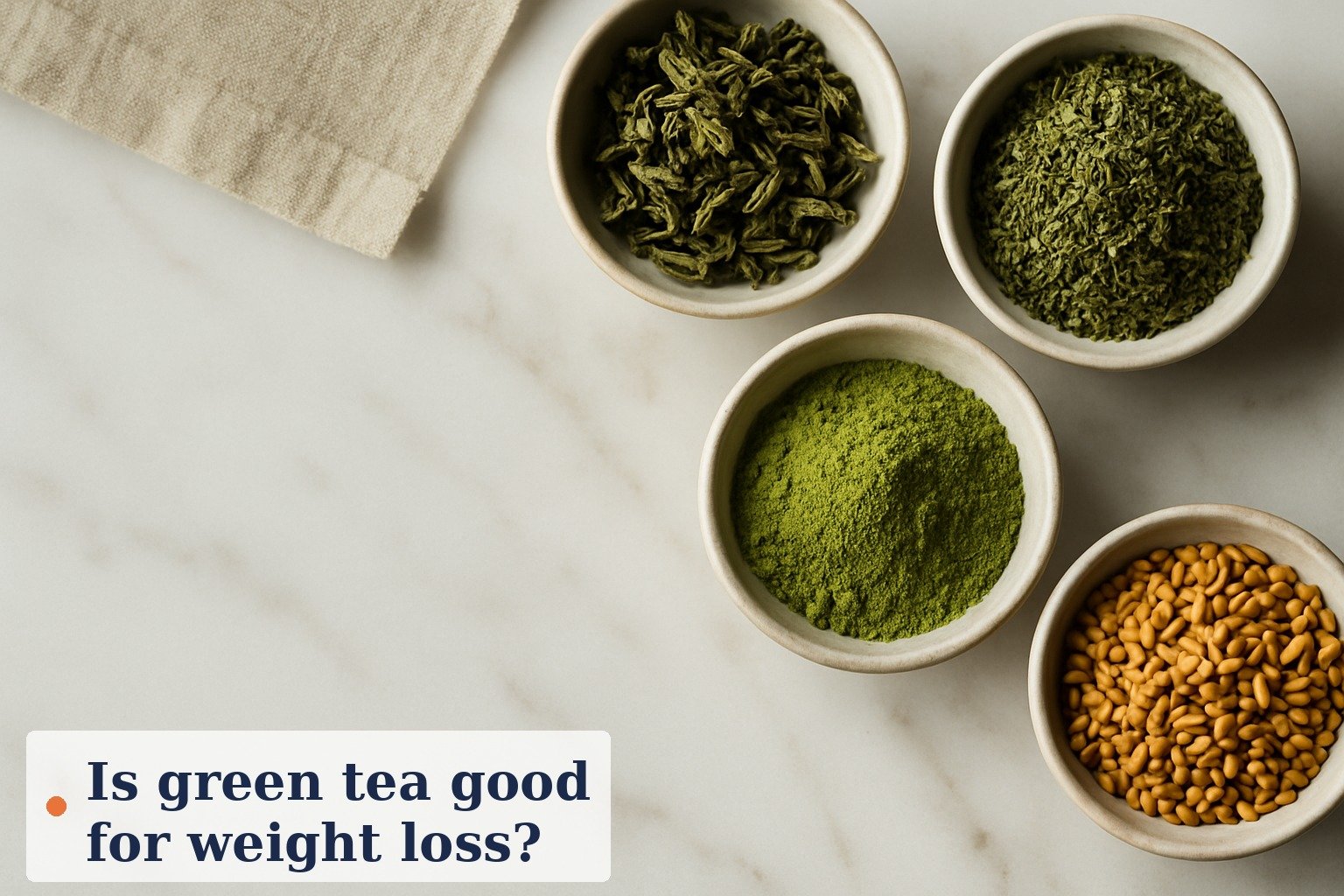
Green tea is modestly good for weight loss when unsweetened. It pairs caffeine with catechins — plant antioxidants, chiefly EGCG — that together produce a small rise in energy expenditure and fat oxidation. A 2009 meta-analysis credited green tea catechins with about 1.3 kg of weight loss over roughly 12 weeks, a real but minor effect[4].
Green tea is the most studied “functional” drink for weight, so it deserves a careful read. The active compounds are catechins (a family of polyphenol antioxidants, of which EGCG is the most studied) working alongside the tea’s natural caffeine. In a tightly controlled metabolic-chamber study, a green tea extract delivering EGCG plus caffeine raised 24-hour energy expenditure by about 4% versus caffeine alone, suggesting the catechins add something beyond the stimulant[5]. Across longer trials, a 2009 meta-analysis found green tea catechins produced a small but statistically significant reduction in body weight and helped with weight maintenance — on the order of 1.3 kg[4].
Keep that number in proportion. A kilogram or so over three months is a nudge, not a transformation, and the effect appears stronger in people who do not already consume a lot of caffeine. Brewed green tea also delivers far less EGCG than the concentrated extracts used in some trials, so a few cups a day is gentler — and safer — than high-dose supplements. (Very high-dose green tea extract supplements have, rarely, been linked to liver injury, which is a supplement issue, not a brewed-tea one.) For the ingredient-level detail, see our green tea explainer.
The verdict on green tea: a genuinely reasonable everyday drink. Unsweetened, it is calorie-free, mildly thermogenic, and a pleasant replacement for sweeter beverages. The mistake is expecting the tea to drive the result — drink it because you enjoy a low-calorie drink with a small metabolic bonus, not because it will melt fat.
Does black coffee help you lose weight?
Black coffee can modestly help weight loss, mainly through caffeine, which raises resting energy expenditure by roughly 3–11% and can briefly blunt appetite[6]. Plain coffee has almost no calories. The catch is what people add: a sweetened, creamy coffee drink can carry 250–500 calories, flipping it from helper to saboteur.
Caffeine is the most reliably effective legal compound for a small metabolic lift. Controlled studies show caffeine increases metabolic rate in a dose-dependent way — older work found a measurable rise in energy expenditure after caffeine, and reviews put the thermogenic effect in the range of a few to about 11% over several hours[6]. Caffeine can also slightly reduce perceived appetite and improve exercise performance and perceived effort, which indirectly supports a calorie deficit. For the broader picture on caffeine-based products, our review of whether Java Burn actually works walks through how these effects translate (and don’t) into a commercial coffee additive.
The realistic effect of coffee on its own is small and tends to shrink as habitual drinkers build tolerance. And the entire benefit is erased — and reversed — the moment coffee becomes a dessert. A large flavored latte or blended frappe can run 250 to 500 calories once syrup, whole milk and whipped cream are in; that is more than a soda, dressed up as a coffee. The rule is blunt: black coffee, or coffee with a splash of milk, is a weight-loss-friendly drink. A sugary coffee shop drink is one of the worst drinks on this page.
Two safety notes. Caffeine is not for everyone — it can worsen anxiety, disrupt sleep (which itself harms weight regulation), and raise heart rate; people who are pregnant, sensitive to stimulants, or managing certain heart or blood-pressure conditions should be cautious and talk to a doctor. And caffeine’s benefits do not stack endlessly: more is not better past a moderate intake.
Are protein shakes a good weight-loss drink?
A protein shake can be a good weight-loss drink because protein is the most filling and metabolically “expensive” macronutrient: it has a higher thermic effect than carbs or fat and helps preserve muscle in a calorie deficit. A shake made with water and whey runs about 100–160 calories. The risk is adding it on top of meals rather than in place of one.
Protein earns its reputation. The body spends more energy digesting protein than carbohydrate or fat — its thermic effect is roughly 20–30% of the calories consumed, versus a few percent for fat — and higher-protein intakes are consistently linked to greater satiety and better preservation of lean mass during weight loss[7]. A shake is simply a convenient delivery vehicle: whey or another protein blended with water gives you 20–30 g of protein for 100–160 calories, far more filling per calorie than juice or soda.
The important distinction is replacement versus addition. A protein shake that stands in for a skipped breakfast or a vending-machine snack supports a deficit. The same shake drunk on top of three full meals just adds calories. Watch the formulation, too — many bottled “protein” drinks and smoothie-bar shakes pile on sugar, juice and full-fat dairy, pushing a “healthy” shake past 400 calories. As with everything on this page, the label decides whether it helps. For where protein sits among evidence-backed strategies, see our roundup of the weight-loss ingredients with the strongest evidence.
What are the worst drinks for weight loss?
The worst drinks for weight loss are sugar-sweetened beverages — regular soda, fruit juice, sweetened coffee drinks, energy drinks and sports drinks — together with alcohol. They deliver fast-absorbed liquid calories that the body does not register as food, so you add them on top of what you eat. Each daily serving of sugary drink is linked to measurable weight gain over time[8].
If the “best” list is short and boring, the “worst” list is where most people’s hidden calories actually live. A systematic review and meta-analysis of sugar-sweetened beverages found a consistent association between higher intake and greater weight gain and obesity risk in both children and adults[8], and large prospective studies tie each daily serving of sugary drink to long-term weight gain[3]. The World Health Organization recommends keeping free sugars below 10% — ideally 5% — of total energy, and a single can of soda can blow most of that budget on its own[9].
| Drink | Why it hurts weight loss | Calories (≈12 oz) | Sugar (≈12 oz) |
|---|---|---|---|
| Regular soda / cola | Pure liquid sugar; zero satiety | ~150 | ~39 g |
| 100% fruit juice | Concentrated sugar without the fruit’s fiber | ~165 | ~36 g |
| Sweetened coffee (frappe/latte) | Sugar plus cream; dessert in a cup | 250–500 | 30–60 g |
| Energy drinks | Sugar load with caffeine marketing | 160–280 | 27–54 g |
| Sports drinks | Sugar designed for endurance athletes, not desk workers | 80–200 | 21–34 g |
| Sweet tea / lemonade | Liquid sugar with a healthy halo | 120–150 | 30–35 g |
| Alcohol (beer / cocktails) | 7 kcal/g; halts fat burning; loosens eating restraint | 150–300+ | Varies |
The common thread is the same mechanism from the top of this guide: these calories arrive as liquid, hit the bloodstream fast, and fail to switch off hunger. A 150-calorie soda does not make you eat 150 fewer calories later — it adds the lot. Drink one a day for a year and, all else equal, that is enough surplus to drive meaningful weight gain. The next three sections take the worst offenders one at a time.
Why is soda so bad for weight loss?
Soda is so bad for weight loss because it is the purest form of liquid sugar: a 12-ounce can carries about 150 calories and 39 grams of sugar with zero fiber, protein or satiety. The body does not compensate for these calories by eating less, so they stack directly on top of your day’s intake — the most-studied driver of beverage-related weight gain[8].
Regular soda is the textbook example of the liquid-calorie problem. There is nothing in it to slow absorption or signal fullness — no fiber, no protein, no fat — just rapidly absorbed sugars. Because of that, the calories behave almost as if invisible to appetite regulation. The compensation studies are blunt on this point: calories from sugary drinks are added, not offset[2], which is exactly why each daily serving tracks with long-term weight gain across large cohorts[3][8].
There is a metabolic-health layer on top of the calories. Sugar-sweetened beverages are independently associated with higher risk of type 2 diabetes, even after accounting for weight — one large analysis estimated meaningfully higher diabetes incidence per daily serving[10]. That is not a disease claim about any product; it is the epidemiology of sugary drinks as a category. For weight specifically, the takeaway is direct: cutting soda is one of the highest-yield single changes most people can make, precisely because it removes calories that were never doing anything for you. If you want the fizz, plain sparkling water or a splash of soda water with citrus delivers the sensation at zero cost.
Are fruit juice and smoothies any better?
Fruit juice is barely better than soda for weight loss: 100% juice carries about 36 grams of sugar per 12 ounces, nearly matching cola, but loses the whole fruit’s fiber. Smoothies vary wildly — a vegetable-and-protein blend can be sensible, while a juice-and-syrup shop smoothie can hit 300–600 calories that pass quickly and barely register as a meal.
The “health halo” on fruit juice is the trap. Because it comes from fruit, juice feels virtuous — but stripping the fruit of its fiber and blending or pressing it concentrates the sugar into a fast-absorbed liquid. A direct comparison of fruit in different forms found that whole apples were far more satiating than applesauce, which in turn beat apple juice; the juice produced the least fullness and the most leftover appetite[11]. Per 12 ounces, orange or apple juice lands around 165 calories and 36 grams of sugar — within a rounding error of soda. For weight loss, “natural” sugar in liquid form behaves much like any other.
Smoothies are genuinely case-by-case, and the difference is the recipe, not the word. A smoothie built on a scoop of protein, a handful of leafy greens or frozen vegetables, and a modest amount of whole fruit can be a reasonable meal replacement with real fiber and protein. But a typical smoothie-bar creation — fruit juice base, sorbet or frozen yogurt, honey or syrup, sometimes 24 ounces of it — can carry 300 to 600 calories that you drink in two minutes and that trigger little fullness. The honest rule: treat any large smoothie as a meal, read its calories, and be suspicious of anything where juice or syrup is the base. Eating the whole fruit is almost always the better call.
Does alcohol cause weight gain?
Alcohol works against weight loss in three ways: it supplies 7 calories per gram with essentially no nutrition, the body prioritizes burning it and suppresses fat oxidation by as much as 73% for hours afterward[12], and it tends to loosen eating restraint. Alcohol does not specifically target belly fat, but its surplus calories make a deficit much harder to hold.
Alcohol is uniquely awkward for fat loss because of how the body treats it. Ethanol carries 7 calories per gram — closer to fat (9) than to sugar or protein (4) — and those calories come with no useful nutrients. More importantly, the body cannot store alcohol, so it pushes ethanol to the front of the metabolic queue and burns it first. In a controlled study, adding alcohol to a meal suppressed whole-body fat oxidation by around 73% in the hours that followed[12]. While your body is busy clearing the alcohol, the fat and sugar eaten alongside it are more likely to be stored.
Then there is the behavioral layer, which is often the bigger problem. Alcohol lowers inhibition and stimulates appetite, which is why drinks so reliably lead to late-night eating and looser food choices. Add the mixers — a cocktail’s syrup and soda, or several beers’ worth of carbohydrate — and the total can quietly dwarf the food. None of this means a single drink ruins a diet, and there is no evidence alcohol selectively builds a “beer belly” over fat elsewhere; the “belly” is simply where many people store surplus calories. But for anyone trying to lose weight, alcohol is calories with a metabolic penalty attached, and cutting back is one of the more effective single levers there is.
Are diet sodas and artificial sweeteners okay?
Diet sodas are a reasonable swap for sugary drinks on a weight-loss diet, because replacing sugar-sweetened beverages with zero-calorie versions or water cuts hundreds of liquid calories and modestly helps weight loss in trials. They are not health drinks, and water or unsweetened tea is a better long-term default — but as a transition tool, a diet soda clearly beats regular soda.
This is the most argued-over corner of the topic, so here is the balanced read. On the calorie math, diet sodas are straightforwardly better than sugary ones: swapping in non-caloric drinks removes the liquid sugar that drives weight gain, and randomized trials generally show modest weight loss when sugar-sweetened beverages are replaced by diet versions or water. The observational studies that link diet soda to obesity are mostly confounded by reverse causation — people already gaining weight or managing diabetes switch to diet drinks, not the other way around.
That said, “better than soda” is a low bar. Major health authorities, including the WHO, have advised against relying on non-sugar sweeteners as a long-term weight-control strategy, because the long-term benefit is uncertain and they keep the taste for sweetness alive[9]. The sensible position: if a diet soda helps you walk away from a 150-calorie sugary one, it is a useful tool — but the goal is to drift toward water, sparkling water and unsweetened tea or coffee as your defaults, with diet drinks as an occasional bridge rather than the foundation.
Do “detox teas,” slimming drinks and ACV actually work?
No — “detox” and “slimming” teas do not burn fat. Any quick scale drop comes from caffeine-driven water loss and from senna, a stimulant laxative that flushes fluid through the gut; the weight returns once you rehydrate. Apple cider vinegar has only thin, small-trial evidence for a fraction of a kilogram, and undiluted it can damage tooth enamel.
This is the category where the marketing is loudest and the evidence is thinnest. Most “detox” and “slimming” teas combine caffeine (a mild diuretic) with senna or other stimulant laxatives. The result is fluid loss — through urine and the bowel — that can move the scale for a day or two and do absolutely nothing to body fat. Worse, regular laxative use can cause dehydration, electrolyte disturbances and dependence. The U.S. Federal Trade Commission treats effortless, dramatic weight-loss claims as a hallmark of deceptive marketing and has taken action against “detox” tea sellers making them[13]. The word “detox” is a marketing term here; a healthy liver and kidneys already perform detoxification continuously, and no tea improves on that.
Apple cider vinegar (ACV) drinks deserve a fairer hearing, but only a slightly better verdict. A handful of small, short trials report that adding a tablespoon or two of vinegar to the diet produces a modest extra loss — typically under a kilogram — possibly via slowed gastric emptying and a small effect on post-meal blood sugar. The trials are small, short and not conclusive, so the honest grade is “weak, possibly real, certainly minor.” And there is a real downside: undiluted vinegar is acidic enough to erode tooth enamel and irritate the throat and stomach, so if you use it, dilute it well. Treat ACV as optional flavoring, not a weight-loss strategy.
Any drink sold on the promise of “flushing,” “detoxing” or “melting” fat is leaning on water loss, laxatives or hope — not fat loss. The same skepticism we apply to supplements applies here: if the claim is effortless and dramatic, the evidence almost never backs it. Real drink wins are quiet: fewer liquid calories, more water.
How should you build a daily drink routine?
Build a daily drink routine around free, satisfying defaults and reserve calorie-containing drinks for when they earn their place. Make water your base, add unsweetened tea or black coffee for variety and a small metabolic bonus, use a protein shake to replace a meal when convenient, and treat soda, juice, sweetened coffee and alcohol as occasional, counted exceptions.
The point of this whole guide is not a list of magic drinks — there isn’t one — but a structure that quietly removes hundreds of liquid calories while keeping you satisfied. A realistic day looks like this:
Make these your defaults
- Water as the base, with about 500 ml before main meals[1]
- Black coffee in the morning or pre-workout; milk splash fine, skip the syrup
- Unsweetened green, black or oolong tea through the day
- Sparkling water with citrus when you want something with fizz
- A protein shake in place of a rushed meal, not on top of one
Count these as exceptions
The biggest single win for most people is auditing the drinks they consume on autopilot — the daily soda, the “healthy” juice, the afternoon flavored latte, the few evening drinks. Replacing even one or two of those with water or unsweetened tea can remove 200–500 calories a day with no change to what you eat. That is the unglamorous, evidence-backed reality: drinks are where calories hide, and water is where they go to disappear. Pair this with the fundamentals — a modest calorie deficit, adequate protein, sleep and movement — and the drinks side of the equation takes care of itself. None of it requires a special product, and no supplement substitutes for it, as we explain in our look at natural alternatives to Ozempic.
The verdict: subtract the sugar, default to water
The honest verdict is that drinks help with weight loss mainly through subtraction. The best drinks — water, unsweetened green tea, black coffee, sparkling water — are calorie-free with at most a small metabolic bonus. The worst — soda, fruit juice, sweetened coffee, energy and sports drinks, and alcohol — add liquid calories your body does not register. No drink burns fat; the win is what you stop pouring.
Strip away the marketing and the picture is refreshingly simple. There is no fat-burning beverage, no detox tea worth buying, no juice cleanse that does what its label promises. What there is — and it is genuinely useful — is a large, easy lever most people leave untouched: the calories they drink without thinking. Move those toward water and unsweetened tea or coffee and you remove hundreds of calories a day while keeping the small, real bonuses of caffeine and catechins. That is the whole game.
Make water your default, lean on unsweetened tea and black coffee for variety and a minor metabolic edge, use a protein shake to replace a meal when it’s convenient, and treat soda, juice, sweetened coffee and alcohol as counted exceptions. Skip the “detox” teas entirely. The best drink for weight loss has been sitting in your tap the whole time.
A lot of weight-loss products are sold as drinks — tonics, juices and coffee add-ins. They are governed by exactly the same rules as everything above: liquid calories and dose matter more than the marketing. Here is our honest, sourced research on the most popular drink-format products, so you can judge them with clear eyes.
Nagano Tonic
A powdered “metabolic tonic” you mix into water. We break down the ingredients, the doses you can and can’t verify, and what the evidence actually supports.
Ikaria Lean Belly Juice
A juice-style powder marketed for belly fat. Our review covers the formula, the realistic effect size and who should skip it — without the hype.
Java Burn
A flavorless powder for your morning coffee, riding on caffeine’s real but modest metabolic effect. See where the evidence holds and where it doesn’t.
The strongest-evidence ingredients
Before any drink-format product, see which weight-loss ingredients actually have human data behind them — and which are filler.
Frequently asked questions
What is the single best drink for weight loss?
Plain water is the single best drink for weight loss. It has zero calories, can blunt appetite when you drink about 500 ml before a meal, and replaces the liquid sugar that drives weight gain.
In one controlled trial, pre-meal water added roughly 2 kg of extra weight loss over 12 weeks compared with dieting alone — a small, real assist on top of a sensible diet.
Does drinking water actually help you lose weight?
Yes, modestly. Drinking about 500 ml of water before meals can reduce how much you eat at that meal, and a 2010 trial found dieters who did this lost about 2 kg more over 12 weeks than dieters who did not.
Most of water’s benefit, though, comes from replacing high-calorie drinks rather than from the water itself.
Is green tea or coffee better for fat loss?
Both help only modestly and through similar mechanisms. Black coffee delivers more caffeine, which raises energy expenditure by roughly 3 to 11 percent and can blunt appetite. Green tea adds catechins that may slightly extend fat oxidation.
Meta-analyses credit green tea with about 1.3 kg of weight loss over 12 weeks. Either works only unsweetened.
Are diet sodas okay on a weight-loss diet?
Diet sodas are a reasonable swap for sugary drinks because they cut hundreds of liquid calories, and trials show replacing sugar-sweetened beverages with diet versions or water modestly aids weight loss.
They are not health drinks, and water or unsweetened tea is a better long-term default, but as a transition tool a diet soda beats regular soda.
Is fruit juice as bad as soda for weight loss?
Nutritionally, 100% fruit juice carries almost as much sugar as soda — about 36 grams per 12 ounces versus 39 in cola — and delivers it without the fiber of whole fruit.
Because liquid sugar triggers little satiety, juice adds calories you do not compensate for, so for weight loss it belongs with the drinks to limit, despite its health halo.
Does alcohol stop you from losing belly fat?
Alcohol works against fat loss in three ways: it supplies 7 calories per gram with no nutrition, your body burns it first and suppresses fat oxidation by as much as 73 percent for hours afterward, and it tends to loosen eating restraint.
It does not uniquely target belly fat, but the surplus calories make a deficit far harder to hold.
Do detox teas and slimming teas work?
No. Most detox and slimming teas owe any short-term scale change to caffeine-driven water loss and to senna, a stimulant laxative that causes fluid loss through the gut, not fat loss. The weight returns once you rehydrate.
The FTC has acted against brands making effortless weight-loss claims, which it flags as a hallmark of deceptive marketing.
Does apple cider vinegar help you lose weight?
The evidence is thin. A few small, short trials report a fraction of a kilogram of extra loss when a tablespoon or two of vinegar is added to a diet, but the studies are small and not conclusive.
Any effect is minor, undiluted vinegar can erode tooth enamel and irritate the throat, so treat it as optional, not a strategy.
Are protein shakes good for weight loss?
They can be useful. A protein shake is more filling per calorie than most drinks, helps preserve muscle in a calorie deficit, and protein has a higher thermic effect than carbs or fat. A shake made with water and whey runs about 100 to 160 calories.
The risk is treating it as an extra rather than replacing a meal or snack.
How much water should I drink to lose weight?
There is no magic number, but a practical target is to drink water consistently through the day and about 500 ml roughly 30 minutes before main meals, which is the routine tested in weight-loss trials.
Thirst and pale-yellow urine are good guides. Drinking far beyond thirst does not accelerate fat loss and can be uncomfortable.
What should I drink before a workout?
For most workouts, water is enough. If you train hard or early, black coffee about 30 to 60 minutes beforehand can improve performance and perceived effort thanks to caffeine, at no calorie cost.
Sports drinks are only worth their sugar for prolonged, intense exercise lasting beyond about an hour; for a typical gym session they are unnecessary calories.
Are smoothies good or bad for weight loss?
It depends entirely on what is in them. A smoothie built on protein, vegetables and a little whole fruit can replace a meal sensibly.
But many shop-bought smoothies pack 300 to 600 calories from fruit juice, syrups and yogurt, blended smooth so they pass quickly and trigger little fullness. Read the calories, and treat a large smoothie as a meal, not a drink.
How to lose belly fat: what actually works
The strongest-evidence weight-loss ingredients
Berberine for weight loss
Green tea, explained
Natural alternatives to Ozempic
Best weight-loss supplements of 2026
All health articles
We research weight-loss supplements and the ingredients inside them, scoring products on label transparency rather than hype. No star spam, no fabricated reviews — just the evidence, stated plainly. Our editorial standards →
- Dennis EA, et al. Water consumption increases weight loss during a hypocaloric diet intervention in middle-aged and older adults. Obesity, 2010. pubmed.ncbi.nlm.nih.gov
- DiMeglio DP, Mattes RD. Liquid versus solid carbohydrate: effects on food intake and body weight. International Journal of Obesity, 2000. pubmed.ncbi.nlm.nih.gov
- Pan A, et al. Changes in water and beverage intake and long-term weight changes: results from three prospective cohort studies. International Journal of Obesity, 2013. pubmed.ncbi.nlm.nih.gov
- Hursel R, et al. The effects of green tea on weight loss and weight maintenance: a meta-analysis. International Journal of Obesity, 2009. pubmed.ncbi.nlm.nih.gov
- Dulloo AG, et al. Efficacy of a green tea extract rich in catechin polyphenols and caffeine in increasing 24-h energy expenditure and fat oxidation in humans. American Journal of Clinical Nutrition, 1999. pubmed.ncbi.nlm.nih.gov
- Acheson KJ, et al. Caffeine and coffee: their influence on metabolic rate and substrate utilization in lean and obese subjects. American Journal of Clinical Nutrition, 1980. pubmed.ncbi.nlm.nih.gov
- Halton TL, Hu FB. The effects of high protein diets on thermogenesis, satiety and weight loss: a critical review. Journal of the American College of Nutrition, 2004. pubmed.ncbi.nlm.nih.gov
- Malik VS, et al. Sugar-sweetened beverages and weight gain in children and adults: a systematic review and meta-analysis. American Journal of Clinical Nutrition, 2013. pubmed.ncbi.nlm.nih.gov
- World Health Organization — Guideline: Sugars intake for adults and children (free sugars <10% of energy). who.int
- Imamura F, et al. Consumption of sugar-sweetened beverages, artificially sweetened beverages, and fruit juice and incidence of type 2 diabetes: systematic review and meta-analysis. BMJ, 2015. pubmed.ncbi.nlm.nih.gov
- Flood-Obbagy JE, Rolls BJ. The effect of fruit in different forms on energy intake and satiety at a meal. Appetite, 2009. pubmed.ncbi.nlm.nih.gov
- Suter PM, et al. The effect of ethanol on fat storage in healthy subjects. New England Journal of Medicine, 1992. pubmed.ncbi.nlm.nih.gov
- U.S. FTC — “Gut Check”: red-flag weight-loss claims; enforcement against deceptive “detox” tea marketing. ftc.gov
- Jun 25, 2026 — Guide published; best- and worst-drink rankings checked against current NIH, WHO, FDA, FTC and peer-reviewed sources.
Affiliate disclosure: SourceLean is reader-supported. When you buy through links on this site, we may earn a commission at no extra cost to you. Checkout is always handled on the official product website.