Protein won’t melt fat off your midsection — but the right daily amount is one of the most reliable nutrition levers for losing fat while keeping muscle. Here’s exactly how much, and why.
For fat loss, aim for roughly 1.2–1.6 g of protein per kg of body weight per day — and up toward 1.6–2.2 g/kg if you’re lifting weights and want to protect muscle in a calorie deficit[1][5]. For a 70 kg (154 lb) adult that’s about 85–155 g/day. Protein does not target belly fat directly; it helps by curbing appetite, raising the thermic effect of eating, and preserving the muscle that keeps your metabolism up while you lose overall fat[4].
“How much protein to lose belly fat” is one of the most searched weight-loss questions, and most answers are either a vague “eat more protein” or a wildly specific number with no source behind it. This guide does the opposite: it gives you a defensible daily target in grams, tied to the actual research, and is honest about what protein can and cannot do. The short version is that protein is genuinely one of the highest-leverage diet changes for fat loss — but the “belly fat” part is misleading, because no nutrient burns fat from a specific body region. What protein does is make a calorie deficit easier to sustain and protect the muscle underneath, so more of the fat you lose comes off for good.
Every number below is tied to a primary source — peer-reviewed trials and meta-analyses on protein and weight loss, the U.S. Institute of Medicine’s Dietary Reference Intakes, the USDA Dietary Guidelines, and NIH resources — not to supplement marketing. SourceLean takes no money for opinions; we earn only through transparent affiliate links, disclosed above, and we apply the same evidence-first standard to food advice as to products. This is educational information, not medical advice.
- How much protein to lose belly fat?
- Does protein actually target belly fat?
- Why does protein help you lose fat?
- Is the RDA of 0.8 g/kg enough?
- How do you calculate your protein target?
- How should you spread protein across the day?
- What are the best protein sources?
- Does protein preserve muscle in a deficit?
- Do protein shakes and supplements help?
- Can you eat too much protein?
- What are the honest limitations?
- How does protein compare with other tactics?
- How do you put a high-protein plan into practice?
- The verdict
- FAQ
How much protein to lose belly fat?
To lose belly fat, most evidence supports eating about 1.2–1.6 g of protein per kg of body weight per day while in a modest calorie deficit, rising to roughly 1.6–2.2 g/kg if you also do resistance training and want to preserve muscle[1][5]. For a 70 kg (154 lb) adult, that is about 85–155 g a day.
Let’s anchor the number before anything else, because it is what you came for. The recommended dietary allowance (RDA) for protein — the amount set to prevent deficiency in a healthy, weight-stable adult — is just 0.8 g/kg/day[7]. That is a floor, not a fat-loss target. When you eat in a calorie deficit, the research consistently shows you need more protein than that, not less, to hold onto muscle and to stay full. A 2015 review in the American Journal of Clinical Nutrition on protein in weight management concluded that intakes in the range of about 1.2–1.6 g/kg/day improve appetite control, body composition, and weight maintenance compared with lower intakes[1].
If you lift weights — which you should, because it is the single best way to make the fat you lose come from fat rather than muscle — the target climbs. A large 2018 meta-analysis of resistance-training studies found protein benefits for muscle plateau at around 1.6 g/kg/day on average in healthy adults, with some individuals benefiting up to roughly 2.2 g/kg[5]. In a calorie deficit specifically, controlled trials have pushed higher still — Pasiakos and colleagues found that 1.6–2.4 g/kg better preserved fat-free mass during energy restriction than lower intakes[2]. The practical takeaway: pick a number inside 1.2–2.2 g/kg based on how active you are, and treat the lower end as “adequate” and the upper end as “optimised for a lean-muscle outcome.”
Sedentary and just want easier appetite control: ~1.2 g/kg. Dieting and exercising: ~1.6 g/kg. Dieting hard, lifting, and protecting muscle: ~1.8–2.2 g/kg. In pounds, a useful shortcut many coaches use is roughly 0.7–1 g of protein per pound of target body weight, which lands in the same place without overestimating for people with a lot of weight to lose.
Does protein actually target belly fat?
No — protein does not target belly fat, and no food can. Spot reduction is a myth: you cannot choose where fat comes off. Protein helps indirectly, by improving overall fat loss through appetite, thermogenesis, and muscle retention. As total body fat falls, abdominal and visceral fat fall with it, which is why a higher-protein diet is associated with a smaller waist[6].
This is the honest correction at the heart of the topic. The phrase “protein to lose belly fat” implies a targeted effect that does not exist physiologically. Body fat is mobilised from all over the body in proportions set largely by genetics, sex, and hormones — not by which muscle you work or which nutrient you eat. When studies report that higher-protein dieters lose more abdominal fat, the mechanism is almost always that they lost more total fat, and the belly simply contributed its share. The waistline often shows change conspicuously because visceral fat — the metabolically active fat packed around the organs — tends to be among the more responsive to an overall calorie deficit.
There is a kernel of legitimate good news inside this. Visceral belly fat is the type most strongly linked to metabolic risk, and it does respond to weight loss driven by diet quality and activity. A diet that is higher in protein and lower in refined carbohydrate tends to produce a body-composition shift — more muscle retained, more fat lost — and observational data associate higher protein quality with lower waist circumference and less abdominal fat over time[6]. But the cause is the overall pattern, not a special belly-burning property of protein. Anyone selling you a protein product as a targeted belly-fat solution is overstating the science. For the bigger picture on what genuinely shrinks a waistline, our guide to how to lose belly fat: what actually works walks through the evidence end to end.
Why does protein help you lose fat?
Protein helps fat loss through three well-established mechanisms: it is the most filling macronutrient, so you eat less overall; it has the highest thermic effect, burning roughly 20–30% of its own calories during digestion; and it preserves calorie-hungry muscle during a deficit, keeping your metabolic rate higher than it would otherwise fall[4].
Understanding the “why” matters, because it tells you protein is a tool that makes a calorie deficit easier and cleaner — not a substitute for one. Here are the three mechanisms in plain terms.
1. Satiety — protein keeps you fuller for longer
Satiety is the feeling of fullness that suppresses the urge to eat again. Gram for gram and calorie for calorie, protein is the most satiating macronutrient. It blunts the hunger hormone ghrelin and stimulates fullness signals such as GLP-1, peptide YY (PYY), and cholecystokinin (CCK)[4]. In practice this means a breakfast of eggs and Greek yogurt leaves most people genuinely less hungry by mid-morning than a bagel of equal calories, so they eat less across the day without consciously “dieting.” Several appetite-controlled trials show people eat fewer total calories when the protein share of their diet rises[1]. This is probably protein’s single biggest real-world advantage for fat loss.
2. The thermic effect of food — protein costs more to digest
The thermic effect of food (TEF) is the energy your body spends digesting and processing a meal. Protein has by far the highest TEF: about 20–30% of protein’s calories are burned during digestion, versus roughly 5–10% for carbohydrate and 0–3% for fat[8]. So if you eat 100 calories of protein, your body nets closer to 70–80 of them. Across a day this is a small but real bump in energy expenditure — modest on its own, but it stacks on top of the satiety and muscle effects rather than competing with them.
3. Muscle preservation — protecting your metabolic engine
When you lose weight, some of the loss normally comes from lean tissue, including muscle. That is a problem because muscle is metabolically active — it helps set your resting energy expenditure — so losing it makes weight regain easier and leaves you “skinny-fat” rather than lean. Higher protein intake, especially paired with resistance training, sharply reduces muscle loss during a deficit, so a larger fraction of what you lose is fat[2]. This is the mechanism most directly responsible for a tighter, leaner-looking waist, and it is covered in detail below.
Is the RDA of 0.8 g/kg enough?
No — the RDA of 0.8 g/kg is not enough for fat loss. It is the minimum to prevent deficiency in a healthy, weight-stable adult, set with a safety margin but not optimised for body composition[7]. When you are dieting, higher intakes of roughly 1.2–2.0 g/kg consistently outperform the RDA for appetite control and muscle retention[1].
This is one of the most common and costly misunderstandings in weight-loss nutrition. The RDA is a public-health floor: the amount that meets the needs of about 97% of healthy people to avoid a deficiency state. It was never designed to answer the question “how much protein optimises fat loss and muscle retention while I am eating fewer calories?” The answer to that question is consistently higher. A calorie deficit increases protein turnover and the risk of breaking down muscle for fuel, so your protein needs go up at exactly the moment many dieters cut their food — and often their protein — down.
It is also worth noting that protein needs are best expressed relative to body weight, not as a flat number of grams, and that for people with significant excess weight, calculating against target or reference body weight (rather than current weight) avoids inflating the number unnecessarily. Older adults are a special case: aging muscle is less responsive to protein, a phenomenon called anabolic resistance, so people over roughly 60 generally do better at the higher end of the range to achieve the same muscle-protective effect[10]. In short, treat 0.8 g/kg as the number that keeps you out of deficiency, and 1.2 g/kg and up as the number that helps you lose fat well.
How do you calculate your protein target?
To calculate your protein target, multiply your body weight in kilograms by a figure between 1.2 and 2.2 depending on activity. Convert pounds to kilograms by dividing by 2.2. For a quick imperial shortcut, aim for about 0.7–1 gram of protein per pound of your goal body weight, which lands in the same evidence-based range without overestimating.
Here is how the math plays out at a few common body weights, using the practical mid-range for an active dieter (1.6 g/kg) and the muscle-protective high end (2.0 g/kg). Round to whatever is easy to track — precision to the gram is unnecessary.
| Body weight | Adequate (1.2 g/kg) | Active / dieting (1.6 g/kg) | Muscle-protective (2.0 g/kg) |
|---|---|---|---|
| 55 kg / 121 lb | ~66 g | ~88 g | ~110 g |
| 70 kg / 154 lb | ~84 g | ~112 g | ~140 g |
| 85 kg / 187 lb | ~102 g | ~136 g | ~170 g |
| 100 kg / 220 lb | ~120 g | ~160 g | ~200 g |
A note for people carrying a lot of excess weight: scaling 2.0 g/kg off current weight can produce an unrealistically high and unnecessary number. In that situation, basing the calculation on a reasonable goal weight or on lean body mass keeps the target sensible. For most readers, though, picking 1.6 g/kg of current body weight and rounding to a clean number — say, 110, 130, or 150 g — is perfectly accurate enough. The body does not measure to the decimal.
How should you spread protein across the day?
Spread protein across three or four meals of roughly 0.4 g/kg each — about 25–40 g for most adults — rather than loading it into one meal. Each meal should reach roughly 2.5–3 g of leucine, the amino acid that switches on muscle protein synthesis, which a palm-sized portion of meat, fish, eggs, dairy, or a scoop of whey delivers[9].
Total daily protein is the dominant factor, but distribution is a useful second-order lever, particularly for protecting muscle. Muscle protein synthesis — the process of building and repairing muscle — is stimulated meal by meal and appears to respond best to a per-meal dose of around 0.4 g/kg, above which the extra is used less efficiently for muscle building in a single sitting[9]. Practically, this means three or four protein-containing meals beat one giant steak dinner if your goal is to hold onto muscle while dieting. There is no need to obsess: hitting your daily total is roughly 80% of the benefit, and even distribution is the remaining polish.
The leucine threshold is the related idea worth knowing. Leucine is the branched-chain amino acid that acts as the main trigger for muscle protein synthesis, and a meal generally needs about 2.5–3 g of it to maximally flip that switch. Animal proteins (meat, dairy, eggs, fish) and soy are leucine-rich, so a normal palm-sized portion clears the threshold easily. Plant proteins tend to be lower in leucine, which is one reason plant-based dieters benefit from slightly larger portions and more variety across the day. Timing around workouts matters far less than people think — total intake and per-meal distribution dwarf the effect of the so-called post-workout window.
What are the best protein sources?
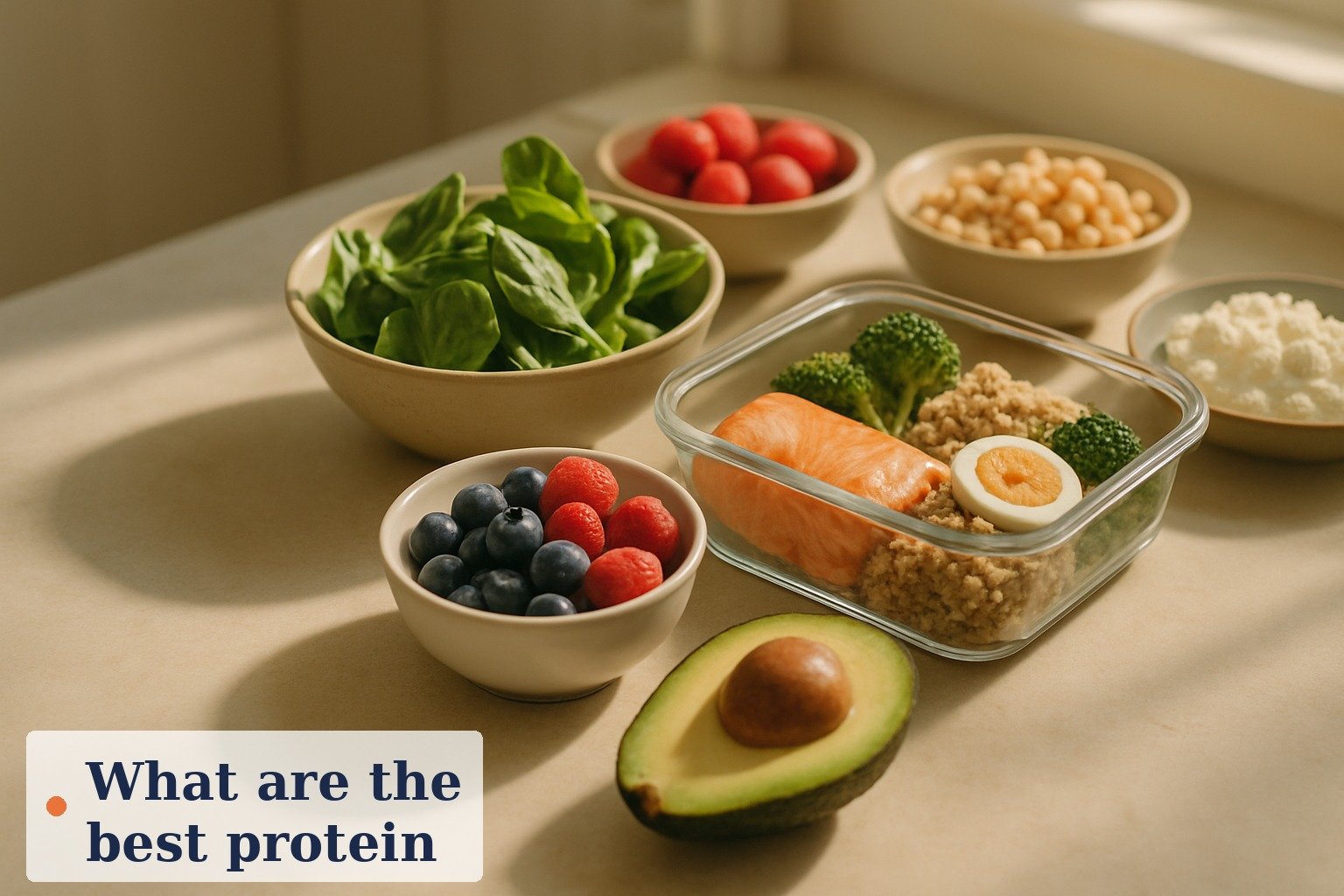
The best protein sources for fat loss are high in protein per calorie and rich in essential amino acids: chicken breast, white fish, lean beef, eggs, Greek yogurt, low-fat cottage cheese, tofu, tempeh, lentils, beans, and whey or soy protein powder. Lean animal proteins and soy are complete proteins; most other plant sources benefit from variety to cover all essential amino acids[11].
Two qualities make a protein source good for fat loss: protein density (grams of protein per calorie, so you get the satiety and amino acids without a calorie cost) and protein quality (the spread of essential amino acids, especially leucine). A complete protein contains all nine essential amino acids in useful amounts — true of animal foods and soy. Most single plant sources are “incomplete,” but eating a variety across the day (legumes plus grains, for instance) covers the full set easily. Here is how common sources compare on an approximate per-portion basis.
| Source | Approx. protein per portion | Protein density | Quality for fat loss |
|---|---|---|---|
| Chicken breast (100 g cooked) | ~31 g | Very high | Excellent |
| White fish, e.g. cod (100 g) | ~20–23 g | Very high | Excellent |
| Lean beef (100 g cooked) | ~26 g | High | Excellent |
| Eggs (2 large) | ~12 g | Moderate | Excellent |
| Greek yogurt, 0% (170 g) | ~17 g | Very high | Excellent |
| Low-fat cottage cheese (100 g) | ~11–12 g | High | Excellent |
| Tofu, firm (100 g) | ~12–17 g | High | Complete (soy) |
| Lentils, cooked (1 cup) | ~18 g | Moderate (plus fiber) | Good — pair for completeness |
| Whey protein (1 scoop) | ~24 g | Very high | Excellent |
| Soy protein isolate (1 scoop) | ~25 g | Very high | Complete (plant) |
A few practical notes. Lean animal proteins and low-fat dairy give you the most protein for the fewest calories, which is why they dominate fat-loss menus — but the goal is sustainability, so include foods you actually enjoy. Legumes bring fiber and resistant starch alongside protein, which is a genuine plus for fullness and gut health even though their protein quality is slightly lower per gram. And processed meats (bacon, sausage, deli meats) can deliver protein but come with extra sodium, saturated fat, and, with regular high intake, established health concerns — so lean toward minimally processed sources most of the time[11]. For a deeper look at what to build meals around, see our guide to the best foods for belly fat.
Does protein preserve muscle in a deficit?
Yes — preserving muscle is protein’s most important job during weight loss. In a calorie deficit, higher protein (roughly 1.6–2.4 g/kg) combined with resistance training markedly reduces the muscle you lose, so a larger share of weight loss comes from fat[2]. This is what produces a leaner, firmer look rather than a smaller-but-soft “skinny-fat” result.
When you eat fewer calories than you burn, your body draws on stored energy — ideally fat, but without the right signals it will also break down muscle protein for fuel and for amino acids. Two signals tell the body to spare muscle: eating enough protein and using your muscles (resistance training). Remove either, and a chunk of your weight loss comes from lean tissue. In a frequently cited controlled trial, participants in a calorie deficit who ate roughly twice or three times the RDA of protein retained significantly more fat-free mass and lost more fat than those eating the RDA[2]. A 2012 meta-analysis of energy-restricted diets similarly found higher-protein diets preserved more lean mass and produced greater fat loss than standard-protein diets[3].
This is precisely why “protein to lose belly fat” has real merit even though protein doesn’t target the belly. Holding onto muscle keeps your resting metabolic rate higher, makes the deficit easier to sustain, and shapes the visible outcome: the same number on the scale looks dramatically different on a body that kept its muscle versus one that lost it. Pairing your protein target with two to four resistance sessions a week is the highest-return combination in the entire fat-loss playbook — far more reliable than any supplement. We rank the evidence behind the popular options in our review of the weight-loss ingredients with the strongest evidence.
Do protein shakes and supplements help?
Protein powder is a convenient tool, not a fat-burner. Trials show protein supplementation helps preserve muscle and can support fat loss when it raises your total protein without adding surplus calories[5]. But a shake is simply food in powder form — whole-food protein works equally well, and a shake only helps if it brings you up to your daily target.
It is worth being clear about what protein powder is and is not. Whey (a fast-digesting dairy protein), casein (a slower dairy protein), and plant blends such as soy or pea are all just concentrated protein. They carry no magic fat-loss property beyond the protein itself. Their genuine value is logistical: they make it easy to hit a target of 120–160 g a day without cooking, they are protein-dense and low in calories, and they travel well. For people who struggle to eat enough protein from food — common when appetite drops on a diet, or for older adults and busy schedules — a shake can be the difference between hitting and missing the number that actually matters.
The key caveat is calorie accounting. A shake helps only if it replaces lower-quality calories or fills a protein gap, not if it is added on top of an already-adequate diet, in which case it just adds calories and can stall fat loss. Watch for “mass gainer” or dessert-style powders loaded with added sugar and oils; a plain isolate or concentrate is usually the better fat-loss choice. And be skeptical of any powder or pill marketed specifically as a belly-fat or “fat-burning protein” — that framing is marketing, not pharmacology. If you want to understand how the broader supplement category is sold and where the real evidence sits, our best weight-loss supplements of 2026 buyer’s guide and our explainer on natural alternatives to Ozempic both apply the same evidence-first lens.
Can you eat too much protein?
For healthy adults, high-protein diets up to around 2 g/kg or more have not been shown to harm kidney function in controlled studies[12]. The kidney caution applies to people who already have chronic kidney disease, who should follow medical advice. The practical downsides of very high intakes are mostly displacement of other nutrients and digestive discomfort, not organ damage.
The “protein wrecks your kidneys” warning is one of the most persistent myths in nutrition, and for healthy people it is not supported by the evidence. A one-year crossover study in resistance-trained adults eating well above 2 g/kg found no adverse effects on kidney or liver markers or blood lipids[12], and broader reviews reach the same conclusion for people with normal kidney function. The important exception is real and must be stated clearly: anyone with chronic kidney disease may need to restrict protein and should follow the guidance of their doctor or a renal dietitian. Protein needs also intersect with other conditions, so individual medical advice always overrides a general target.
The genuine, non-myth downsides of overdoing protein are practical. Eating very large amounts can crowd out fiber-rich vegetables, fruit, and whole grains, which matter for gut health, satiety, and overall diet quality. Extremely high intakes can cause bloating, constipation, or other digestive discomfort in some people. And protein still has calories — about 4 per gram — so it is not “free”; eating far more than you need provides no extra fat-loss benefit and adds calories. For nearly everyone, the sweet spot of 1.2–2.0 g/kg captures essentially all the upside with none of these issues, especially when the rest of the plate is built around vegetables and whole carbohydrates.
Who should be cautious with high protein
- People with chronic kidney disease or reduced kidney function — follow medical advice on protein limits
- Anyone with a liver condition or a metabolic disorder affecting protein handling
- People advised to restrict protein for a specific medical reason
- Those prone to certain kidney stones, who should discuss intake with a clinician
Who benefits most from hitting the target
- Anyone in a calorie deficit trying to lose fat while keeping muscle
- People doing resistance training alongside dieting
- Older adults, due to age-related anabolic resistance[10]
- Anyone who struggles with appetite control and between-meal hunger
What are the honest limitations?
The honest limitation is that protein is a multiplier, not a mechanism for fat loss on its own. Without an overall calorie deficit, eating more protein will not reduce belly fat; it can even add calories. Protein improves the quality and ease of fat loss — but energy balance, sleep, activity, and consistency still do the heavy lifting[1].
It is important to set expectations, because the internet routinely oversells protein. Here is what the evidence does not show. It does not show that protein burns belly fat directly, or that you can out-protein a calorie surplus — eat more than you burn, and you will not lose fat regardless of how the calories are split. It does not show dramatic effect sizes: the metabolic and satiety benefits are real but modest, measured in a smoother, more muscle-sparing fat loss rather than a faster scale drop. And it does not justify extreme intakes — past roughly 2 g/kg, there is little added benefit for most people and rising practical downsides.
There are also individual factors the average target glosses over. Activity level, age, sex, training status, how much fat you have to lose, and personal food preferences all shift the ideal number within the range. Adherence is the great equalizer: the “best” protein target is the one you will actually hit most days for months, which usually means a sustainable, food-first approach rather than a rigid gram-counting regimen you abandon in three weeks. Protein is a powerful lever precisely because it works with the fundamentals — a modest deficit, resistance training, adequate sleep, and steady habits — not instead of them. For the full picture of why a waistline can stay stubborn even when you are “eating well,” our broader guide on how to lose belly fat is the companion piece to this one.
How does protein compare with other tactics?
Compared with other belly-fat tactics, a higher-protein diet ranks among the most evidence-backed and sustainable — on par with resistance training and a modest calorie deficit, and well ahead of “fat-burner” supplements or detoxes. Its strength is that it makes the proven fundamentals easier to stick to, rather than competing with them.
It helps to see protein in context rather than as a standalone fix. The table below grades common approaches on the strength of evidence for fat loss and on how sustainable they tend to be in real life.
| Tactic | Evidence for fat loss | Sustainability | Best role |
|---|---|---|---|
| Higher protein (1.2–2.0 g/kg) | Strong | High | Appetite control + muscle retention |
| Modest calorie deficit | Strong | High | The actual driver of fat loss |
| Resistance training | Strong | High | Protects muscle, shapes the result |
| More daily movement / steps | Strong | High | Raises total energy burn |
| Cutting added sugar & refined carbs | Moderate | Moderate–High | Improves diet quality & satiety |
| “Fat-burner” supplements | Weak | Low–Moderate | Marginal at best; not a foundation |
| Detoxes & cleanses | None | Low | Skip — no evidence for fat loss |
The pattern is clear: the tactics that work are unglamorous and they reinforce each other. Protein earns its high ranking not because it is exotic but because it quietly makes the deficit, the training, and the daily habits easier to maintain. Supplements sit far lower because, with a handful of modestly evidenced exceptions like caffeine and green tea catechins, they offer little on top of the fundamentals — a conclusion we reach repeatedly across our product reviews, from Java Burn to Mitolyn. If your real interest is the metabolic ingredients with genuine data, our berberine for weight loss guide is the most evidence-rich example.
How do you put a high-protein plan into practice?
To put it into practice, set one daily protein number, anchor every meal with a clear protein source, and pair it with a modest calorie deficit and resistance training. Aim for a palm-sized protein portion at each of three or four meals, which naturally lands most people in the 1.2–1.6 g/kg range without weighing food.
You do not need an app or a kitchen scale to make this work, though either helps if you like data. The simplest, most durable system is structural rather than numerical:
- Anchor every meal with protein first. Decide the protein source before anything else — eggs and yogurt at breakfast, chicken or fish or tofu at lunch and dinner — then build vegetables and carbohydrates around it.
- Use the palm rule. A palm-sized portion of a dense protein is roughly 25–40 g for most adults. Three to four such portions a day lands you in range. Add a serving of dairy or a shake to top up if you fall short.
- Front-load it. A protein-rich breakfast (25–40 g) blunts appetite for hours and tends to reduce later snacking — a high-leverage move for anyone whose calories creep up in the evening.
- Keep convenient backups. Greek yogurt, cottage cheese, tinned fish, edamame, jerky, and a tub of protein powder make hitting your number on a busy day realistic rather than aspirational.
- Pair with lifting and steps. Two to four resistance sessions a week plus a daily step target turns “weight loss” into “fat loss with muscle intact” — the outcome that actually changes how your midsection looks.
Then give it time. Appetite changes show up within days, but a visibly leaner waist tracks with overall fat loss, which at a sustainable pace means about 0.25–0.5 kg (roughly 0.5–1 lb) per week. Over two to three months, that combination — a sensible deficit, enough protein, and resistance training — is what consistently shrinks belly fat. There is no faster honest route, and protein’s real job is to make that route easier to walk.
The verdict: a multiplier, not a miracle
The verdict is that protein is one of the most reliable nutrition levers for fat loss — but it works by making a calorie deficit easier and protecting muscle, not by targeting the belly. Aim for about 1.2–1.6 g/kg/day, or up to ~2.2 g/kg if you lift and want to protect muscle, and pair it with the fundamentals.
If you take one thing from this guide, make it this: the question “how much protein to lose belly fat” has a solid, evidence-based answer — roughly 1.2–2.2 g/kg/day, scaled to your activity — but the “belly fat” framing oversells what protein does. Protein does not burn fat from a region. It curbs appetite, costs more calories to digest, and preserves the muscle that keeps your metabolism up, so that the fat loss you drive through an overall deficit comes off cleaner and shows up as a leaner waist. That is a genuinely valuable, well-supported role — just not a magical one.
Set a daily protein target in the 1.2–2.2 g/kg range, anchor every meal with a quality protein source, keep a modest calorie deficit, and lift weights. That combination — not any supplement or “belly-fat protein” — is what the evidence actually supports. Protein is the multiplier that makes the fundamentals work; it is not a substitute for them.
Protein is the food side of the equation. If you’re weighing whether any supplement is worth adding on top, start with our evidence-first guides — we grade products on data, not hype.
How to Lose Belly Fat: What Actually Works
The full evidence walkthrough — deficit, protein, training, sleep — that this protein guide fits inside. Start here if you want the complete picture.
Strongest-Evidence Weight-Loss Ingredients
Which supplement ingredients actually have human data behind them — and which are mostly marketing. The honest ranking.
Best Weight-Loss Supplements of 2026
If you’re considering a product alongside a high-protein diet, see how the popular options stack up on transparency and evidence.
Berberine for Weight Loss
The metabolic ingredient with the most credible data — what it does, the studied dose, and realistic effect size.
Frequently asked questions
How much protein should I eat to lose belly fat?
Most evidence points to about 1.2 to 1.6 grams of protein per kilogram of body weight per day while you are in a calorie deficit, rising toward 1.6 to 2.2 g/kg if you also lift weights and want to protect muscle. For a 70 kg (154 lb) adult that is roughly 85 to 155 grams a day.
Protein does not target the belly specifically, but it supports the overall fat loss that shrinks a waistline.
Does protein specifically burn belly fat?
No single food or nutrient burns belly fat on its own, and spot reduction is a myth. Protein helps indirectly: it increases fullness, has a high thermic effect, and preserves calorie-burning muscle during a deficit, which improves overall fat loss.
As total body fat falls, visceral and abdominal fat tend to fall with it, but the mechanism is energy balance, not a direct fat-burning effect on the belly.
Is the RDA of 0.8 g/kg of protein enough to lose belly fat?
The RDA of 0.8 grams per kilogram is the minimum to prevent deficiency in a healthy, weight-stable adult, not an optimal target for fat loss. During a calorie deficit, higher intakes of roughly 1.2 to 2.0 g/kg are consistently linked to better appetite control and more muscle retention.
For fat loss, treat 0.8 g/kg as a floor to clear, not a goal to aim for.
How much protein should I eat per meal to lose belly fat?
Spreading protein across three or four meals of roughly 0.4 g/kg each (about 25 to 40 grams for most adults) appears to support muscle retention better than loading it all into one meal.
Each of those meals should reach roughly 2.5 to 3 grams of leucine, the amino acid that triggers muscle protein synthesis, which a palm-sized portion of meat, fish, eggs, dairy, or a protein shake provides.
Can you lose belly fat without counting protein grams?
Yes. Many people lose belly fat simply by building meals around a clear protein source, vegetables, and whole carbohydrates without weighing anything. The protein target is a useful guide, not a rule.
A practical shortcut is a palm-sized protein portion at each meal, which naturally pushes intake toward the 1.2 to 1.6 g/kg range while keeping you full enough to eat fewer total calories.
Does eating more protein increase your metabolism?
Modestly. Protein has the highest thermic effect of food of any macronutrient, with roughly 20 to 30 percent of its calories burned during digestion, versus about 5 to 10 percent for carbohydrate and 0 to 3 percent for fat.
Over a day this adds a small extra calorie burn. The larger metabolic benefit is preserving muscle during weight loss, since muscle keeps resting energy expenditure higher.
Can you eat too much protein, and is it bad for your kidneys?
For healthy adults, high-protein diets up to around 2 g/kg or more have not been shown to harm kidney function in controlled studies. The kidney caution applies to people who already have chronic kidney disease, who should follow medical advice.
Very high intakes can crowd out fiber-rich foods and cause digestive discomfort, so most people do best in the 1.2 to 2.0 g/kg range with plenty of vegetables.
What are the best protein sources for losing belly fat?
The best sources are high in protein per calorie and rich in essential amino acids: chicken breast, white fish, lean beef, eggs and egg whites, Greek yogurt, low-fat cottage cheese, tofu and tempeh, lentils and beans, and whey or soy protein powder.
Lean animal proteins and soy are complete proteins, while most plant sources benefit from variety across the day to cover all essential amino acids.
Do protein shakes or supplements help you lose belly fat?
Protein powder is a convenient way to hit a daily target, and trials show protein supplementation helps preserve muscle and can support fat loss when it replaces lower-quality calories. But a shake is just food in powder form, not a fat-burner.
Whole-food protein works equally well, and a shake only helps if it brings your total intake up without adding surplus calories.
How long does higher protein take to affect belly fat?
Appetite and fullness changes can appear within days of raising protein, but visible changes in belly fat track with overall fat loss, which realistically means several weeks to months.
At a sustainable deficit producing about 0.25 to 0.5 kg of weight loss per week, higher protein mainly improves the quality of that loss, protecting muscle so more of what you lose is fat.
Should I eat protein before or after a workout to lose belly fat?
Total daily protein matters far more than precise timing. Having a protein-containing meal within a few hours before or after training is sensible and easy, but the old idea of a narrow post-workout anabolic window is overstated.
If you eat protein at regular meals across the day, you will comfortably cover any benefit that timing around exercise might add.
Does a high-protein approach work for women and older adults?
Yes. The same per-kilogram targets apply to women and men, and older adults may benefit from the higher end of the range because aging muscle responds less efficiently to protein.
For anyone over about 60 trying to lose fat while protecting muscle, roughly 1.2 to 2.0 g/kg combined with resistance exercise is a well-supported approach, taken within any limits a doctor has set for kidney or other conditions.
How to lose belly fat: what actually works
How to lose belly fat
Best foods for belly fat
Strongest-evidence ingredients
Ingredient database
We research weight-loss nutrition and the supplements sold around it, scoring claims on evidence rather than hype. No star spam, no fabricated reviews — just the research, stated plainly. Our editorial standards →
- Leidy HJ, et al. The role of protein in weight loss and maintenance. American Journal of Clinical Nutrition, 2015. pubmed.ncbi.nlm.nih.gov
- Pasiakos SM, et al. Effects of high-protein diets on fat-free mass and muscle protein synthesis following weight loss: a randomized controlled trial. FASEB Journal, 2013. pubmed.ncbi.nlm.nih.gov
- Wycherley TP, et al. Effects of energy-restricted high-protein, low-fat compared with standard-protein, low-fat diets: a meta-analysis of randomized controlled trials. American Journal of Clinical Nutrition, 2012. pubmed.ncbi.nlm.nih.gov
- Halton TL, Hu FB. The effects of high protein diets on thermogenesis, satiety and weight loss: a critical review. Journal of the American College of Nutrition, 2004. pubmed.ncbi.nlm.nih.gov
- Morton RW, et al. A systematic review, meta-analysis and meta-regression of the effect of protein supplementation on resistance training-induced gains in muscle mass and strength. British Journal of Sports Medicine, 2018. pubmed.ncbi.nlm.nih.gov
- Moon J, Koh G. Clinical evidence and mechanisms of high-protein diet-induced weight loss. Journal of Obesity & Metabolic Syndrome, 2020. pubmed.ncbi.nlm.nih.gov
- Institute of Medicine. Dietary Reference Intakes for Energy, Carbohydrate, Fiber, Fat, Fatty Acids, Cholesterol, Protein, and Amino Acids (protein RDA 0.8 g/kg). National Academies Press, 2005. ncbi.nlm.nih.gov
- Westerterp KR. Diet induced thermogenesis. Nutrition & Metabolism, 2004. pubmed.ncbi.nlm.nih.gov
- Schoenfeld BJ, Aragon AA. How much protein can the body use in a single meal for muscle building? Implications for daily protein distribution. Journal of the International Society of Sports Nutrition, 2018. pubmed.ncbi.nlm.nih.gov
- Bauer J, et al. Evidence-based recommendations for optimal dietary protein intake in older people (PROT-AGE Study Group). Journal of the American Medical Directors Association, 2013. pubmed.ncbi.nlm.nih.gov
- U.S. Department of Agriculture & U.S. Department of Health and Human Services. Dietary Guidelines for Americans, 2020–2025 (protein foods group). dietaryguidelines.gov
- Antonio J, et al. A high protein diet has no harmful effects: a one-year crossover study in resistance-trained individuals. Journal of Nutrition and Metabolism, 2016. pubmed.ncbi.nlm.nih.gov
- Jun 26, 2026 — Guide published; protein targets, mechanisms and safety notes checked against current Institute of Medicine, USDA and peer-reviewed sources.
Affiliate disclosure: SourceLean is reader-supported. When you buy through links on this site, we may earn a commission at no extra cost to you. Checkout is always handled on the official product website.