A “mitochondria” weight-loss formula built on antioxidants and adaptogens — wrapped in a science-flavored story that promises far more than the human evidence supports. Here’s the honest, fully-sourced read.
Mitolyn is a WEAK-to-MODEST weight-loss supplement, leaning weak. There are no published human trials of Mitolyn itself, and its individual ingredients — maqui, rhodiola, astaxanthin, amla, schisandra and theobromine — are mostly antioxidants and adaptogens with thin direct weight-loss data[9]. The central “boost your mitochondria to melt fat” claim is not demonstrated in humans, so our verdict is WEAK for weight loss alone.
If you’ve seen a Mitolyn video ad, you’ve met the pitch: a “newly discovered” reason for stubborn weight isn’t willpower or calories — it’s the number of mitochondria in your cells, and one purple-fruit formula supposedly switches your fat-burning back on. At SourceLean we take that kind of claim apart for a living, so this Mitolyn review is the honest version — every effectiveness claim below is tied to a numbered source. Mitolyn is a capsule supplement that bundles several antioxidant and adaptogenic plant extracts, a few with genuine but modest research behind them for energy or blood sugar — and almost none with strong evidence for weight loss. Whether Mitolyn earns a place in your routine depends almost entirely on what you expect from it.
Every effectiveness claim below is checked against primary sources — peer-reviewed research on the individual ingredients, the NIH Office of Dietary Supplements, the NIH National Center for Complementary and Integrative Health, and FDA and FTC guidance — not Mitolyn’s marketing. SourceLean makes money only through transparent affiliate links, disclosed above; we run no star ratings, sponsored placements or fabricated reviews, and our verdict scale (real / modest / weak / hype) is applied the same way to every product. This is educational information, not medical advice.
- What is Mitolyn?
- What ingredients are in Mitolyn?
- Does Mitolyn work for weight loss?
- How is Mitolyn supposed to work?
- Do the mitochondria claims hold up?
- What do Mitolyn’s ingredients actually do?
- Is Mitolyn dosed effectively?
- What are Mitolyn’s side effects?
- Does Mitolyn interact with medications?
- Who should take Mitolyn?
- How much does Mitolyn cost?
- How does Mitolyn compare?
- How should you take Mitolyn?
- Is Mitolyn a scam or legit?
- The verdict
- FAQ
What is Mitolyn?
Mitolyn is a capsule dietary supplement sold online and marketed as a “mitochondrial support” weight-loss formula. It combines antioxidant fruit extracts and adaptogenic herbs, and is sold on the premise that increasing the number or health of your mitochondria — the cell’s energy factories — helps the body burn more calories and lose fat.
Mitolyn’s positioning leans on a genuinely real piece of biology: mitochondria are the tiny structures inside almost every cell that convert food and oxygen into usable energy, and people with obesity do, on average, show differences in mitochondrial function compared with lean people[1]. There is a kernel of truth there. But Mitolyn’s marketing stretches that association into a promise it cannot keep — that swallowing a blend of berries and herbs will multiply your mitochondria and, with them, melt fat. That leap is where the science stops and the sales copy begins.
A few honest framing points before the hype takes over. A dietary supplement is a product taken by mouth that contains a “dietary ingredient” — vitamins, minerals, herbs, amino acids and similar — intended to supplement the diet, not to treat disease. Dietary supplements like Mitolyn are not approved by the U.S. Food and Drug Administration; the FDA does not approve any supplement before sale[7]. And the dose of each active ingredient is what separates a clinically meaningful formula from a sprinkle on the label — so throughout this review we keep asking the only question that matters: is each ingredient present at the amount that research actually used?
Mitolyn is a digital-first product, meaning it is sold primarily through its own sales pages and video presentations rather than in pharmacies or major retailers. That distribution model is common for this category and is not in itself a red flag — but it does mean the only place to verify Mitolyn’s current price, ingredient panel and guarantee is the official website, and that independent shelf-testing of the product is scarce. It also means the most aggressive claims live inside long video “presentations” that are harder to fact-check than a printed label.
What ingredients are in Mitolyn?
Mitolyn’s ingredients typically include maqui berry, rhodiola rosea, Haematococcus pluvialis (a source of astaxanthin), amla (Indian gooseberry), schisandra and theobromine, plus added vitamins — a mix of antioxidant fruit extracts and adaptogenic herbs. The label groups several of these so the individual dose of each active is not fully transparent.
Below is the honest read on Mitolyn’s main ingredients, with the strength of evidence for weight graded plainly. “Evidence for weight” here means human research showing the ingredient affects body weight or fat — not whether it is an antioxidant, supports energy, or nudges blood sugar, which are separate questions. As you’ll see, almost every ingredient earns its place on an antioxidant or “energy” rationale, not on weight-loss data.
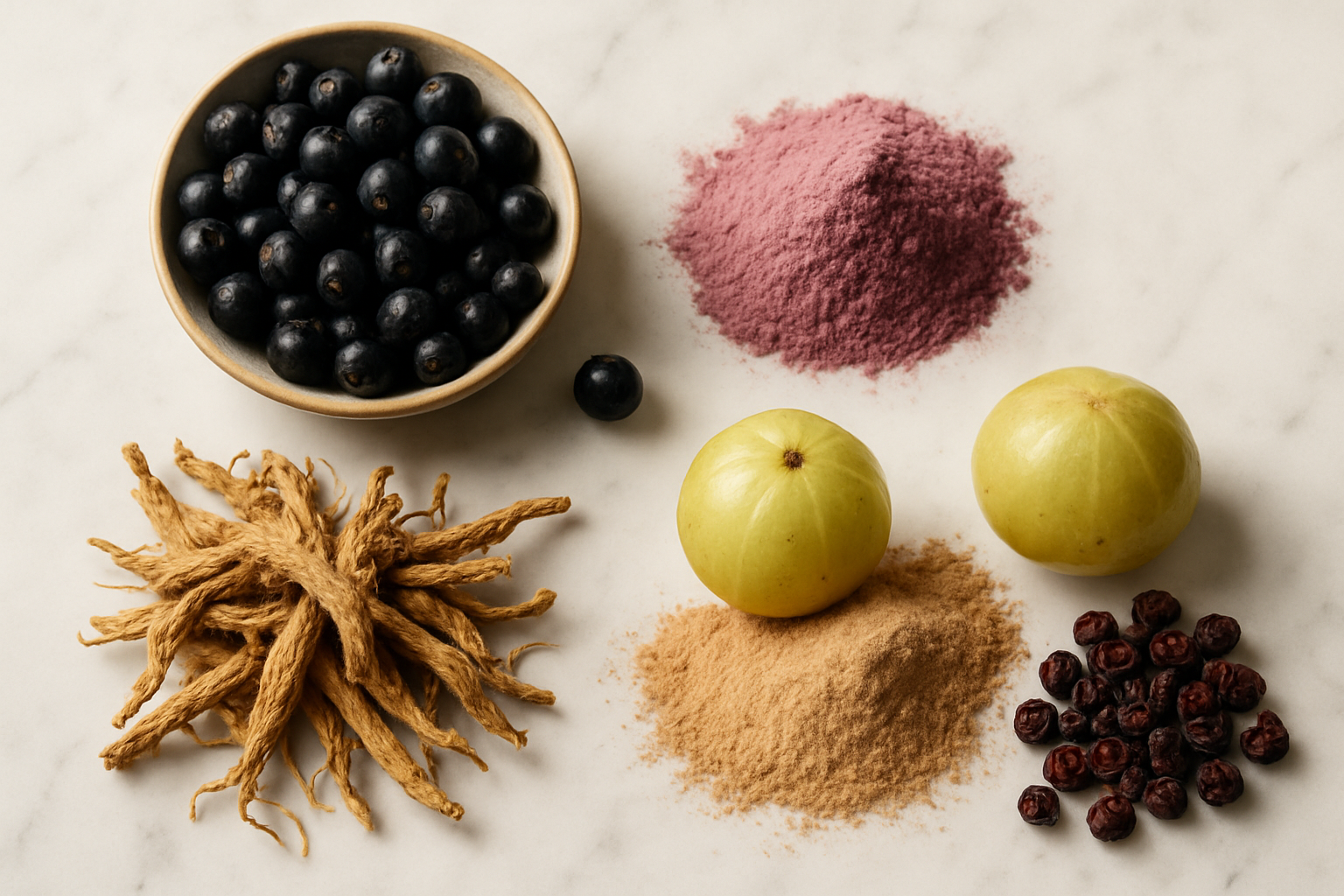
| Ingredient | Why it’s in Mitolyn | Studied dose | Evidence for weight |
|---|---|---|---|
| Maqui berry (anthocyanins) | Antioxidant; blood-sugar support | ~60–180 mg standardized extract[2] | Thin |
| Rhodiola rosea | Adaptogen, anti-fatigue | ~200–600 mg (3% rosavins)[3] | Weak |
| Haematococcus / astaxanthin | Antioxidant | ~4–12 mg astaxanthin/day[4] | Weak |
| Amla (Indian gooseberry) | Antioxidant; lipid support | ~500–1,000 mg/day[5] | Weak |
| Schisandra | Adaptogen, liver support | Not well established[6] | Thin |
| Theobromine | Mild stimulant (cacao alkaloid) | ~200–300 mg/day[8] | Thin |
The pattern is clear before we even reach the detail: Mitolyn is built almost entirely from ingredients with an antioxidant or adaptogenic rationale and only thin direct weight-loss evidence. Unlike some rivals, there is no single anchor ingredient here with strong, repeatedly replicated metabolic data — no berberine, no clinically meaningful dose of green tea catechins. That absence is the most important fact in the whole formula, and the rest of this review works through what each ingredient can and cannot do.
Does Mitolyn work for weight loss?
Mitolyn has no published human trials of the finished product, and its ingredients carry only weak or preliminary weight-loss evidence. Most are antioxidants and adaptogens studied for energy, fatigue or blood sugar — not fat loss. Realistically, Mitolyn may add a marginal effect at most, layered on top of diet and activity, not the dramatic transformation the ads imply.
Here is the balanced picture. Mitolyn is built around real, recognizable ingredients, and a couple of them — rhodiola for fatigue, maqui and amla for antioxidant and blood-sugar markers — have legitimate, if modest, research for purposes other than weight loss[2][3]. What is missing is the thing the product is actually sold for: human trials showing the formula, or even its individual ingredients at the label dose, cause meaningful fat loss. That is a glaring gap for a product whose entire pitch is weight loss.
The “multiply your mitochondria and watch the fat fall off” narrative is exactly the kind of effortless-weight-loss promise the U.S. Federal Trade Commission flags as a hallmark of deceptive marketing[11]. The NIH Office of Dietary Supplements reaches the same sober conclusion across the entire category: weight-loss supplements produce, at best, modest effects and are no substitute for diet and physical activity[9]. If Mitolyn helps you at all, it will be at the margins — perhaps a small lift in perceived energy from rhodiola or theobromine that makes you slightly more active — layered on top of the things that actually move the needle: a calorie-aware diet, adequate protein, sleep, movement and time.
It is worth being precise about why the honest answer is “probably very little.” When a finished product has not been tested in people, the most generous case you can build for it is to add up the evidence for each ingredient at its studied dose — and even that best case here is weak, because the per-ingredient weight-loss data is thin and the label doses are uncertain. An unproven blend of individually unimpressive weight-loss ingredients does not become a proven weight-loss product simply by being combined and given a science-flavored name. For the broader context, see our guide to the weight-loss ingredients with the strongest evidence — and notice how few of Mitolyn’s actives appear on it.
How is Mitolyn supposed to work?
Mitolyn claims to work by raising the number and health of your mitochondria, the cellular structures that turn food into energy, so your body burns more calories at rest. The underlying biology is only half-right: mitochondria do power metabolism, but no human evidence shows a supplement can multiply them or that doing so produces meaningful fat loss.
Mitochondria are genuinely central to metabolism. They are the structures inside your cells that take the fuel from food and the oxygen you breathe and convert them into ATP, the molecule your body runs on. Tissues that burn a lot of energy — muscle, heart, brown fat — are packed with them. The body really can build more mitochondria through a process called mitochondrial biogenesis, and the most reliable trigger for it is well established: regular physical activity, especially endurance and interval exercise. Mitolyn’s marketing borrows this real concept and implies a capsule can do what training does.
The evidence points the other way for most people. In obesity, reduced mitochondrial capacity in muscle and fat tissue is largely a consequence of excess energy intake, inactivity and fat accumulation, not the upstream cause that a pill can simply switch off[1]. That direction matters because it changes what actually fixes the loop. Moving more, eating in a modest deficit and building muscle are what improve mitochondrial function in practice. A handful of antioxidant berries cannot “turn the factories back on” in the way the ad describes; at most they play a small supporting role around the edges of the real work.
So when Mitolyn frames itself as unlocking a dormant fat-burning system, treat that as a story built on real cell biology, not as a demonstrated mechanism for the product. The honest version is narrower: a few of Mitolyn’s ingredients are antioxidants that may protect cells from oxidative stress, and a couple are adaptogens that may modestly affect perceived energy or fatigue. That is the mechanism worth examining — not the “multiply your mitochondria” framing.
Do the mitochondria claims hold up?
The mitochondria claims do not hold up as stated. It is true that mitochondrial function and obesity are linked, and that antioxidants exist in Mitolyn — but there is no human trial showing Mitolyn, or its ingredients at the label dose, increases mitochondrial number or causes fat loss. The mechanism is plausible-sounding, not demonstrated.
This is the heart of the Mitolyn pitch, so it deserves a careful, skeptical look. The argument runs: low mitochondrial levels → slow metabolism → weight gain → Mitolyn’s antioxidants restore mitochondria → weight loss. Each arrow is doing a lot of work. The first link is real but more complicated than the ad allows — mitochondrial differences in obesity are well documented, but causation is tangled and bidirectional[1]. The crucial later links — that swallowing these specific extracts raises mitochondrial count in humans, and that this then drives clinically meaningful fat loss — are simply not established by human research.
There is also a logical sleight of hand worth naming. Antioxidants neutralize reactive molecules called free radicals, and excessive oxidative stress can damage mitochondria, so “antioxidant” sounds like “mitochondria booster.” But the NIH National Center for Complementary and Integrative Health is blunt about antioxidant supplements: rigorous trials have generally not shown that taking antioxidant supplements provides the broad health benefits their marketing suggests, and more is not better[10]. Being an antioxidant is not the same as causing weight loss, and the leap from one to the other is exactly where Mitolyn’s reasoning breaks.
The single most telling fact about Mitolyn’s mechanism is what is absent: no peer-reviewed, placebo-controlled human trial of the Mitolyn formula showing it increases mitochondria or reduces body fat. For a product whose entire identity is “the mitochondria weight-loss breakthrough,” that gap is not a minor footnote — it is the whole story.
What do Mitolyn’s ingredients actually do?
Mitolyn’s ingredients — maqui berry, rhodiola, astaxanthin, amla, schisandra and theobromine — are mostly antioxidants and adaptogens. A few have modest evidence for blood sugar, fatigue or cholesterol markers, but none has strong human evidence for causing weight loss, and several have only preliminary or traditional support at best.
Maqui berry (Aristotelia chilensis) is a deep-purple South American fruit unusually rich in anthocyanins — the antioxidant pigments that give it its color. Small studies of standardized maqui extracts (around 60–180 mg) suggest modest effects on post-meal blood sugar and oxidative markers[2]. That is genuinely interesting for metabolic health, but it is a long way from fat loss, and the trials are small and short. You can read the fuller picture in our maqui berry guide.
Rhodiola rosea is an adaptogen — a herb traditionally used to help the body cope with stress and fatigue. A systematic review found rhodiola may modestly reduce mental and physical fatigue, though the trial quality is mixed[3]. If it helps you feel slightly less depleted and therefore move more, that is a plausible indirect route to spending more energy — but rhodiola itself has essentially no direct weight-loss evidence. See our rhodiola guide for the dose detail.
Astaxanthin, supplied here via the microalga Haematococcus pluvialis, is a potent carotenoid antioxidant studied at roughly 4–12 mg per day, mostly for skin, eye and cardiovascular markers[4]. It is a legitimate antioxidant, but human weight-loss data is weak. Amla (Indian gooseberry, Emblica officinalis) is extremely high in vitamin C and polyphenols; some small trials at around 500–1,000 mg report improvements in cholesterol and blood-sugar markers[5], but again, not weight loss directly. Our astaxanthin and amla guides go deeper.
Schisandra (Schisandra chinensis) is a traditional adaptogenic berry used for liver support and endurance, but robust human trials are scarce, so most of its reputation rests on traditional use and laboratory studies rather than clinical data[6]. Theobromine is the mild stimulant alkaloid found in cacao — chemically a cousin of caffeine, weaker but longer-acting, studied around 200–300 mg[8]. It can produce a subtle lift in alertness and mood and a small effect on blood pressure, but it is not a proven fat-burner. Notably, theobromine is the reason a “stimulant-free” framing for Mitolyn would be misleading — it is a stimulant, just a gentle one. Our schisandra and theobromine guides cover the specifics. None of these is a reason to buy Mitolyn for weight loss on its own.
Is Mitolyn dosed effectively?
You cannot fully confirm whether Mitolyn is dosed effectively, because the label does not clearly disclose the per-ingredient amounts for every active, and several ingredients have no firmly established “effective” weight-loss dose to begin with. Without transparent milligram amounts, you cannot verify the actives reach the levels used in research.
This is a core problem with Mitolyn and the category around it. Under U.S. labeling rules (21 CFR 101.36), a supplement’s Supplement Facts panel must list its dietary ingredients, and where a proprietary blend is used it must show the blend’s total weight but need not reveal the milligrams of each individual ingredient[12]. When amounts are grouped or under-specified, a label can look complete while hiding exactly the number that decides whether the product works.
Even on the most generous reading, Mitolyn’s ingredients have only thin weight-loss evidence at their studied doses. If the label amounts fall below those studied levels — a practice called “fairy dusting,” where a recognizable ingredient is added in a token amount — the realistic effect shrinks further toward nothing. Transparent, full-disclosure dosing is what would let you check; where that is missing, skepticism is the correct default.
The practical takeaway: a fully disclosed label lets you compare each ingredient against the dose used in research; anything less takes that ability away from you. We walk through exactly how to spot fairy dusting and read a panel properly in our guide to reading a supplement label. For Mitolyn specifically, the honest position is that the dosing does not give you enough to confirm effectiveness — and for a product already short on human evidence, that is a second strike, not a tie-breaker in its favor.
What are Mitolyn’s side effects?
Mitolyn’s side effects are usually mild in healthy adults. The most likely culprit is theobromine, a mild stimulant that can cause jitteriness, a faster heartbeat, headache or trouble sleeping in sensitive people[8]. Rhodiola can occasionally cause dizziness, dry mouth or irritability, and any botanical can cause digestive upset or allergy.
For most healthy adults, Mitolyn’s individual ingredients are generally well tolerated, but “natural” does not mean “no effects.” Because theobromine is a stimulant — milder than caffeine but real — people who are caffeine-sensitive, prone to anxiety, or who take Mitolyn late in the day may notice restlessness, a racing heart or disrupted sleep[8]. Rhodiola is usually well tolerated but has been linked to occasional dizziness, dry mouth and, in some people, an activating or jittery feeling, especially at higher doses[3].

The remaining ingredients — maqui, astaxanthin, amla and schisandra — are usually well tolerated at typical amounts, though amla’s high vitamin C content can cause stomach upset or loose stools in some people, and schisandra occasionally causes heartburn or appetite changes[5][6]. As with any supplement, product quality varies between manufacturers, and individual responses differ, so it is sensible to start with a single serving, take it earlier in the day because of the theobromine, and watch how you feel. The more important safety story for Mitolyn, though, is not the side effects themselves but the potential drug interactions — covered next.
Does Mitolyn interact with medications?
Yes — Mitolyn can potentially interact with medications. Theobromine may add to the effect of stimulants and some heart or blood-pressure drugs; rhodiola and schisandra can affect liver enzymes that metabolize many medicines; and amla may enhance blood-sugar-lowering and blood-thinning effects. If you take any prescription drug, check with your doctor first.
This is the part of the Mitolyn review to take most seriously, even though the interactions are generally milder than those of a strong single-ingredient product. Theobromine, as a stimulant, can compound the effects of caffeine and other stimulants and may not mix well with certain heart-rhythm or blood-pressure medications[8]. Schisandra has been shown to influence cytochrome P450 enzymes (the liver’s drug-processing system), which can change the blood levels of medications cleared through that pathway[6]. Rhodiola may have similar enzyme and additive effects, and has theoretical interactions with antidepressants and other centrally acting drugs[3].
Amla, with its blood-sugar and antiplatelet activity, could in theory add to the effect of diabetes drugs or blood thinners, raising the risk of low blood sugar or bleeding[5]. Mitolyn should also be avoided in pregnancy and breastfeeding, since the safety of several of these botanicals has not been established in those groups, and it is not appropriate for children. The practical rule for Mitolyn is simple: if you take any prescription medication, are pregnant or nursing, or have a heart, liver or bleeding condition, talk to your doctor or pharmacist before starting it. This is exactly the situation where a two-minute conversation beats a guess.
Who should take Mitolyn?
Mitolyn may suit people who already have their diet and activity in order, want a general antioxidant-and-adaptogen blend, and accept a small, unproven weight effect. Mitolyn is a poor fit for anyone expecting real weight loss from a capsule, sensitive to stimulants, on interacting medications, pregnant or breastfeeding, or shopping on a tight budget.
Mitolyn might suit you if…
- You’re already doing the fundamentals — calorie-aware diet, protein, activity, sleep
- You like the idea of an antioxidant-and-adaptogen blend and accept a small, not-guaranteed effect
- You tolerate mild stimulants and want a gentle perceived-energy lift
- You’re comfortable spending on a “maybe a small nudge,” not a transformation
You should skip Mitolyn if…
- You expect meaningful weight loss from the capsule alone
- You’re sensitive to stimulants or have a heart-rhythm or blood-pressure condition
- You take medication that interacts with theobromine, rhodiola, schisandra or amla
- You’re pregnant, breastfeeding, or shopping on a tight budget — the fundamentals cost nothing
The honest summary: Mitolyn is a niche product wearing the costume of a breakthrough. The people most likely to get something out of it are those who need it least — already-healthy individuals curious about antioxidants and adaptogens — while the people the marketing targets hardest, those hoping a capsule will do the work for them, are the ones most likely to be disappointed. If your real goal is fat loss, our guide to how to lose belly fat is a better starting point than any bottle.
How much does Mitolyn cost?
Mitolyn is sold online in tiered multi-bottle bundles, with bigger discounts on larger orders, and is typically backed by a money-back guarantee in the region of 90 days. Exact prices, bonuses and refund terms change frequently, so the only reliable source is Mitolyn’s official order page.
Mitolyn follows the standard digital-supplement pricing model: a higher per-bottle price for a single bottle, falling sharply for three- and six-bottle bundles, often with free shipping on larger orders and occasional “bonus” digital guides. This structure is designed to push larger upfront purchases, so it is worth deciding in advance how long you actually intend to trial it before the bundle math tempts you into a six-month commitment for a product with thin evidence behind it.
The roughly 90-day money-back guarantee is genuinely useful here, because it transfers some of the risk back to the seller — if Mitolyn does nothing for you, a refund window exists. Two practical notes: guarantees on digital-first products sometimes require returning bottles or contacting support within a set window, and the terms can change, so read the current guarantee on the official page rather than trusting any figure in a review, including this one. We have deliberately not printed a specific dollar price for that reason.
How does Mitolyn compare?
Compared with the alternatives, Mitolyn’s weakness is evidence. It lacks both a single, strongly-evidenced anchor ingredient and any human trial of the finished formula. Against other “mechanism” weight-loss blends, Mitolyn is broadly similar — real ingredients, a science-flavored story, and claims that outrun the data.
| Option | Doses disclosed? | Weight evidence | Best for |
|---|---|---|---|
| Mitolyn | Partially / unclear | Weak / unverified | Antioxidant-curious buyers, eyes open |
| A single, well-dosed active | Yes — single ingredient | Modest, verifiable | Anyone wanting to verify a real dose |
| Other “mechanism” blends | Usually no | Weak / unverifiable | Few people — same evidence problem |
| Diet + activity (no supplement) | N/A | Strong | Everyone, as the foundation |
The comparison makes Mitolyn’s position clear. If your genuine interest is one of its ingredients — say maqui for blood sugar or rhodiola for fatigue — a transparently dosed standalone product is almost always the smarter purchase, because you can confirm you are getting the studied amount and you are not paying for fairy-dusted extras inside a story. Mitolyn only makes sense if you specifically want the broad antioxidant-adaptogen blend and you have set realistic expectations about its small, unproven effect. For category context, see how we assessed similar “mechanism” pitches in our Java Burn review and our Ikaria Lean Belly Juice review, or browse all our side-by-side comparisons.
How should you take Mitolyn?
Take Mitolyn as directed on the label — usually once daily — and treat it as one small input rather than the centerpiece of a plan. Because of its theobromine content, take it earlier in the day, and use it consistently for several weeks while you track diet, protein, steps and sleep, so you can tell whether Mitolyn or your habits caused any change.
Following the label’s serving instructions matters, and so does timing: because Mitolyn contains the stimulant theobromine, taking it in the morning or early afternoon reduces the chance it disrupts your sleep[8]. Give it a fair window — several weeks, in line with how its adaptogenic and antioxidant ingredients are studied — before judging it; a few days tells you nothing. If you are on any medication or have a heart condition, clear Mitolyn with your pharmacist or doctor first, particularly because of the theobromine and the herb-drug interactions covered above.
The single most useful thing you can do is structure the trial so it is actually informative: change one thing at a time, keep a simple record of weight and waist measurements, and be honest about whether your diet and activity also shifted. That way, the roughly 90-day guarantee window doubles as a genuine test period — and if Mitolyn does nothing measurable on top of your habits, you have both the evidence and the refund option to walk away without sunk-cost regret.
Is Mitolyn a scam or legit?
Mitolyn is not obviously a scam: its ingredients are real, recognizable and generally safe, it is sold by an identifiable seller, and it offers a standard refund window. The fair criticism is a mitochondria story that outruns the human evidence and dosing that is not fully transparent — so you cannot verify the actives reach studied amounts.
It helps to separate “scam” from “overhyped.” A scam takes your money and delivers nothing or something dangerous. Mitolyn delivers a real supplement containing recognizable, generally safe ingredients, with a refund window — that is not the profile of an outright scam. What Mitolyn shares with weaker products in the category is marketing that outruns the evidence — a dramatic, video-driven “discovery” narrative — combined with dosing transparency that is not good enough to verify, which together make its central promise impossible to confirm.
There is one category-wide safety note worth stating plainly, even though it is not specific to Mitolyn: independent testing has repeatedly found some weight-loss supplements adulterated with undeclared pharmaceutical drugs, and the FTC warns that effortless, dramatic weight-loss claims are a hallmark of deceptive products[11]. This is the strongest practical reason to buy any such product only from its official source rather than unknown third-party marketplaces, where counterfeits are more likely. For Mitolyn specifically, the verdict is not “scam” — it is “real product, oversold, and short on the human evidence its story claims.”
The verdict: a science-flavored story, thin on proof
Mitolyn earns a verdict of WEAK, leaning toward modest only for non-weight uses. It is a reasonable antioxidant-and-adaptogen blend wrapped in a mitochondria narrative the human evidence does not support, with no trial of the finished product and dosing too unclear to verify the actives reach studied amounts.
Strip away the “multiply your mitochondria” story and what is left is a defensible but unremarkable antioxidant supplement whose real-world impact on weight — given the absence of human trials and the thin per-ingredient data — is probably very small for most people, on top of diet and activity. A couple of ingredients may modestly help energy, fatigue or blood-sugar markers, which is not nothing, but it is a long way from the sales-page promise of effortless fat loss.
If a specific ingredient is what you’re really after — maqui for blood sugar, rhodiola for fatigue — a standalone, transparently dosed product is usually the smarter buy, because you can verify the dose. If you like the idea of a broad antioxidant-adaptogen blend and you’ve set realistic expectations, Mitolyn is defensible — just don’t expect the sales page’s miracle, and buy only from the official site.
If you’ve read the trade-offs above and still want to try Mitolyn, buy only from the official site — and treat it as an adjunct to diet and activity, not a substitute.
Mitolyn
The mitochondria-themed blend reviewed on this page. Check the current price, bundle tiers and the money-back guarantee on the official site.
Compare the alternatives
See how Mitolyn’s approach stacks up against other metabolism formulas on transparency and evidence.
Frequently asked questions
Does Mitolyn work for weight loss?
Mitolyn has no published human trials of the finished product, and its individual ingredients have only weak or preliminary weight-loss evidence. Most are antioxidants and adaptogens studied for energy, blood sugar or fatigue, not fat loss.
Realistically Mitolyn may, at best, add a marginal effect on top of diet and activity, not the dramatic results its marketing implies.
Is Mitolyn FDA approved?
No. The FDA does not approve any dietary supplement, so Mitolyn cannot be FDA approved. Under DSHEA, the FDA regulates supplements only after they reach the market.
The accurate phrase a brand may use is “made in an FDA-registered, GMP facility,” which describes the factory, not approval of the product or proof it works.
What is in Mitolyn?
Mitolyn is marketed as a mitochondrial-support weight-loss formula and typically lists maqui berry, rhodiola rosea, Haematococcus pluvialis (a source of astaxanthin), amla (Indian gooseberry), schisandra and theobromine, plus added vitamins. These are mostly antioxidant and adaptogenic ingredients.
The amounts are often grouped so the per-ingredient dose is not fully transparent.
How is Mitolyn supposed to work on mitochondria?
Mitolyn claims that low mitochondrial number or function causes stubborn weight, and that its antioxidants raise mitochondrial levels so you burn more energy.
Mitochondrial dysfunction is genuinely linked to obesity, but the cause-and-effect runs mostly the other way, and no trial shows Mitolyn increases mitochondria or causes fat loss in humans.
Is Mitolyn safe, and what are the side effects?
Mitolyn’s ingredients are generally well tolerated in healthy adults, but theobromine is a mild stimulant that can cause jitteriness, a faster heartbeat or trouble sleeping in sensitive people, and rhodiola can cause dizziness or dry mouth.
As with any supplement, quality and individual response vary, so introduce it cautiously and earlier in the day.
Does Mitolyn interact with medications?
Possibly. Theobromine may add to the effect of stimulants and some heart or blood-pressure medications, rhodiola and schisandra can affect drug-metabolizing liver enzymes, and amla may enhance blood-sugar and blood-thinning effects.
Avoid Mitolyn in pregnancy and breastfeeding, and talk to your doctor or pharmacist before use if you take any medication.
How long does Mitolyn take to work?
Any effect from Mitolyn would build gradually over several weeks of consistent daily use alongside diet and activity changes, in line with how its adaptogenic and antioxidant ingredients are studied.
A product promising visible weight loss in days is overstating what these ingredients can realistically do.
Does Mitolyn have a money-back guarantee?
Mitolyn is typically sold online with a money-back guarantee in the region of 90 days, which is common for this category.
Refund terms, bundle prices and bonus offers change frequently, so confirm the current guarantee and price on the official order page before buying.
Is Mitolyn a scam?
Mitolyn is not obviously a scam: its ingredients are real, recognizable and generally safe, and it offers a standard refund window. The fair criticism is a mitochondria story that outruns the human evidence and dosing that is not fully transparent, so you cannot verify the actives reach studied amounts.
Treat the weight-loss claims skeptically and buy only from the official site.
Where can I buy Mitolyn safely?
Buy Mitolyn only through its official ordering page rather than third-party marketplaces, where counterfeits and mishandled stock are more likely.
The official channel is also the only reliable place to confirm the current price, ingredient panel and the money-back guarantee, all of which change over time.
Is Mitolyn better than diet and exercise?
No. No supplement, including Mitolyn, outperforms a calorie-aware diet and regular activity, which remain the only approaches with strong evidence for weight loss.
The NIH concludes weight-loss supplements produce, at best, modest effects and are no substitute for those fundamentals. Treat Mitolyn as a possible small add-on, not a replacement.
Maqui berry: what the research says
Rhodiola rosea, explained
Astaxanthin and antioxidants
How to read a supplement label
The ingredients with the strongest evidence
Side-by-side comparisons
We research weight-loss supplements and the ingredients inside them, scoring products on label transparency and evidence rather than hype. No star spam, no fabricated reviews — just the evidence, stated plainly. Our editorial standards →
- Bournat JC, Brown CW. Mitochondrial dysfunction in obesity. Current Opinion in Endocrinology, Diabetes and Obesity, 2010. pubmed.ncbi.nlm.nih.gov
- Alvarado J, et al. Delphinidin-rich maqui berry extract (Delphinol) lowers fasting and postprandial glycemia and insulinemia in prediabetic individuals. Panminerva Medica / J Diabetes Res, 2016. pubmed.ncbi.nlm.nih.gov
- Hung SK, Perry R, Ernst E. The effectiveness and efficacy of Rhodiola rosea L.: a systematic review of randomized clinical trials. Phytomedicine, 2011. pubmed.ncbi.nlm.nih.gov
- Visioli F, Artaria C. Astaxanthin in cardiovascular health and disease: mechanisms of action, therapeutic merits, and knowledge gaps. Food & Function, 2017. pubmed.ncbi.nlm.nih.gov
- Akhtar MS, et al. Effect of Amla fruit (Emblica officinalis Gaertn.) on blood glucose and lipid profile of normal subjects and type 2 diabetic patients. International Journal of Food Sciences and Nutrition, 2011. pubmed.ncbi.nlm.nih.gov
- Nowak A, et al. The Health Benefits of Schisandra chinensis and its bioactive compounds (review). Nutrients, 2019. pubmed.ncbi.nlm.nih.gov
- U.S. FDA — Questions and Answers on Dietary Supplements (supplements are not FDA approved; post-market oversight). fda.gov
- Baggott MJ, et al. Psychopharmacology of theobromine in healthy volunteers. Psychopharmacology, 2013. pubmed.ncbi.nlm.nih.gov
- NIH Office of Dietary Supplements — Dietary Supplements for Weight Loss (Health Professional Fact Sheet). ods.od.nih.gov
- NIH National Center for Complementary and Integrative Health — Antioxidants: In Depth. nccih.nih.gov
- U.S. FTC — “Gut Check”: red-flag weight-loss claims; Health Products Compliance Guidance. ftc.gov
- U.S. FDA — Supplement Facts panel and proprietary blend rules, 21 CFR 101.36 (eCFR). ecfr.gov
- Jun 15, 2026 — Review published as a full evidence review; claims checked against current NIH, FDA, FTC and peer-reviewed sources.
Affiliate disclosure: SourceLean is reader-supported. When you buy through links on this site, we may earn a commission at no extra cost to you. Checkout is always handled on the official product website.