No food melts belly fat on its own — but a handful genuinely make fat loss easier to sustain. Here’s the honest list, how each one works, the science underneath it, and where the research stops.
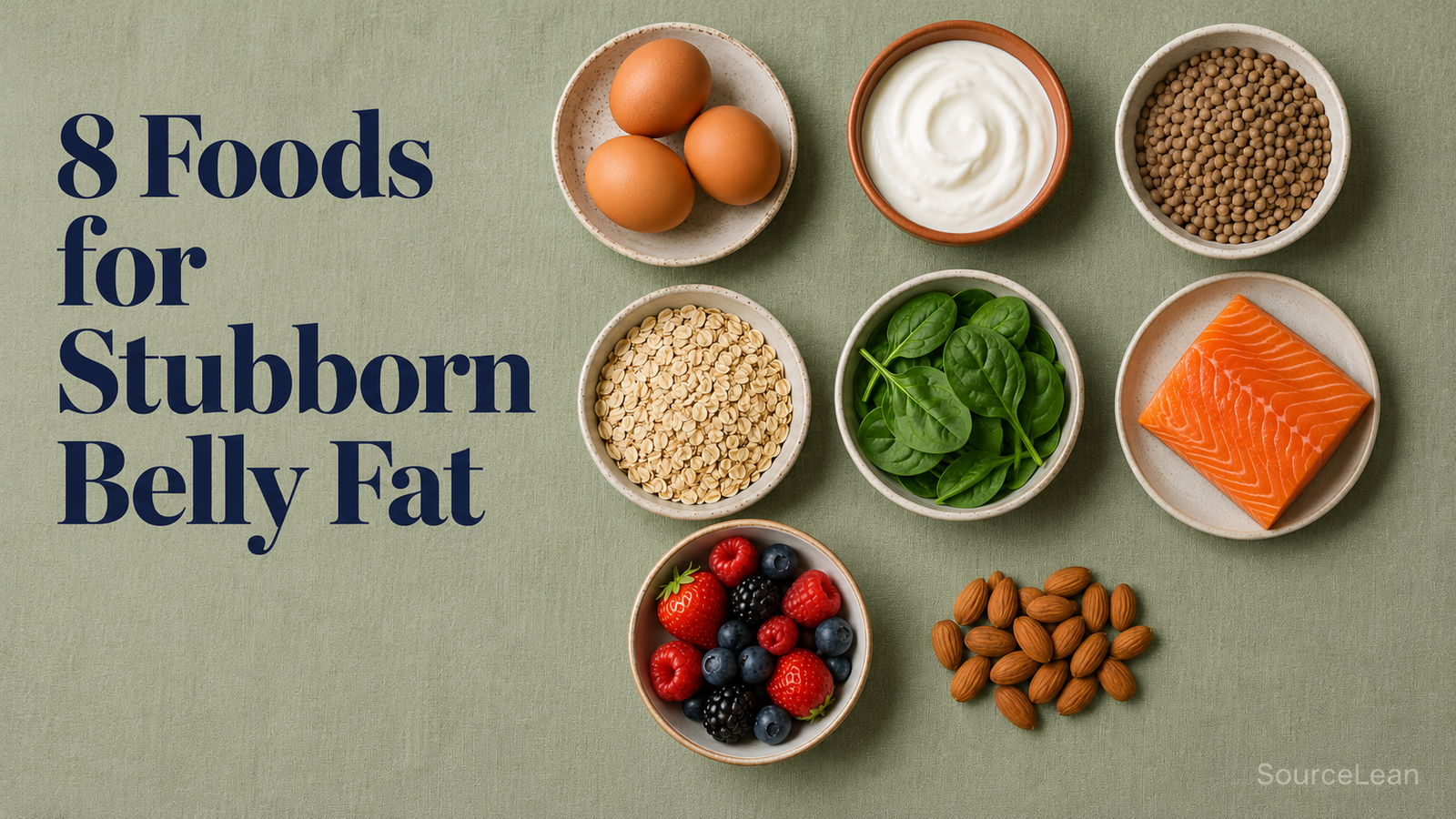
“Eat this to burn belly fat” is one of the most repeated promises online — and one of the most misleading. The honest starting point: you cannot aim fat loss at your stomach. Spot reduction isn’t supported by the evidence; a meta-analysis of 13 trials with more than 1,100 people found that training a specific body part did not reduce fat in that part.[1] Fat comes off across your whole body when you are in a sustained calorie deficit, and the order in which it leaves is set largely by your genes — for many people the abdomen is the last place to slim. What certain foods can do is make that deficit far easier to reach and hold: by keeping you full for longer, protecting the muscle that keeps your metabolism humming, and crowding out the refined, calorie-dense foods that quietly drive weight gain. That mechanism — not a magic compound — is the thread that connects every food on this list.
This guide is longer than most, on purpose. There is no shortage of interchangeable “10 belly-fat foods” posts that simply list produce with no explanation of why it would help or where the claim falls apart. Our aim is the opposite: to give you the working model behind fat loss, walk through each food and the human evidence for it, show you exactly how to assemble meals and a day around these foods, and be candid about the limits — including the uncomfortable truth that you can eat every food here and still not lose an inch if the bigger picture is off. By the end you should be able to look at any “belly-fat food” claim, including the ones in this article, and judge it for yourself.
We built this list from the human evidence, not marketing claims. Each food was checked against peer-reviewed meta-analyses and randomized trials for protein, fibre and weight-management outcomes — and we say plainly where the evidence is strong and where it is thin. SourceLean doesn’t run star ratings, sponsored placements or fabricated reviews; we make money only through transparent affiliate links, disclosed above. This is editorial analysis from health writers, not medical advice — always talk to your doctor or a registered dietitian before major dietary changes, especially if you have a health condition or take medication.
- First, the honest frame
- Belly fat is two different things
- How fat loss actually works
- How we chose these foods
- The 8 foods at a glance
- The 8 foods, in detail
- The nutrients doing the real work
- Building a day around these foods
- Common mistakes that stall progress
- Where movement fits
- What about fat-burner supplements?
- Honest limitations
- Who should be cautious
- Frequently asked questions
First, the honest frame
Before a single food, the frame matters more than the list. If you take away one idea, make it this: foods do not burn belly fat. They help you eat fewer calories without feeling deprived, which is the actual lever that moves fat — including the fat around your midsection.
The reason this distinction matters is that it changes how you choose. If you believe a food “attacks” belly fat, you will pile it on top of everything else you already eat and wonder why nothing happens. If you understand that a food helps by replacing something worse and keeping you fuller for longer, you will use it correctly: as a swap, not an addition. Every recommendation below assumes the second mindset.
None of these foods “burn” fat. They help you eat fewer calories without feeling deprived — which is the actual lever. A single food, or a supplement, is a minor supporting actor at best. The eating pattern is the engine, and the foods here are the parts that make the engine easy to keep running.
It also reframes what success looks like. The scale is a noisy, partial measure: it moves with water, sodium, glycogen, hormones and bowel timing, none of which is body fat. A more useful set of signals over weeks and months includes how your clothes fit, your waist measurement, your energy and hunger between meals, and whether you can keep the pattern going without misery. Those are the things the foods below actually influence.
Belly fat is two different things
“Belly fat” is not one substance. It is two, and they behave differently — which is good news, because the more dangerous type is also the more responsive one.
Subcutaneous fat is the soft layer just under the skin — the part you can pinch. It is largely a storage and insulation tissue, and while excess amounts are linked to higher overall body fat, subcutaneous fat is comparatively inert from a health standpoint.
Visceral fat sits deeper, wrapped around the liver, intestines and other organs inside the abdominal cavity. It is metabolically active, releasing signalling molecules that influence inflammation and insulin sensitivity, and it is the type more strongly associated with metabolic risk — including type 2 diabetes and cardiovascular disease. This is the fat that creates the firm, protruding “apple-shaped” abdomen, as opposed to the softer, pinchable kind.
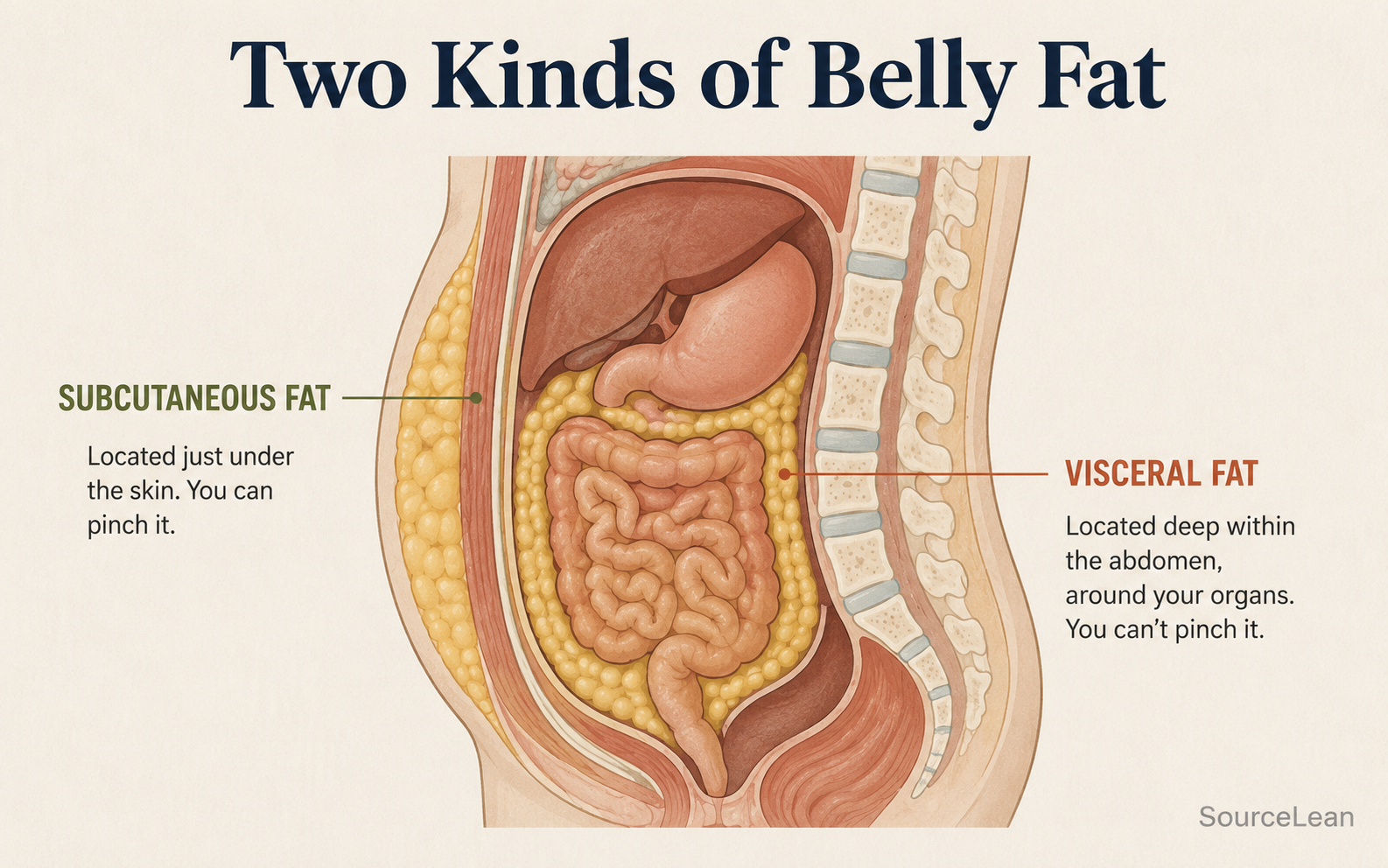
Here is the encouraging part. Visceral fat tends to be the first to respond to improved diet quality, a calorie deficit and increased activity. Even before the scale moves dramatically, people who clean up their eating and start moving often see waist circumference shrink, because visceral fat is readily mobilised for energy. So while you cannot target the belly with a specific exercise or food, the belly — and specifically its riskier inner layer — is often where general fat loss shows up early. The foods in this guide support exactly the kind of eating pattern that drives that.
Waist circumference is a more useful day-to-day marker than the scale for abdominal fat. Measure around the navel, relaxed, at the same time of day. A downward trend over weeks is a better sign than any single morning’s weight.
How fat loss actually works (in plain terms)
You don’t need a physiology degree, but a clear mental model helps you cut through nearly every fad. Here is the whole thing in four moving parts.
1. Energy balance is the foundation
Your body stores fat when you consistently take in more energy than you use, and releases it when the reverse is true. This is not a fad position; it is the consistent finding across the research base. Every diet that works — low-carb, Mediterranean, high-protein, intermittent fasting — works because it helps a person eat less than they burn, whether or not it advertises itself that way. The interesting question is therefore not “which diet melts fat” but “which approach helps this person sustain a modest deficit without being miserable.” For most people, the answer involves more protein, more fibre and more food volume per calorie — which is precisely what the eight foods deliver.
2. Satiety decides whether you can stick to it
A deficit you cannot maintain is worthless. This is where food choice earns its keep. Protein is the most satiating macronutrient: higher-protein meals consistently increase fullness and can reduce overall energy intake later in the day.[2] Viscous soluble fibre slows the stomach’s emptying and blunts blood-sugar swings, extending fullness between meals.[3] Foods with low energy density — lots of water and fibre, few calories per gram — let you eat a satisfying volume while the calorie math still works. Build meals around those three properties and the deficit starts to feel less like restriction and more like a slightly different way of eating.
The real problem: for many people the diet doesn’t fail at the plate — it fails at 3pm, when energy dips and hunger spikes. If you want a transparent, metabolism-and-energy option to pair with that protein-forward approach, see our review of Java Burn.
3. Protein protects the muscle you don’t want to lose
When you lose weight, some of it can come from muscle as well as fat — and losing muscle is counterproductive, because muscle is metabolically active tissue that helps keep your daily energy expenditure up. Adequate protein, especially combined with some resistance training, shifts the balance of weight lost toward fat and away from lean mass.[2] This is one reason “eat less of everything” crash diets backfire: they often strip muscle, lower metabolism and set up rebound weight gain. Protein-forward eating is the antidote.
4. The rest of life is not optional
Sleep, alcohol, stress and movement all influence appetite, hormones and how readily the body holds onto abdominal fat. Chronic short sleep raises hunger hormones and makes a deficit harder to keep. Alcohol delivers dense, easy calories and tends to loosen food restraint. None of this can be out-eaten with a “fat-burning food.” The foods help most when the broader picture is reasonably in order — which is why this guide keeps returning to it rather than pretending a grocery list is the whole story.
How we chose these foods
There are dozens of near-identical “belly fat foods” lists online. We applied five plain criteria so this one earns its place — and so you can see exactly why each food made the cut.
- Human evidence for the mechanism. Does the food work through something actually studied in people — protein-driven satiety, viscous fibre, low energy density — rather than a test-tube or rodent-only claim?
- Protein or fibre density. These are the two nutrients with the strongest, most consistent link to fullness and fat-loss support.[2][3]
- Fullness per calorie. Foods that fill you up for fewer calories make a deficit easier to hold without hunger dominating your day.
- Practicality. Affordable, widely available, and realistic to eat most days — not exotic powders or once-a-month splurges.
- Displacement value. A food’s biggest win is often what it replaces: refined snacks, sugary drinks, low-protein convenience meals. We favoured foods that naturally push worse options off the plate.
Notice what is deliberately absent: we did not rank by “fat-burning power,” because no whole food has a meaningful direct fat-burning effect worth ranking. The “Evidence” labels in the table below describe how well each food’s mechanism is supported in humans — not a product rating, and not a promise of results.
The 8 foods at a glance
A quick map before the detail. “Evidence” refers to how well the food’s mechanism (satiety, fibre, low energy density) is supported in humans — not a score for the food itself.
| Food | Why it helps | Standout property | Evidence | Smart way to use it |
|---|---|---|---|---|
| Eggs | High satiety; steadies later-day hunger | Protein | Strong | Swap for refined-carb breakfasts |
| Greek yogurt | Protein-dense, filling base | Protein | Strong | Plain, unsweetened; add berries |
| Beans & lentils | Protein + soluble fibre in one | Fibre + protein | Moderate | Base of meals; stretch meat dishes |
| Oats | Viscous fibre slows digestion | Beta-glucan | Moderate | Plain oats; skip sugary flavoured packs |
| Leafy greens & veg | High volume, very low calories | Low energy density | Strong | Fill half the plate |
| Fatty fish | Filling protein + omega-3 | Protein + omega-3 | Moderate | 2 servings/week; replaces processed protein |
| Berries | Sweet, fibrous, lower-sugar fruit | Fibre | Moderate | Swap for refined desserts |
| Nuts | Satiating snack; curbs hunger | Protein + healthy fat | Moderate | Measured handful — portion matters |
The 8 foods, in detail
For each food: how it works, what the human evidence actually shows, and an honest caveat. Read the caveats — they are where most “healthy” eating quietly goes wrong.
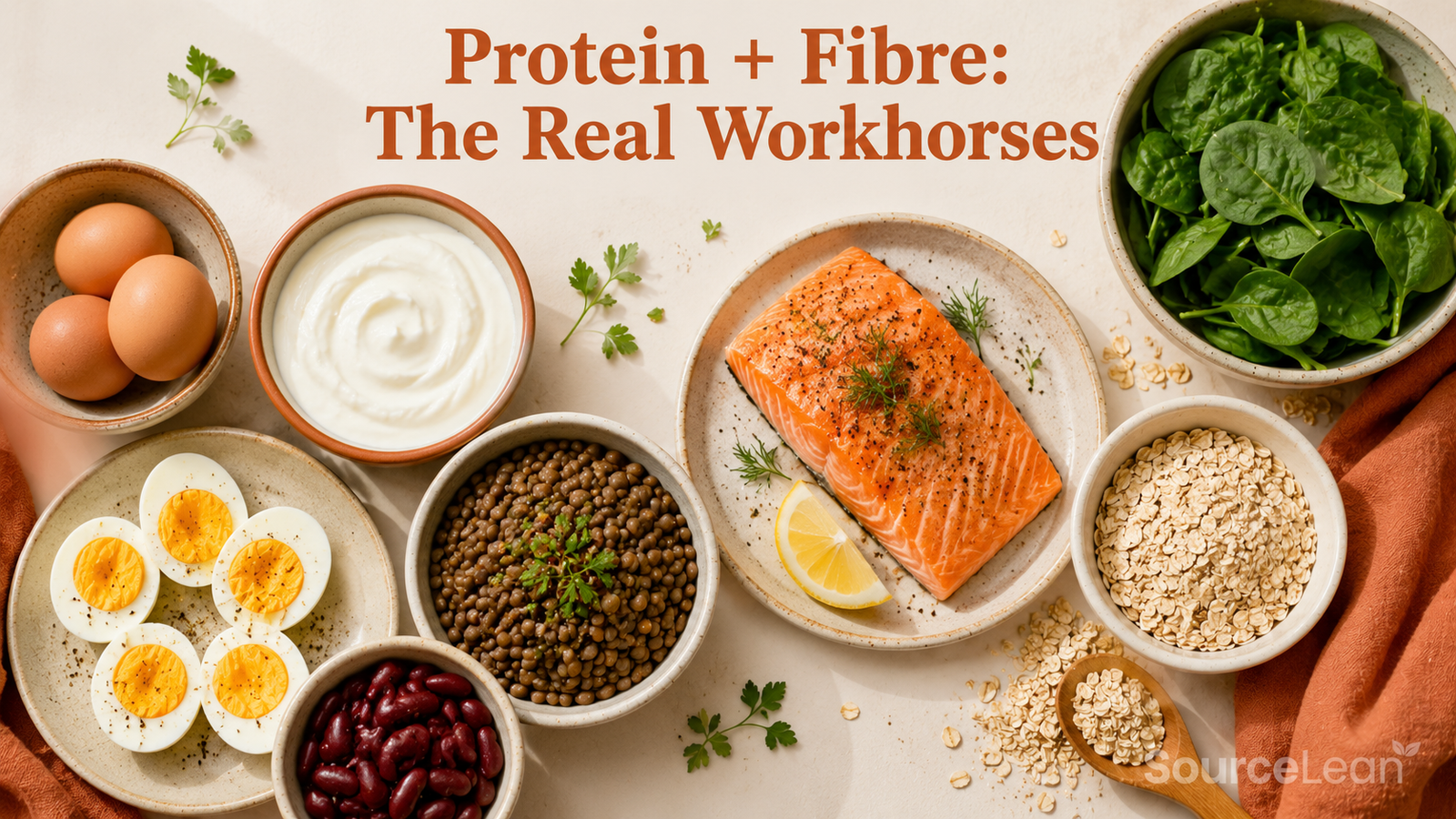
01Eggs
Eggs are a compact source of high-quality, complete protein, and protein is the single most satiating macronutrient. Studies repeatedly show that higher-protein meals increase fullness and can reduce how much people eat later in the day.[2] The classic application is breakfast: swapping a refined-carb start (sugary cereal, pastry, white toast) for a protein-forward one built around eggs tends to flatten the mid-morning hunger spike that sends people back to the kitchen. Eggs are also cheap, fast, endlessly versatile and rich in nutrients like choline and vitamin D.
Keep in mind: the benefit is the protein and the swap — not the egg itself. Fried in lots of oil, or paired with refined, greasy sides, the advantage disappears. For most healthy people, dietary cholesterol from eggs has a limited effect on blood cholesterol, but if you have specific cardiac guidance, follow it.
USE IT: 2–3 eggs at breakfast, with vegetables, in place of refined carbs.
02Greek yogurt
Plain Greek yogurt is strained, which concentrates its protein — often roughly double that of regular yogurt for the same volume. That makes it one of the easiest high-protein, high-volume foods to keep on hand, working as a breakfast base, a snack, or a swap for sour cream and mayonnaise. Adequate protein intake helps preserve lean muscle while you lose fat, which keeps your metabolism steadier through a deficit.[2] It also pairs naturally with two other foods on this list — berries and nuts — to build a genuinely filling, low-effort meal.
Keep in mind: flavoured and “fruit-on-the-bottom” tubs can carry as much added sugar as dessert, which undoes the point. Buy plain, full-fat or low-fat to taste, and sweeten it yourself with fruit. If you are dairy-intolerant, a high-protein unsweetened plant yogurt can play a similar role — check the protein figure on the label.
USE IT: plain, as a base; add berries for sweetness and nuts for crunch.
03Beans & lentils
Legumes are a rare two-in-one: meaningful plant protein and soluble fibre in the same cheap, shelf-stable package. The fibre slows digestion and supports fullness, while the volume helps you feel satisfied on fewer calories. Higher soluble-fibre intake is associated with modest but real reductions in body weight and waist circumference across randomized trials.[3] Practically, beans and lentils are superb “stretchers” — adding them to a meat dish lets you cut the meat portion while keeping the meal filling, lowering both calories and cost.
Keep in mind: increase fibre gradually and drink water with it. A sudden jump in beans and lentils is the most common cause of the bloating and gas that makes people abandon them. Tinned, rinsed beans are just as nutritious as dried and far more convenient.
USE IT: build the meal around them, or use them to stretch and shrink meat portions.
04Oats
Oats are rich in beta-glucan, a viscous soluble fibre that forms a gel in the gut, slows gastric emptying, supports prolonged fullness and helps steady post-meal blood sugar.[3] Beta-glucan is also one of the better-evidenced fibres for nudging cholesterol in a favourable direction. A bowl of plain oats is a far better-anchored breakfast than most cereals, and it is cheap, filling and easy to batch-prepare (overnight oats, for instance).
Keep in mind: “flavoured” instant packets are frequently loaded with added sugar that cancels much of the benefit. Use plain rolled or steel-cut oats and flavour them yourself with fruit, cinnamon or a spoon of yogurt. Portion still counts — oats are healthy but not calorie-free, and a giant bowl with lots of toppings adds up.
USE IT: plain rolled/steel-cut oats; sweeten with berries, not sugar.
05Leafy greens & non-starchy veg
Spinach, kale, salad leaves, broccoli, peppers, courgette and the like are the workhorses of low-energy-density eating: lots of water and fibre, very few calories per gram. That lets you fill a plate — and a stomach — for almost no calorie cost, which is one of the most reliable ways to make a deficit feel generous rather than punishing. The simple habit of filling half your plate with non-starchy vegetables crowds out more calorie-dense foods automatically, with no calorie counting required.
Keep in mind: the calorie advantage is fragile. Drowning greens in oily dressing, cheese, or frying them in butter can quietly turn a 50-calorie side into a 400-calorie one. Use dressings deliberately, and lean on herbs, spices, lemon and vinegar for flavour.
USE IT: fill half the plate; keep dressings and added fats modest.
06Fatty fish
Salmon, sardines, mackerel and trout deliver filling, high-quality protein alongside omega-3 fats. The protein supports fullness and muscle retention; the omega-3s contribute to overall diet quality and cardiovascular health, even though they are not a fat-loss agent in their own right. Used as a swap for processed or low-protein convenience meals, fatty fish raises the protein and nutrient quality of a meal without leaving you hungry. Tinned sardines and salmon are an inexpensive, convenient way to get the same benefits.
Keep in mind: if you are pregnant or breastfeeding, follow current guidance on fish and mercury and favour lower-mercury options such as salmon and sardines. Heavily battered, deep-fried fish is a different food entirely — the cooking method, not the fish, becomes the calorie story.
USE IT: aim for around two servings a week; baked, grilled or tinned.
07Berries
Strawberries, blueberries, raspberries and blackberries are naturally sweet, high in fibre and relatively low in sugar compared with most fruit, with a high water content that adds volume. Their real value is as a swap: they satisfy a sweet craving while adding fibre and micronutrients instead of the empty calories of refined desserts.[3] They also pair perfectly with Greek yogurt and oats to turn two other foods on this list into something that tastes like a treat.
Keep in mind: berries replace dessert; they do not earn a place alongside it. Buried under cream, sugar or granola they lose the point. Frozen berries are just as nutritious as fresh, cheaper, and last longer.
USE IT: in place of refined dessert; stir into yogurt or oats.
08Nuts (measured)
Nuts are genuinely satiating, and despite their energy density, large reviews consistently find that nut consumption is not associated with weight gain — and is even linked to slightly lower odds of becoming overweight in long-term studies.[4] The likely reasons: their protein, fibre and fat curb hunger, some of their calories are not fully absorbed, and chewing them takes time. A small, planned handful makes an excellent hunger-bridging snack between meals.
Keep in mind: this is the one food on the list where “more” works against you. Calories add up fast, and it is genuinely easy to eat several hundred without noticing. Portion them out — a small handful, roughly 30 grams — rather than eating from the bag. Choose unsalted, and skip if you have a nut allergy.
USE IT: one measured handful (~30g) as a planned snack, not grazing.
The nutrients doing the real work
Strip away the food names and three properties explain almost everything on this list. Understand these and you can evaluate any food yourself — including ones we didn’t include.
| Property | How it helps | Evidence | Best sources here |
|---|---|---|---|
| Protein | Boosts satiety, preserves lean mass, mildly raises the thermic effect of food | Strong | Eggs, Greek yogurt, fish, legumes |
| Soluble (viscous) fibre | Slows gastric emptying, increases fullness, steadies blood sugar | Moderate–Strong | Oats, beans, lentils, berries |
| Low energy density | More food volume for fewer calories, so portions stay satisfying | Strong | Leafy greens, non-starchy veg, berries |
| Omega-3 fats | Support overall diet quality and heart health; not a direct fat-loss agent | Supportive | Fatty fish |
Protein, in a little more depth
Protein helps fat loss through three distinct routes. First, satiety: gram for gram it is the most filling macronutrient, partly through its effect on appetite-regulating gut hormones.[2] Second, muscle preservation: in a deficit, sufficient protein steers the body toward burning fat rather than breaking down muscle, helping protect the lean tissue that supports your daily metabolism. Third, the thermic effect of food: the body spends more energy digesting protein than carbohydrate or fat, a small but real bonus. Many studies that show benefit use roughly 1.2 to 1.6 grams of protein per kilogram of body weight per day, spread across meals — higher than the basic RDA, but achievable from the whole foods above. (People with kidney disease should get individual medical guidance before raising protein.)
Fibre, and why “soluble” and “viscous” matter
Not all fibre behaves the same. The fibres most useful for fullness are soluble and viscous — they absorb water and form a gel that slows how fast your stomach empties, which prolongs the feeling of fullness and softens blood-sugar spikes.[3] Beta-glucan in oats and the fibre in beans, lentils and berries are good examples. Across randomized trials, higher soluble-fibre intake is associated with modest reductions in body weight and waist measures.[3] Fibre also feeds beneficial gut bacteria, an area of active research. The practical point: most people eat far too little fibre, and closing that gap with whole foods is one of the highest-leverage changes available.
The real problem: hunger and cravings are what quietly break a deficit, and whole-food fibre alone isn’t always enough to keep them in check. If you’d rather support fullness with a transparent fibre-and-botanical formula we’ve vetted, see our review of Ikaria Lean Belly Juice.
Energy density: the quiet superpower
Energy density is simply calories per gram. Foods high in water and fibre — vegetables, fruit, broth-based dishes, legumes — are low in energy density, so you can eat a large, satisfying volume for relatively few calories. Research on eating behaviour consistently shows people tend to eat a fairly constant weight of food day to day; lower the calories packed into that weight and intake falls without a corresponding rise in hunger. This is why “eat more vegetables” is such durable advice: it works through a mechanism that doesn’t rely on willpower.
Building a day around these foods
Knowing the foods is one thing; assembling them is another. Here is a simple, repeatable framework plus an example day — not a rigid meal plan, but a template you can adapt to your own tastes, budget and culture.
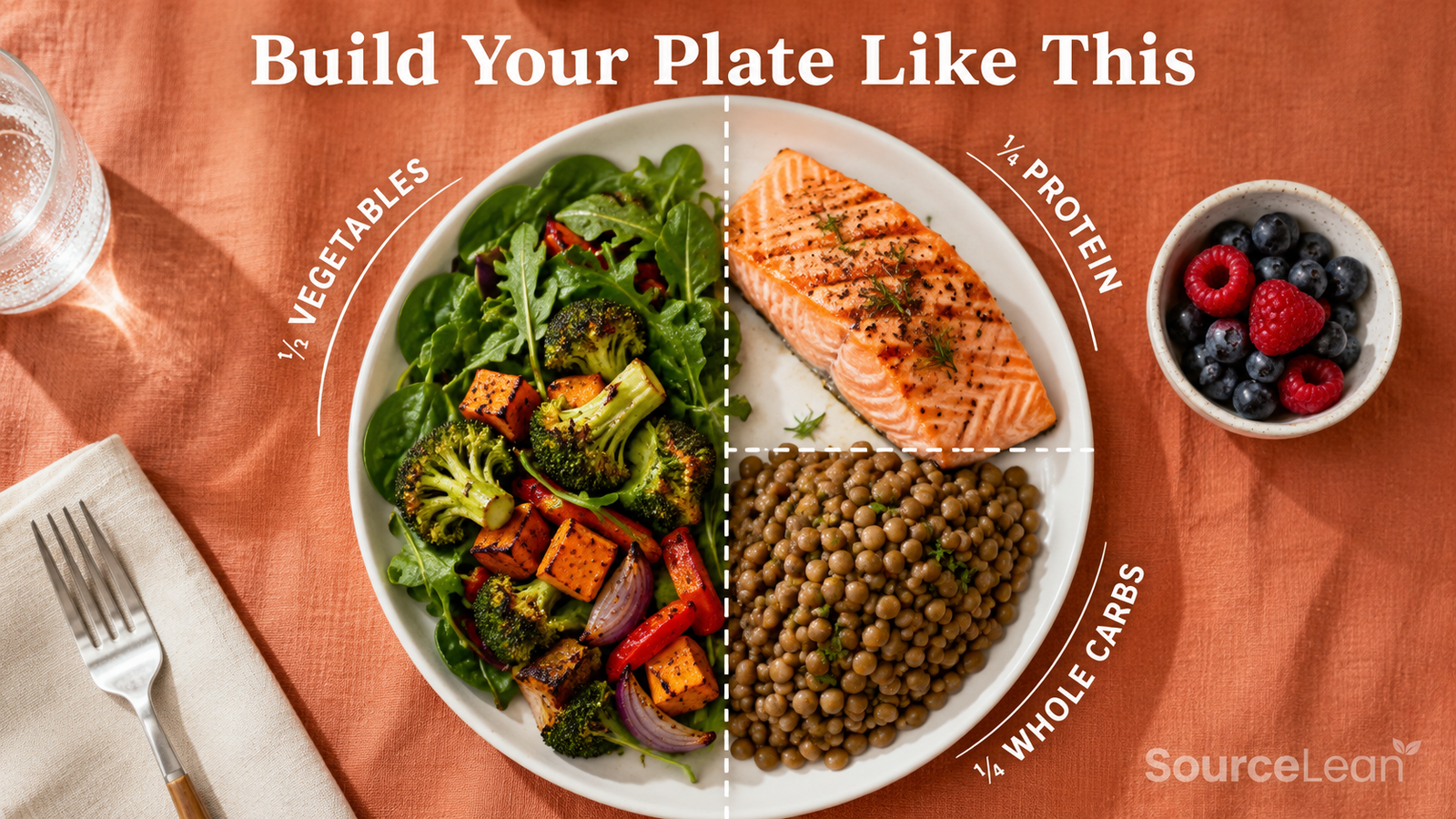
The plate template
For most main meals, a reliable structure is: a palm-sized portion of protein (eggs, fish, Greek yogurt, beans/lentils, or your usual meat), half the plate of non-starchy vegetables for volume and fibre, and a controlled portion of whole-food carbs or healthy fat (oats, whole grains, a measured handful of nuts, a little olive oil). You do not have to weigh anything; the hand-portion and half-plate cues get most people close enough.
An example day
- Breakfast: 2–3 eggs with spinach and tomatoes; or plain oats topped with berries and a spoon of Greek yogurt.
- Lunch: large salad or grain bowl with leafy greens, lentils or tinned salmon, plenty of vegetables, olive-oil-and-lemon dressing.
- Snack: Greek yogurt with berries, or a measured (~30g) handful of nuts.
- Dinner: baked fatty fish or a bean-stretched stew, half a plate of vegetables, a controlled portion of whole grains.
Five principles that carry it
- Protein at every meal — it anchors fullness across the day.
- Half the plate vegetables — volume for almost no calories.
- Swap, don’t add — these foods replace worse options.
- Drink mostly water — liquid calories are easy to overlook.
- Keep it boring-sustainable — a plan you can repeat beats a perfect plan you can’t.
A note on liquids, because they undo more diets than any single food: sugary drinks, juices, sweetened coffees and alcohol deliver dense calories that barely register as fullness. Shifting the default drink to water, unsweetened tea or coffee is one of the simplest high-impact moves, and it pairs naturally with everything above.
Common mistakes that stall progress
You can choose every “right” food and still see nothing change. Almost always, the culprit is one of these.
- Adding instead of swapping. The most common error. These foods help by replacing more calorie-dense options. Eaten on top of an unchanged diet, they simply add calories.
- The “health halo.” Granola, smoothies, dried fruit, nut butters, flavoured yogurt, oils and “superfood” snacks are healthy in some sense but easy to over-consume. Healthy does not mean unlimited.
- Forgetting drinks and “bites.” Liquid calories and the handful here, the taste there while cooking, are genuinely invisible to most people and can quietly erase a deficit.
- Ramping fibre too fast. Going from little fibre to a lot overnight causes bloating and discomfort that makes people quit. Increase gradually with water.
- Under-eating protein. Cutting calories without enough protein tends to cost muscle, which lowers metabolism and worsens rebound. Keep protein up even while calories come down.
- Chasing speed. Aggressive crash diets are the least likely to last and the most likely to strip muscle. Slow, sustainable change wins on every meaningful measure.
- Ignoring sleep and stress. Both shift appetite and make a deficit harder to hold. No food list can offset chronic short sleep.
Honesty is more useful than hype here. If a food, plan or product promises rapid, effortless belly-fat loss, that promise is the red flag — not the selling point. The unglamorous combination of protein, fibre, vegetables, water, sleep and patience is what actually moves the needle.
Where movement fits
This is a food guide, but leaving out movement would be dishonest, because activity and diet work together on exactly the fat this article is about.

Diet is the more powerful lever for creating a calorie deficit — it is far easier to not eat 500 calories than to burn them off — so if you only have the energy to change one thing, change what is on your plate. But movement earns its place for reasons that go beyond calories burned. Resistance training, in particular, helps preserve the muscle that adequate protein protects, which keeps your metabolism higher through a deficit and improves the proportion of weight you lose as fat rather than lean tissue. The two reinforce each other: protein supplies the building blocks, training supplies the signal to keep the muscle.
Aerobic activity — walking, cycling, swimming, anything that gets you moving regularly — adds to your daily energy expenditure and is associated with reductions in visceral fat specifically, even when the scale moves only modestly. And one of the most underrated contributors is simply moving more throughout the day: standing, walking, taking stairs, fidgeting. This “non-exercise activity” can account for a surprising share of daily energy use and tends to quietly fall when people diet, which is one reason progress can stall. The practical takeaway is unglamorous but reliable: pair the foods in this guide with regular movement you can actually sustain — a mix of some resistance work and daily walking beats an ambitious plan you abandon in three weeks. As always, if you have a heart condition, joint problems or other medical concerns, get clearance before starting a new exercise routine.
The real problem: low daily energy makes both movement and consistency harder, and that’s where many people stall. If you want a transparent option focused on cellular energy and metabolism to support an active routine, see our review of Mitolyn.
What about fat-burner supplements and green tea?
If foods are minor levers, most “fat-burner” supplements are smaller ones still. Here is the honest read.
A few ingredients have modest, real evidence. Green tea catechins taken with caffeine show small but statistically significant reductions in body weight and waist measures across meta-analyses — though researchers describe the clinical significance as modest at best, and catechins without caffeine show little effect.[5] The soluble fibre glucomannan has similarly mixed-to-modest support, working through the same fullness mechanism as the fibre-rich foods above.[3] None of these replace the eating pattern; at best they are a small extra lever once the basics are genuinely in place.
It is also worth saying plainly that independent reviews of large numbers of weight-loss supplement trials have generally found no clinically meaningful weight reduction for most products on the market. So the realistic expectation for any supplement is “small effect, if any” — and the burden is on the product to prove otherwise with a transparent, researched dose.
If you are weighing a product, the single most useful habit is to check whether the label discloses a research-backed dose at all — many hide their amounts inside “proprietary blends,” which makes it impossible to know whether you are getting a studied dose or a sprinkle. Our guide on how to read a supplement label walks through exactly how to check, you can browse the dose-by-dose evidence in our ingredient database (including green tea extract and its real liver-safety caveat at high doses), and you can compare transparent options in our side-by-side comparisons. For the bigger picture on what supplements can and cannot do, see our overview of whether weight-loss supplements actually work.
If — and only if — your diet, movement and sleep are reasonably in place and you want a small extra lever, these are formulas we’ve reviewed for label transparency. They are supporting players, not a substitute for the eating pattern above. Checkout always happens on the official product site.
Java Burn
A metabolism-and-energy formula aimed at the afternoon-slump problem — easiest paired with a protein-forward day.
Ikaria Lean Belly Juice
A fibre-and-botanical blend aimed at appetite and fullness — the same mechanism as the fibre-rich foods above.
Liv Pure
Built around liver and metabolic support — relevant because the liver plays a central role in how the body handles fat.
Mitolyn
Focused on cellular energy and metabolism — aimed at the low-energy problem that makes consistency hard.
Nagano Tonic
A powdered metabolism-support tonic — another option for those wanting a small lever alongside the basics.
Side-by-side comparisons
Not sure which fits? Compare formulas on transparency and ingredients before you choose anything.
Honest limitations you should know
Every claim in this guide comes with edges. Here they are, stated openly.
- No food targets the belly. Where you lose fat first is largely genetic, and the abdomen — particularly its subcutaneous layer — is often among the last areas to visibly slim.
- Foods don’t override total calories. Add these on top of an already-high intake and you will not lose fat. Their power is in replacing worse choices, not in some intrinsic fat-burning property.
- Effects are modest and gradual. Even the strongest food mechanisms here produce their results slowly, over months, by making a deficit easier to keep — not through dramatic week-to-week change.
- Evidence quality varies. Protein satiety and low energy density are well supported; some fibre and individual-food claims rest on more modest or mixed data. We have flagged this throughout rather than levelling everything up to “proven.”
- Diet is not the only lever. Sleep, alcohol, stress, activity and medical conditions all affect visceral fat. Foods cannot compensate for chronic short sleep, heavy drinking, or an untreated underlying condition.
- Individual variation is large. Two people eating identically can see meaningfully different results because of genetics, hormones, medication, age and activity. Your mileage will genuinely vary.
- This is general information. It is not a diagnosis or a treatment plan, and it cannot account for your specific health situation.
Who should be cautious
This guide is general information, not personalised advice. Check with your doctor, pharmacist or a registered dietitian first if any of the following apply to you.
Talk to a professional first if you…
- Have kidney disease. A sharp increase in protein may not be appropriate — get individual guidance before raising intake.
- Have a digestive condition such as IBS. A rapid jump in beans, lentils or fibre can worsen symptoms; increase slowly and watch your response.
- Are pregnant or breastfeeding. Follow current advice on fish and mercury, and clear any supplement with your provider.
And also bear in mind…
- Nut allergies. Obvious but worth stating — skip the nuts entirely and lean on the other satiating foods.
- Medications. Some ingredients, notably high-dose green tea extract, carry interaction and liver-safety considerations — clear them with a pharmacist.
- A history of disordered eating. Rigid rules and calorie focus can be harmful for some people; a professional can help you find a safer, more flexible approach.
If you have a significant amount of weight to lose, an existing health condition, or you simply want a plan built around your life, a registered dietitian is genuinely worth the visit. The foods here are a sound foundation, but personalised guidance beats any generic list.
Frequently asked questions
Can certain foods target belly fat specifically?
No. Spot reduction is a myth — a meta-analysis of 13 trials found that localised training did not reduce fat in the worked area, and the same logic applies to food.[1] Fat is lost across the whole body in a calorie deficit.
Foods help by making that deficit easier to sustain through fullness and protein, not by targeting the belly. The order in which you lose fat is set largely by genetics, and the abdomen is often one of the last areas to visibly change.
What foods help reduce belly fat?
Foods high in protein and fibre and low in calorie density help most — eggs, Greek yogurt, beans and lentils, oats, leafy greens, fatty fish, berries and a measured portion of nuts. They keep you full on fewer calories, supporting the overall fat loss that reduces belly fat.
The common thread is fullness per calorie. None of them work in isolation; they work by replacing more calorie-dense foods and making a sustainable deficit easier to maintain.
Is belly fat different from other body fat?
Partly. Visceral fat, which sits deep around the organs, is more metabolically active and more strongly linked to health risk than the subcutaneous fat just under the skin.
The encouraging part is that visceral fat tends to respond well — and often early — to overall weight loss, better diet quality and activity. So while you can’t target it directly, it is frequently where general fat loss shows up first.
How long does it take to lose belly fat?
There’s no fixed timeline, but a sustainable loss of roughly 0.5–1 lb per week is realistic for most people. Visceral belly fat often responds early to improved diet and movement, but expect months rather than weeks for a clearly visible change.
Crash approaches that promise faster results tend to strip muscle and rebound. Slow and steady is not a cliché here — it genuinely outperforms on every measure that matters.
How much protein should I eat to lose belly fat?
Many studies supporting fat loss and muscle retention use roughly 1.2 to 1.6 grams of protein per kilogram of body weight per day, spread across meals. That’s higher than the basic RDA but achievable from whole foods like eggs, yogurt, fish and legumes.
People with kidney disease should get individual medical guidance before raising protein intake.
Does cutting carbs reduce belly fat faster?
Low-carb diets often produce fast early weight loss, but much of that initial drop is water, not fat. Over the longer term, studies find low-carb and balanced diets produce similar fat loss when calories and protein are matched.
What matters most is a sustainable calorie deficit and enough protein — not the carb number itself. Choose the approach you can actually stick to.
Do fat-burner supplements work for belly fat?
At best modestly. Green tea catechins with caffeine show small, statistically significant reductions in weight and waist measures, but the clinical significance is modest and they’re no substitute for diet and activity.[5]
Most weight-loss supplements show little clinically meaningful effect in independent reviews. If you try one, check the label discloses a researched dose rather than hiding it in a “proprietary blend.”
Can I eat these foods and still not lose belly fat?
Yes. These foods support fat loss but don’t override total calories. If overall intake stays too high — or sleep, alcohol and activity work against you — belly fat can persist.
They help most when they replace more calorie-dense foods rather than adding to them. If nothing is changing, the most common reasons are adding rather than swapping, hidden liquid calories, and underestimating portions.
Do weight-loss supplements actually work?
The ingredient database
How to read a supplement label
All weight-loss formulas
Side-by-side comparisons
We research weight-loss supplements and the ingredients inside them, scoring products on label transparency rather than hype. No star spam, no fabricated reviews — just the evidence, stated plainly. Our editorial standards →
- Ramírez-Campillo R, et al. Systematic review with meta-analysis on exercise-induced localized fat reduction (spot reduction); 13 studies, 1,158 participants, finding no localised effect. Human Movement, 2021. Summary via University of Sydney. sydney.edu.au
- Leidy HJ, et al. The role of protein in weight loss and maintenance. American Journal of Clinical Nutrition, 2015. ajcn.nutrition.org
- Systematic review and meta-analysis: prolonged isolated soluble dietary fibre supplementation in overweight/obese patients (27 RCTs, 1,428 participants; mean body-weight difference −1.25 kg). PMC, 2022. ncbi.nlm.nih.gov
- Nishi SK, et al. Are fatty nuts a weighty concern? Systematic review, meta-analysis and dose–response of prospective cohorts and RCTs. Obesity Reviews, 2021. onlinelibrary.wiley.com
- Phung OJ, et al. Effect of green tea catechins with or without caffeine on anthropometric measures: a systematic review and meta-analysis. American Journal of Clinical Nutrition, 2010. pubmed.ncbi.nlm.nih.gov
- Jun 8, 2026 — Article published with evidence-checked sources, comparison tables and full mechanism breakdown.
Affiliate disclosure: SourceLean is reader-supported. When you buy through links on this site, we may earn a commission at no extra cost to you. Checkout is always handled on the official product website.