Most of what matters on a supplement label is hidden in plain sight — or hidden on purpose. Here’s how to read one like a skeptic, in ten minutes.
A supplement label is the one place a brand has to tell you the truth — but the rules let it tell you a lot less than you’d think. Learn to read the Supplement Facts panel properly and you can spot, in under a minute, whether a product is being straight with you or burying the only number that matters. This guide walks through every part of the label, the one loophole that hides doses, why no supplement is “FDA approved,” and the handful of green flags worth paying more for. It’s the skill the rest of our reviews are built on.
Every regulatory claim here is drawn from primary sources — the FDA’s labeling rules (21 CFR 101.36), the DSHEA disclaimer requirement, the FTC’s weight-loss advertising guidance, and the NIH Office of Dietary Supplements — not from marketing copy. SourceLean makes money only through transparent affiliate links, disclosed above; we run no star ratings, sponsored placements or fabricated reviews. This is educational information, not medical or legal advice.
- Why the label is your best defence
- The “FDA approved” myth
- The Supplement Facts panel, line by line
- Proprietary blends: the big loophole
- Checking for a clinically studied dose
- The rest of the label
- Claims, and the FDA disclaimer
- Third-party seals worth trusting
- Red flags at a glance
- Weight-loss labels and FTC rules
- The 60-second checklist
- FAQ
Why the label is your best defence
In a market where the regulator doesn’t pre-screen products, the label is the main thing standing between you and a sprinkle of expensive powder. Knowing how to read it is the single most useful supplement skill there is.
Here’s the situation in one sentence: in the United States, dietary supplements are not reviewed or approved by the FDA before they go on sale. That puts more responsibility on you than most people realise — and it makes the label, flawed as the rules are, your primary tool for telling a serious product from a marketing exercise. The good news is that the most important judgments take seconds once you know where to look. The two questions that decide most of it: does this label disclose the actual dose of every active ingredient, and do the claims and seals hold up? Everything below builds toward answering those two quickly.
The “FDA approved” myth
If a supplement says or implies it’s “FDA approved,” that alone is a reason to be skeptical — because no dietary supplement is.
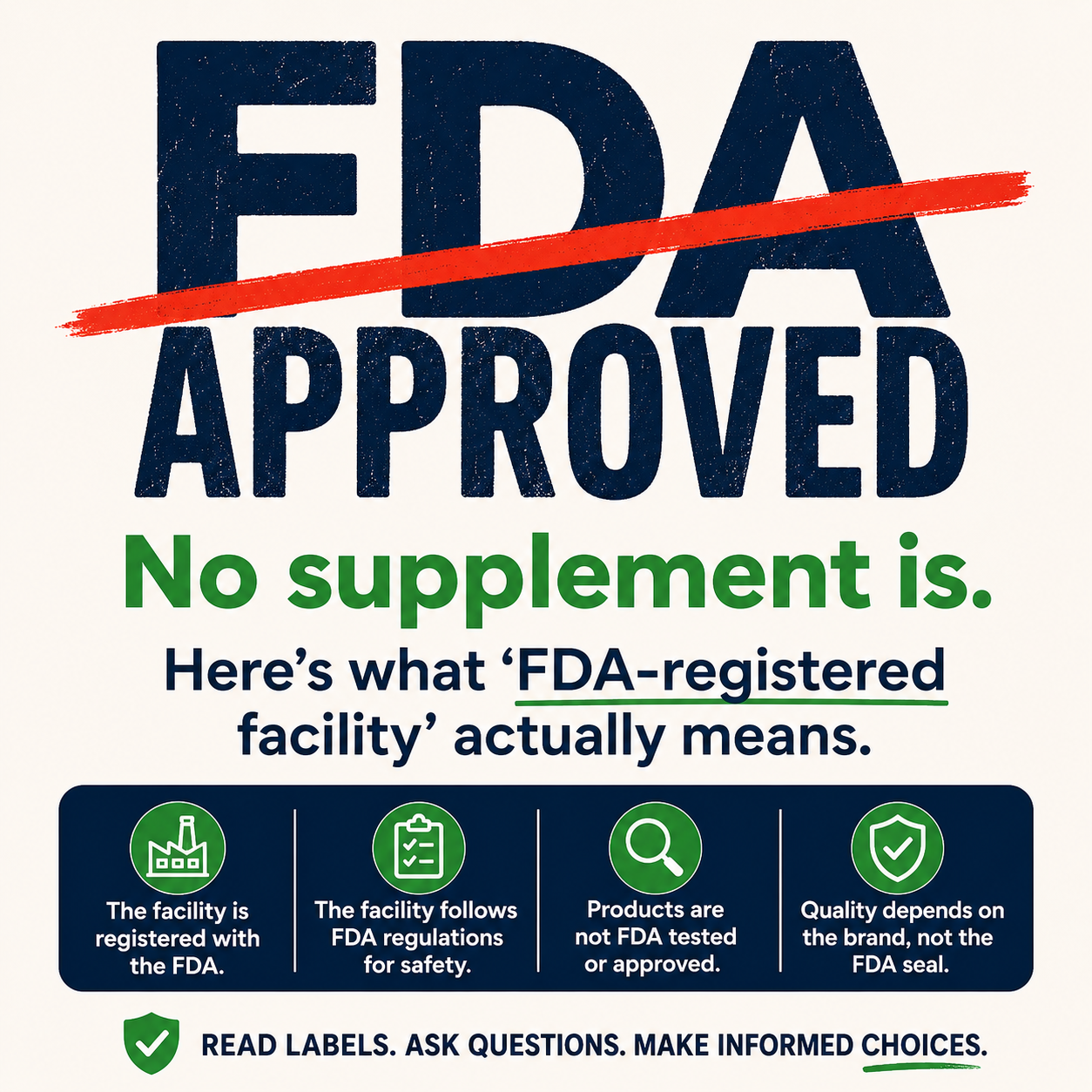
The FDA is explicit about this: it does not approve dietary supplements or their labelling. Under the Dietary Supplement Health and Education Act (DSHEA), the agency’s role is largely post-market — it can act against a product for being unsafe or mislabelled after it’s already on shelves, but there’s no pre-market approval step the way there is for prescription drugs. The FDA itself warns consumers that “FDA-approved” dietary supplements don’t exist and that some sellers misuse the phrase.
So what does the FDA do? It sets and enforces current Good Manufacturing Practices (cGMP) under 21 CFR Part 111, which govern how products are made, packaged and labelled; it can inspect facilities; it reviews notifications for genuinely new ingredients; and it monitors safety reports. That’s meaningful, but it’s about manufacturing quality and accurate labelling — not a stamp that the product is safe, effective, or “approved.”
The accurate thing a brand can say is that a product is “manufactured in an FDA-registered facility that follows cGMP.” That describes the manufacturing system — not approval of the product, and not proof that it works. Anytime you see “FDA approved” on a supplement, read it as a marketing red flag, not a credential. (It’s why you’ll never see that phrase anywhere on SourceLean.)
The Supplement Facts panel, line by line
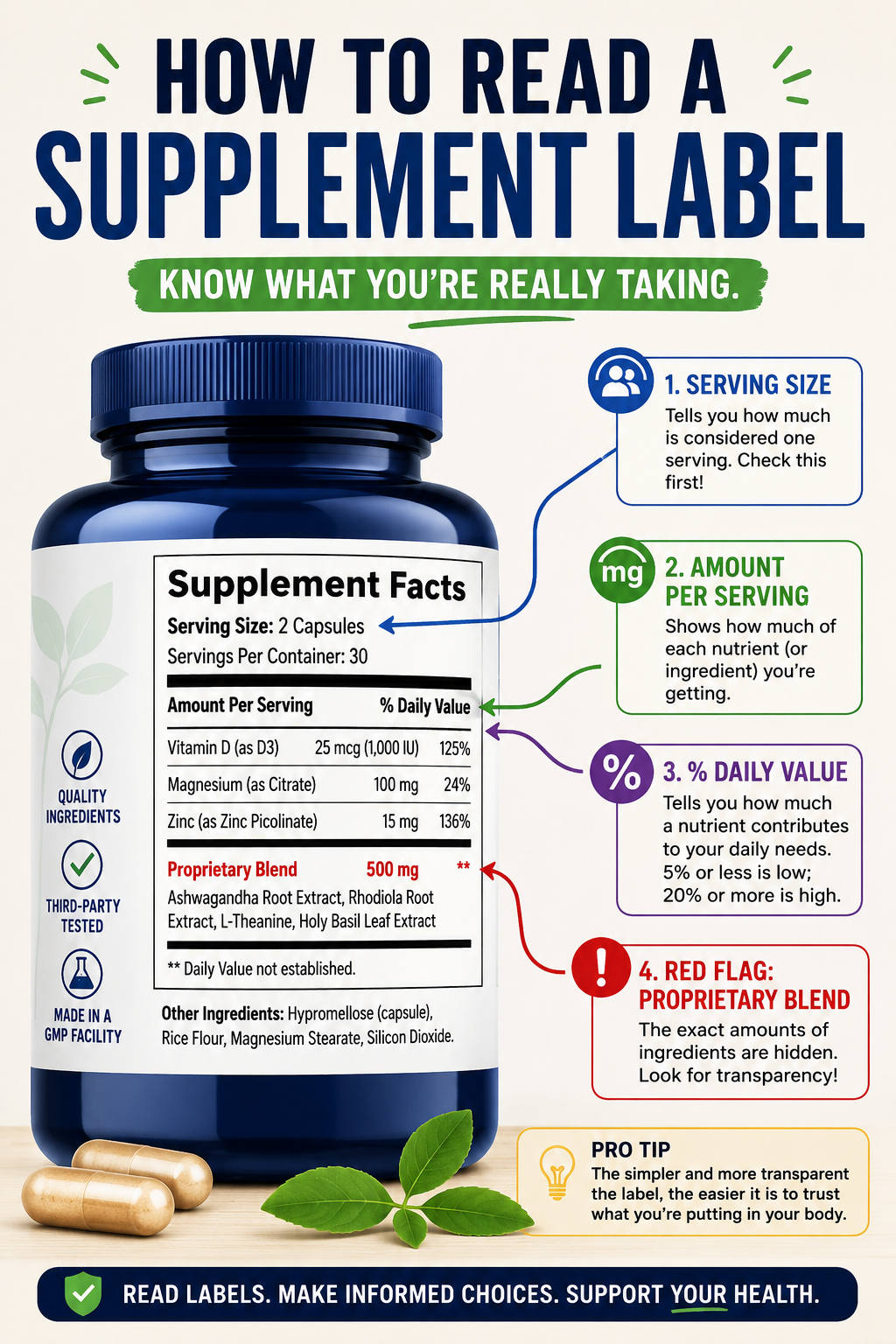
Supplements carry a “Supplement Facts” panel — not the “Nutrition Facts” panel you see on food. It’s governed by 21 CFR 101.36, and each line tells you something specific.
Read the panel top to bottom and you’ll find the same elements every time:
| Line | What it tells you | What to watch for |
|---|---|---|
| Serving size | How much counts as one dose (e.g. “2 capsules”) — set by the manufacturer | Doses split across many capsules can make a serving feel bigger than it is |
| Servings per container | How many doses are in the bottle — i.e. how long it lasts | A cheap bottle with few servings can cost more per dose |
| Amount per serving | The weight of each ingredient in one dose — the number that matters most | Missing amounts, or amounts shown only as a blend total |
| % Daily Value | How a nutrient compares to recommended daily intake (for nutrients that have one) | Botanicals and many actives show “Daily Value not established” — normal, not a flaw |
| Other ingredients | Fillers, binders, capsule material, flavours and colours, listed below the panel | A long list of fillers relative to actives |
The line that earns your attention is amount per serving. For an ingredient to do anything, it has to be present in a real, disclosed quantity — and ideally one that matches what was used in human research. Which brings us to the loophole that exists precisely to keep that number from you.
Proprietary blends: the big loophole
This is the single most important thing in this guide. A proprietary blend is how a label can look fully detailed while hiding the only numbers that matter.
A proprietary blend groups several ingredients together under one name — “blend,” “complex,” “matrix,” “formula,” or some invented brand term — and, under FDA rules (21 CFR 101.36), the manufacturer has to disclose only the total weight of the whole blend, plus the ingredients listed in descending order by weight. The amount of each individual ingredient inside the blend does not have to be revealed.
Read that again, because it’s the whole game. Descending order tells you which ingredient there’s most of — but not by how much. A “500 mg Proprietary Fat-Burn Matrix” listing ten ingredients could be 450 mg of a cheap filler and a trace of everything you actually bought the product for, and the label would be entirely legal and “complete.”
If an active ingredient is inside a proprietary blend, you cannot verify its dose — full stop. You can’t tell whether you’re getting the amount studied in research or a marketing-only sprinkle. That uncertainty is the point of the blend, and it’s why we treat any dose hidden inside one as unverifiable, no matter what the marketing says.
There’s even a name for the trick the blend enables: “fairy dusting.” A brand lists an impressive, research-backed “hero” ingredient on the label — but at a token amount far below what studies used — so it can name-drop the ingredient without paying to include an effective dose. Inside a blend, fairy dusting is invisible. On a fully disclosed label, it’s obvious. That’s the entire case for transparency in one comparison.
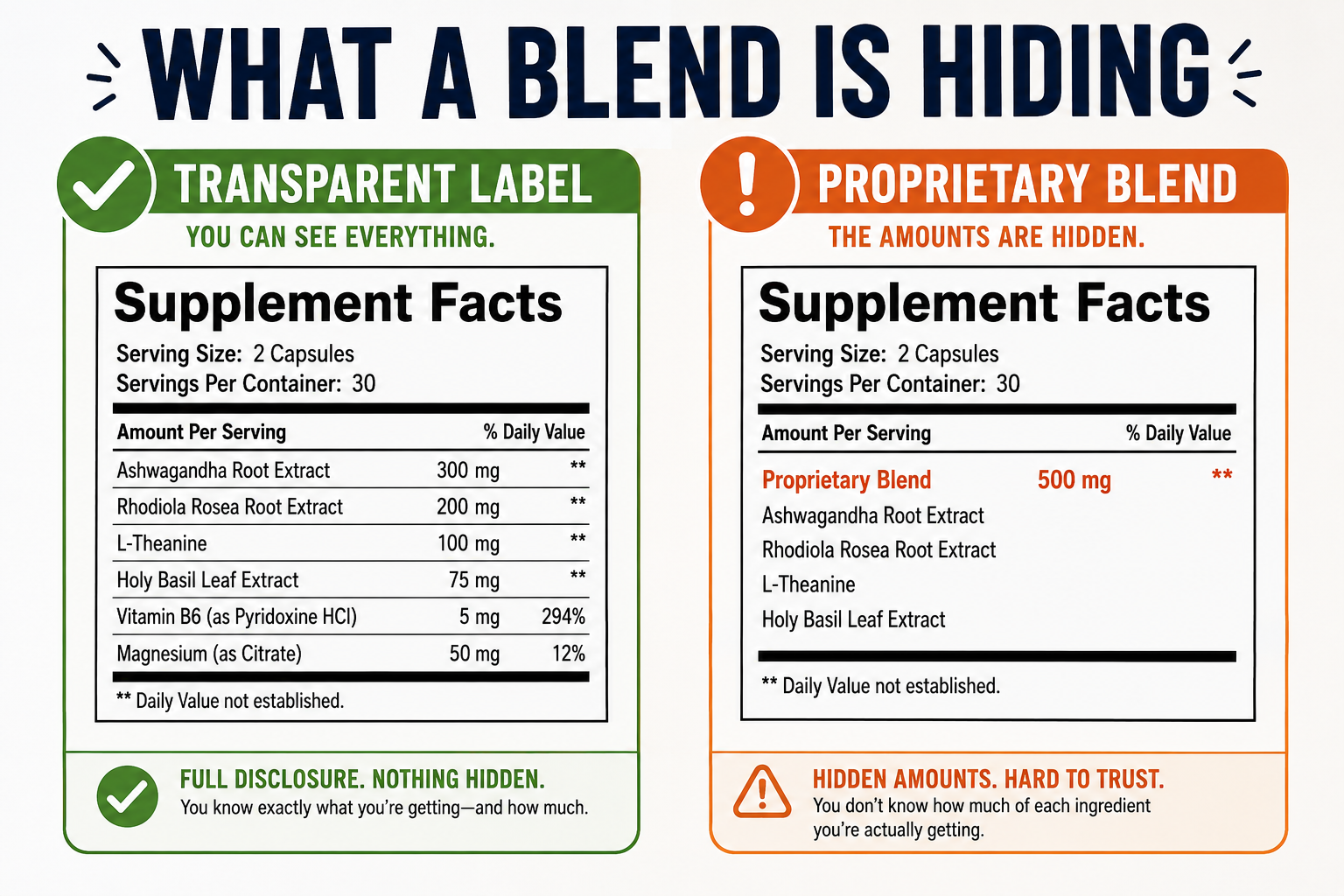
A transparent label
- Every active ingredient listed with its own amount
- Doses you can look up and check against research
- Ingredient forms named (e.g. the specific extract)
- Nothing important hidden in a “blend total”
A proprietary-blend label
- One total weight for a group of ingredients
- Individual doses hidden — impossible to verify
- Hero ingredient may be present in trace amounts
- Descending order only hints at proportions
Not every blend is sinister — flavour systems and some genuinely proprietary formulations exist for real reasons. But when a blend hides the dose of an active ingredient that the product is sold on, treat it as a strike against the product, not a neutral choice.
Checking for a clinically studied dose
A good ingredient at the wrong dose does nothing. Here’s the three-step check that separates a real formula from a hopeful one.
- Find the studied dose. Look up the amount used in human trials for the ingredient. For example, green-tea catechin research often used several hundred milligrams of EGCG per day; the fibre glucomannan was studied around a gram before meals. Our ingredient database lists these dose-by-dose.
- Compare it to the label. Check the per-serving amount against that studied dose. If the label amount is a fraction of it, the ingredient is likely underdosed.
- Check the form. The specific form and any standardisation percentage matter — a standardised extract is not the same as raw powder, and forms of the same mineral absorb differently.
Here’s the catch that ties the whole guide together: if the ingredient is inside a proprietary blend, you can’t do step two at all. Only the blend total is shown, so the dose is unknowable. A short, fully disclosed label almost always beats a long blend with hidden amounts — fewer ingredients you can actually verify is worth more than a dozen you can’t.
The rest of the label
Beyond the panel, a few required elements tell you whether a real, accountable company stands behind the product.
- Statement of identity — the product name and the words “dietary supplement” (or “herbal supplement,” etc.).
- Net quantity — the count or weight of what’s in the container.
- Other ingredients — everything not in the panel: fillers, binders, capsule shell, flavours, colours.
- Manufacturer or distributor name and address — a real, named company you could contact, plus a US address or phone number for reporting serious problems. Its absence is a meaningful red flag.
- Allergen disclosure — the major allergens (milk, eggs, fish, shellfish, tree nuts, peanuts, wheat, soy, and now sesame) must be declared if present.
Claims, and the FDA disclaimer
What a label is allowed to claim — and the fine print it must carry — tells you a lot about whether a brand is playing by the rules.
Supplements can make structure/function claims: statements about supporting a normal body function, like “supports healthy metabolism” or “helps maintain normal energy levels.” They cannot make disease claims — saying a product treats, cures, or prevents a disease (for example “treats diabetes”) turns it into an unapproved drug in the eyes of the law. A brand that leans on disease claims is either careless or willing to break the rules; neither is reassuring.
Any structure/function claim must be accompanied by a specific disclaimer, required word-for-word by the FDA. It reads, verbatim:
“This statement has not been evaluated by the Food and Drug Administration. This product is not intended to diagnose, treat, cure, or prevent any disease.”
Seeing this disclaimer is normal and correct — it’s not a warning sign, it’s the law working as intended. What should concern you is its absence alongside bold health claims, or claims that quietly cross into disease territory without it.
Third-party seals worth trusting
Because the FDA doesn’t pre-approve products, independent testing is one of the few real quality signals — but only some marks mean much, and you should verify each one.
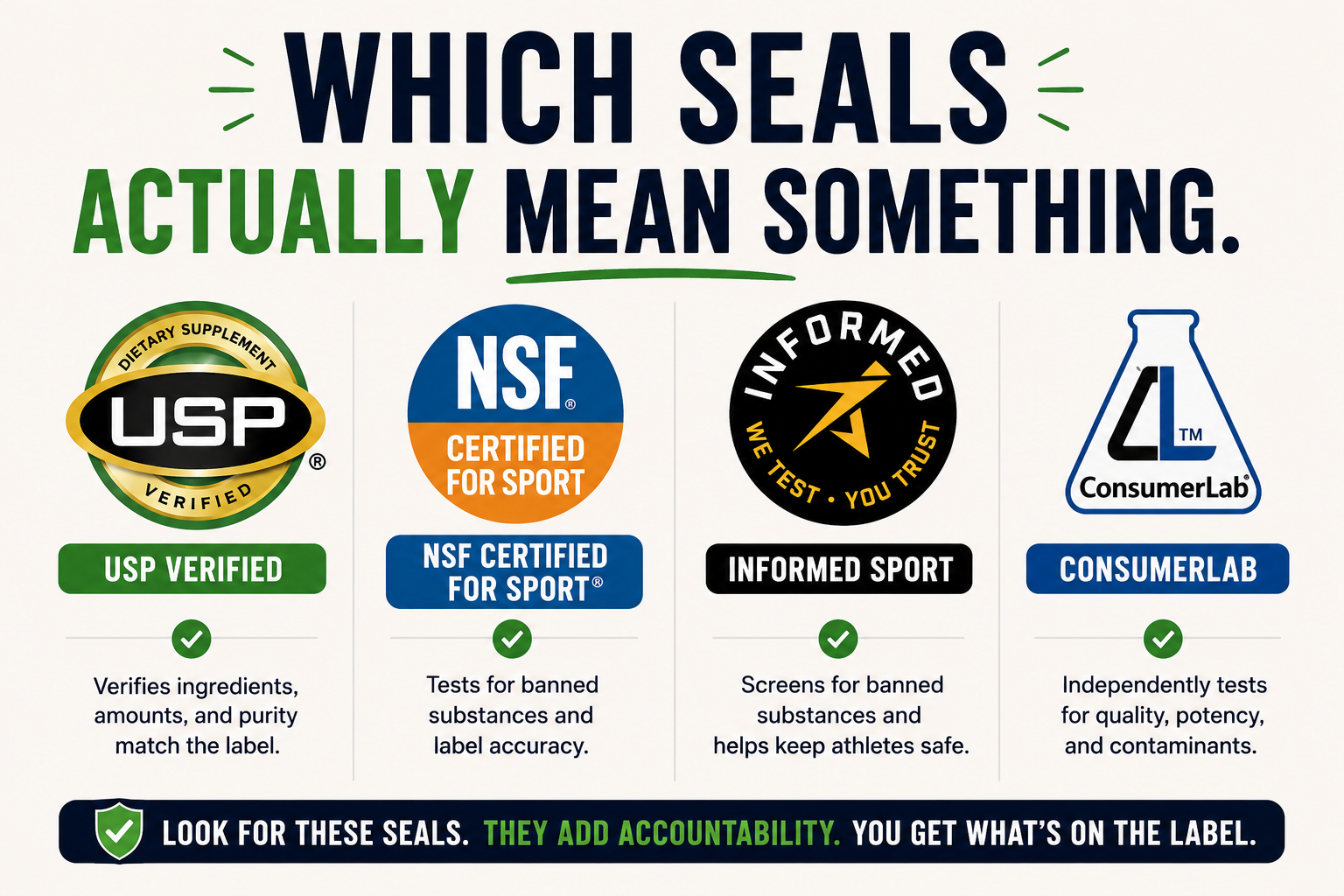
| Seal | What it verifies | Best for |
|---|---|---|
| USP Verified | Contains the listed ingredients at stated potency, free of specified contaminants, and dissolves properly | General quality assurance |
| NSF Certified for Sport | Label accuracy and contaminant testing, plus screening for banned substances, lot by lot | Athletes & the drug-tested |
| Informed Sport | Banned-substance screening on every manufactured batch before release | Competitive athletes |
| ConsumerLab | Independent off-the-shelf testing for identity, potency and purity | General consumers |
Three caveats keep these honest. First, “GMP certified” by itself is a manufacturing baseline, not a product certification. Second, “third-party tested” with no named lab or certifier is a weak claim — verify the mark in the certifier’s own online database, since a logo on a bottle is only a claim until you do. Third, and most important: certification confirms what’s in the bottle, not that the product works or is dosed effectively. A verified seal is a genuine plus; it is not proof of results.
Red flags at a glance
Once you’ve read a few labels, the warning signs jump out. Here’s the shortlist.
- Proprietary blends that hide the dose of active ingredients — the headline red flag.
- Fairy dusting — a hero ingredient present in a token, sub-effective amount.
- “FDA approved” language, which is never accurate for a supplement.
- No third-party testing, or vague “lab tested” claims with no named certifier.
- Disease claims, or “miracle,” “guaranteed,” and “breakthrough” language.
- No manufacturer information or no US contact for adverse events.
- Unstandardised botanicals with no plant part, form or dose given.
- Effortless, dramatic weight-loss promises — a flag for both deception and, in the worst cases, hidden pharmaceutical adulterants.
Weight-loss labels and FTC rules
Weight-loss products attract the boldest claims and the most enforcement. The FTC — which polices advertising, separate from the FDA — has drawn some bright lines.
The FTC’s guidance for spotting false weight-loss claims lists several that, experts agree, simply cannot be true. Treat any of them as proof an ad is deceptive. A product cannot honestly claim it:
- causes substantial weight loss without diet or exercise;
- causes weight loss no matter what or how much you eat;
- causes permanent loss even after you stop using it;
- works by blocking the absorption of fat or calories;
- safely produces more than about three pounds a week for over a month;
- causes substantial weight loss for everyone; or
- works just by being worn on the body or rubbed on the skin.
There’s a sober reason to be this careful. Independent analyses have repeatedly found weight-loss supplements tainted with undeclared pharmaceutical drugs — most commonly sibutramine, a withdrawn weight-loss medication, and phenolphthalein, a suspected carcinogen. The bolder and more “effortless” the promise, the higher the risk. The honest evidence picture, from the NIH Office of Dietary Supplements and others, is that weight-loss supplements produce modest effects at best and are no substitute for diet and activity — which is exactly how we frame every product we cover.
If you want to put this label-reading skill to use on specific products, we’ve applied it to the ones people search for most. You can compare formulas side by side in our comparisons, read the dose-by-dose breakdown of individual ingredients in the ingredient database, or see it applied in full reviews of Java Burn, Ikaria Lean Belly Juice, Liv Pure, Mitolyn and Nagano Tonic — where the first thing we check is whether the dose is disclosed at all.
The 60-second checklist
Put it all together and you can vet a label faster than you can read the marketing copy. Run these five checks in order.
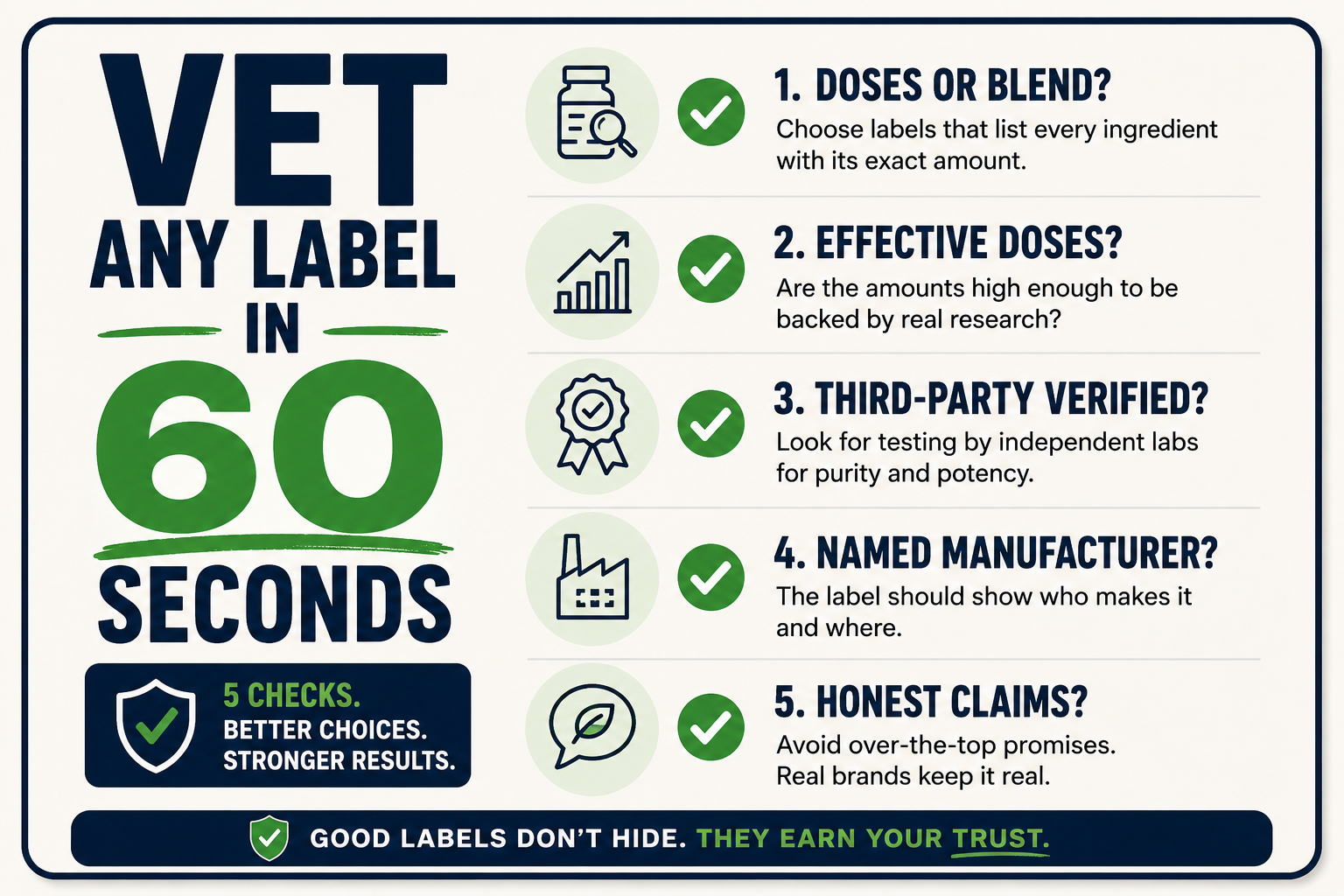
Run these five checks
- 1. Doses or blend? Is every active ingredient’s amount disclosed, or is it hidden in a blend?
- 2. Effective doses? Do the key ingredients hit the amounts used in research, in good forms?
- 3. Verified? Is there a third-party mark you can confirm in the certifier’s database?
…and finish with
- 4. Accountable? Is there a named manufacturer and a US contact for problems?
- 5. Honest claims? Do the claims avoid disease and FTC red flags, and carry the required disclaimer?
- Bottom line: a fully disclosed label beats a long, blended one every time.
If you remember nothing else: a label that hides its doses inside a proprietary blend has already told you the most important thing about it.
We’ve applied exactly the checks above to the formulas people search for most. Each link goes to the official product site, where checkout is handled. As always, these are adjuncts to diet and activity, not a substitute.
Java Burn
A coffee-mixed metabolism and energy formula — we check whether its actives are disclosed and dosed.
Ikaria Lean Belly Juice
A fibre-and-botanical tonic aimed at appetite and fullness — judged on label transparency.
Liv Pure
Built around liver and metabolic support — we look at whether doses match the research.
Mitolyn
Focused on cellular energy and metabolism — checked for disclosed amounts, not blends.
Nagano Tonic
A powdered metabolism-support tonic — assessed on transparency and ingredient forms.
Side-by-side comparisons
Not sure which fits? Compare formulas on transparency and ingredients before choosing.
Frequently asked questions
Are supplements FDA approved?
No. The FDA does not approve dietary supplements or their labels before sale. Under DSHEA, oversight is post-market — the agency can act against unsafe or mislabelled products only after they reach shelves.
The accurate phrase is that a product is made in an FDA-registered facility following cGMP — that describes manufacturing quality, not approval, and not whether the product works.
What is a proprietary blend on a supplement label?
It groups several ingredients under one name and discloses only the blend’s total weight, not the amount of each ingredient inside. Rules require only the total and a descending-order list.
That means you can’t tell whether the active ingredient is at an effective dose or a token sprinkle — which is why we treat any dose hidden in a blend as unverifiable.
How do I know if a supplement has a clinically studied dose?
Look up the dose used in human studies for the ingredient, then compare it to the per-serving amount on the label, and check the form.
If the ingredient is hidden inside a proprietary blend, only the blend total is shown — so the dose is impossible to confirm. A fully disclosed label is the only way to check.
What does “FDA-registered facility” mean?
It means the manufacturing facility is registered with the FDA and is expected to follow current Good Manufacturing Practices (21 CFR Part 111).
It refers to manufacturing quality and accurate labelling — not to FDA approval of the product, and not to whether the supplement actually works.
What third-party certifications should I look for?
USP Verified, NSF Certified for Sport, and Informed Sport are meaningful marks that confirm a product contains what the label says and is screened for contaminants (and, for the sport marks, banned substances). ConsumerLab independently tests off-the-shelf products.
Always verify the mark in the certifier’s online database, and remember certification confirms quality, not effectiveness.
What weight-loss claims are always false?
The FTC says some claims simply cannot be true — for example that a product causes substantial weight loss without diet or exercise, no matter what you eat, permanently after you stop, by blocking fat or calories, for everyone, or just by wearing or rubbing it on the skin.
Any of these is a red flag for a deceptive product, and sometimes for one hiding undeclared pharmaceutical ingredients.
Do weight-loss supplements actually work?
The ingredient database
Side-by-side comparisons
8 foods for stubborn belly fat
We research weight-loss supplements and the ingredients inside them, scoring products on label transparency rather than hype. No star spam, no fabricated reviews — just the evidence, stated plainly. Our editorial standards →
- U.S. FDA — Supplement Facts panel and proprietary blend rules, 21 CFR 101.36 (eCFR). ecfr.gov
- U.S. FDA — Questions and Answers on Dietary Supplements (supplements are not FDA approved; post-market oversight). fda.gov
- U.S. FDA — Current Good Manufacturing Practices for dietary supplements, 21 CFR Part 111. ecfr.gov
- U.S. FDA — Structure/function claims and the DSHEA disclaimer, 21 CFR 101.93. ecfr.gov
- U.S. FTC — “Gut Check”: red-flag weight-loss claims; Health Products Compliance Guidance (2022). ftc.gov
- NIH Office of Dietary Supplements — Dietary Supplements for Weight Loss (Health Professional Fact Sheet). ods.od.nih.gov
- U.S. DoD Operation Supplement Safety — “Proprietary blends: what does this mean?” opss.org
- Tucker J, et al. Unapproved pharmaceutical ingredients in dietary supplements. JAMA Network Open, 2018. jamanetwork.com
- Jun 9, 2026 — Article published, sourced from current FDA, FTC and NIH guidance.
Affiliate disclosure: SourceLean is reader-supported. When you buy through links on this site, we may earn a commission at no extra cost to you. Checkout is always handled on the official product website.